The Subway Stranger Whose Snap Changed Our Lives Forever
The rhythm of my life was once dictated entirely by the relentless, metallic screech of the subway and the heavy scent of industrial cleaning supplies. Being a single father wasn’t a role I had auditioned for, but it was the one I embraced with every ounce of my being after my marriage fractured into irreparable pieces. My days were a blur of orange vests and sanitation trucks, hauling the city’s refuse under a sun that always felt too hot or a wind that felt too sharp. When the city went home, my second shift began. I spent my nights buffing floors in silent office buildings, the hum of the machinery the only soundtrack to my thoughts. I did it all for two people: my aging mother, whose bones ached with every change in the weather, and my seven-year-old daughter, Lily, who was the only light in our cramped, fifth-floor walk-up.
Lily was a child of grace in a world of concrete. She didn’t want dolls or gadgets; she wanted to fly. It started with a crumpled flyer she found on a telephone pole—a local community center offering beginner ballet classes. When she showed it to me, her small fingers tracing the silhouette of a dancer in mid-leap, her eyes held a spark I hadn’t seen since her mother left. In that moment, I knew I would do anything to keep that spark alive. I told her we would make it happen, even as I mentally calculated the impossible gap between my paycheck and our mounting bills.
I started an envelope. It was a plain, white legal envelope tucked behind a photo of my parents on the mantle, labeled Lily’s Dream in my shaky handwriting. Every extra cent went inside. I skipped meals, claiming I’d eaten a heavy lunch at the depot. I walked thirty blocks to save the fare. I took on weekend shifts that left my back feeling like it was made of broken glass. At home, our small living room became a makeshift studio. My mother would sit on the edge of the worn sofa, clapping her rhythmic, papery hands while Lily practiced her positions. She didn’t have real slippers yet, just a pair of thick white socks that slid across the linoleum, but she practiced with a fierce, quiet determination that broke my heart and healed it all at once. She would look at me after every clumsy pirouette, seeking my approval. No matter how much my eyes burned from exhaustion, I never looked away. I stayed present. I became her audience of one.
The weeks bled into months until the day of her first real recital arrived. It was the culmination of all those skipped meals and double shifts. I had managed to pay for the classes and a modest pink tutu that she insisted on wearing even to breakfast. That morning, she clutched my hand, her voice a tiny whisper of nerves and excitement. She made me promise, over and over, that I would be there to see her dance. I promised her with the solemnity of a blood oath.
But the city is a fickle mistress. An afternoon emergency at the sanitation department—a burst main near our route—turned into a mandatory overtime situation. My heart sank as the clock ticked past four, then five. I worked like a man possessed, my hands shaking with a mix of adrenaline and fear. The moment I was cleared, I bolted. I didn’t have time to change. I was soaked in sweat and rain, my work boots heavy on the pavement as I sprinted toward the theater. I reached the auditorium breathless, my chest heaving, slipping through the heavy oak doors just as the lights dimmed.
I stood at the very back, a man in a grimy uniform among a sea of parents in their Sunday best. Then, Lily stepped onto the stage. She looked so small under the blinding white spotlight. I saw her head turn, her eyes scanning the dark crowd with a growing sense of panic. She was looking for me. The music started—a soft, tinkling piano melody—but she remained frozen. Then, our eyes met. I raised my hand just slightly, a small wave to let her know I had made it. The transformation was instantaneous. Her shoulders dropped, a radiant smile broke across her face, and she began to move.
She wasn’t the most technical dancer on that stage, but she was the most vibrant. She danced with her whole soul, her tutu fluttering like the wings of a bird finally tasting the sky. In that moment, the debt, the grime, and the exhaustion didn’t exist. There was only my daughter and the magic she was creating. When she finished, she didn’t wait for the formal curtain call. She scanned the back of the room again, and when she saw me still standing there, she ran off the stage and directly into my arms. You came, she sobbed into my shoulder, her tears wetting my work vest. You really came.
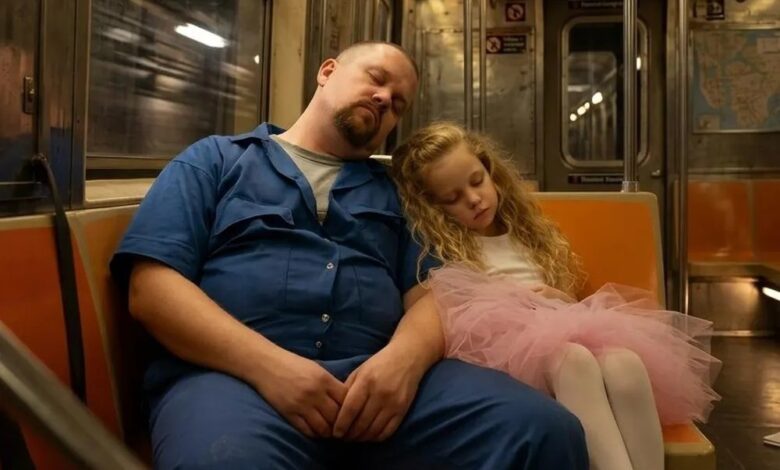
The journey home was quiet. We boarded the late-night subway, the car nearly empty except for a few weary commuters. Lily was draped across me, her head lolling against my chest, still clutching her bouquet of grocery-store carnations. She had fallen asleep the moment we sat down, her tutu a cloud of pink against my dark, stained trousers. I held her close, feeling the steady beat of her heart, overwhelmed by a protective love that felt heavy enough to sink through the floor.
Across from us sat a man with a camera. He was older, with a kind, weathered face and silver hair tucked under a beanie. He didn’t ask; he just lifted his lens and captured the moment—the sleeping ballerina and her tired, blue-collar father. I was too drained to protest, and something about his peaceful expression made me feel safe. He nodded to me, a silent acknowledgment between strangers, and got off at the next stop.
The following morning, there was a knock on my door. I was confused; nobody visited us. When I opened it, the man from the subway was standing there. He held a high-quality print of the photo he had taken. Seeing ourselves through his lens was a revelation. I didn’t see a poor laborer and a girl in a cheap costume; I saw a portrait of absolute devotion.
The man introduced himself as Elias. He told me he was a retired photojournalist who had spent his career documenting war and strife, but that our image on the train had reminded him of why he picked up a camera in the first place—to find beauty in the struggle. He wasn’t there to offer charity. He was there with a proposition. He had a close friend who ran one of the city’s most prestigious dance academies, and he wanted to sponsor Lily’s formal training. Furthermore, his son owned a logistics company and was looking for a reliable supervisor—someone who knew the city’s streets and understood the value of showing up.
It wasn’t a handout; it was a bridge. He saw the work I was already putting in and decided to help me build something permanent. A year has passed since that night on the subway. Our lives are different now. We live in a place where the heat always works, and Lily’s “stage” is no longer the kitchen linoleum but a professional studio with mirrors and barre rails. I still work hard, perhaps harder than ever, but the weight on my shoulders has shifted from desperation to responsibility. I haven’t missed a single performance. Every time Lily takes her place under the lights, I remember that tired night on the train. I realized then that while money can buy the lessons, only love can give a child the courage to dance. Showing up didn’t just change her life; it saved mine.