The story of a father digging a grave for his 2yearold daughter
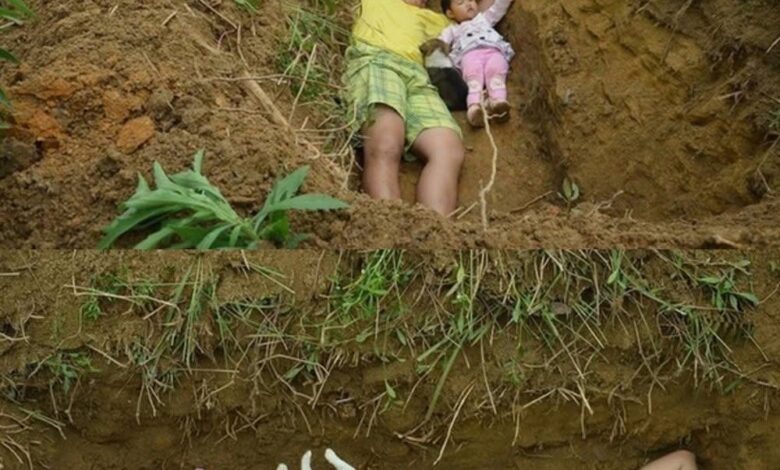
A photograph of a father lying beside his two-year-old daughter in a grave he dug himself spread across Chinese social media and moved people around the world. The father, Zhang Liyong, was not preparing an ordinary burial. He said he wanted his critically ill daughter, Zhang Lei, to become familiar with the place he feared she would soon have to rest. The image captured a family’s exhaustion, love, and desperation in a way words struggled to express.
Zhang Liyong was 24 and lived with his family in Jiuzu Yan village near Neijiang in China’s Sichuan province. His daughter had been diagnosed with congenital anemia when she was only two months old. From that point forward, the family organized life around keeping her alive. She required regular hospital visits and monthly blood transfusions, while her parents searched for a treatment that might offer more than temporary relief.
The medical bills overwhelmed their limited income. The source reported that the family had spent more than 140,000 yuan on care, while Liyong earned about 2,500 yuan a month as a worker. Every transfusion bought time, but it also brought another cost the family could barely meet. Their savings and other resources gradually disappeared as Lei’s condition continued to decline.
Her weakened immune system created additional difficulties. She frequently became ill and could not live like other children in the village. While other children played together, Lei often spent time with the family’s puppy, watched the ducks, or entertained herself in the yard. When he was free, her father tried to give her ordinary childhood moments by taking her outside, playing with her, or bringing her fishing.
Doctors had not said there was absolutely no hope. According to Lei’s mother, Deng Min, a stem-cell transplant could potentially save her. The problem was finding a compatible donor. Neither parent was a match. The couple decided to have another child in the hope that the new baby’s stem cells might be compatible with Lei. Deng Min was expecting the baby in early July.
Even that possibility came with another financial barrier. Collecting, preserving, and transplanting compatible stem cells would cost money the family no longer had. Hope existed, but it seemed to remain just beyond reach. The parents faced an unbearable contradiction: a possible path to treatment was visible while the price of reaching it kept the path closed.
Overcome by grief, Liyong dug the grave. He brought Lei there and lay beside her. To an outsider the action can seem shocking, but he described it as an attempt to make the cold ground less frightening if the worst happened. It was the gesture of a father who could not accept abandoning his child, even while believing he might be unable to save her.
The photographs traveled widely online. Viewers saw the small girl resting beside her father and responded with sorrow, disbelief, and calls to help the family. Many people said the scene made them think about their own parents and children. Others urged donations so that treatment could continue and the family would not have to face the future alone.
The story also exposed the crushing choices severe illness can impose on families with limited money. Medical decisions are difficult enough without calculating whether a month’s wages can cover a procedure, a hospital trip, or the next transfusion. Liyong and Deng Min had already spent everything they could find. Their daughter’s survival appeared to depend not only on medicine and donor compatibility, but on access to resources.
At the center of the story is not the grave but the bond between a father and his daughter. Liyong’s decision came from despair, yet the same photographs that documented that despair also brought public attention to Lei’s condition. The image became a plea even when the family had no more words. It reminded viewers that behind every medical bill is a child who wants to play and parents who will sacrifice nearly anything for one more chance.