The New Student Under My Right Eye Had My Dead Sons Birthmark
The weight of a child’s absence never truly leaves a room. For five years, I lived in the quiet, drafty corners of a home that used to echo with laughter. I was Ms. Rose, the kindergarten teacher whose days were measured in glue sticks, spilled apple juice, and the soft, repetitive rhythm of children’s songs. It was a life built entirely on distraction.
My world had shattered on a rainy Tuesday night when my nineteen-year-old son, Owen, was killed by a drunk driver. I still remember the warm mug of cocoa he’d left on the counter, the steam rising as the telephone rang. In the years that followed, I poured myself into my classroom, using the vibrant, chaotic energy of five-year-olds to drown out the silence waiting for me at home. I convinced myself that survival was enough.
Then came a chilly Monday morning. The principal, Ms. Moreno, knocked on my classroom door, guiding a little boy wearing a oversized green raincoat and clutching a dinosaur backpack.
Ms. Moreno introduced him as Theo, a mid-semester transfer due to school rezoning. He stood quietly, shifting his weight from one sneaker to the other. Then, he tilted his head to the side and offered a shy, lopsided smile.
My breath caught in my throat. My hands trembled, sending a container of glue sticks scattering across the floor.
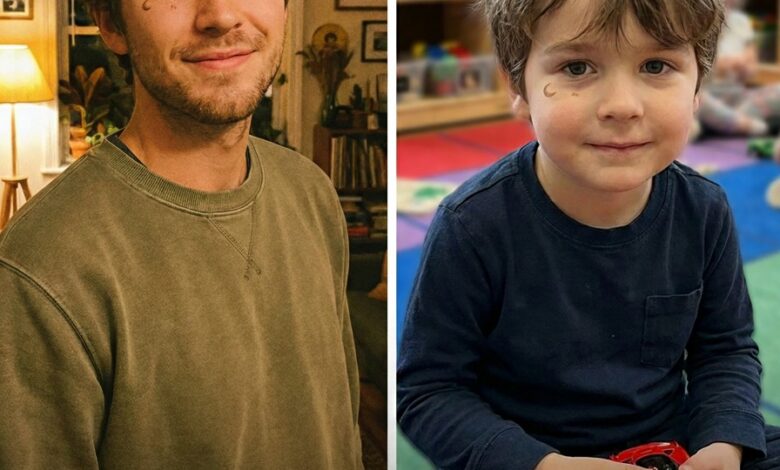
Beneath Theo’s right eye was a distinct, crescent-shaped birthmark. It was the exact shape, in the exact same placement, as the one my son Owen had carried. It was a physical detail I had kissed a thousand times. Looking at Theo was like looking through a tear in the fabric of time. When he spoke, answering my greeting with a quiet “Yes, ma’am,” the pitch of his voice vibrated in my chest, sounding exactly like Owen did at that age.
I spent the rest of the day in a trance. I read the scheduled stories and hummed the clean-up songs, but my eyes kept tracking Theo’s movements. I watched how he squinted at the goldfish tank, and how he offered his last apple slice to a classmate. The familiar gestures were too precise to be mere coincidence. During recess, I knelt beside him and gently asked who would be picking him up. With a bright grin, he told me both his mom and dad were coming.
When the final bell rang, I lingered under the pretense of organizing art supplies, my heart hammering against my ribs. The classroom emptied until only Theo remained, humming to himself as he turned the pages of a picture book.
The door swung open, and a woman stepped inside. When she called Theo’s name, my heart stopped. It was Ivy.
She was older now, her hair pulled back and her expression guarded, but I recognized her instantly. She had been Owen’s girlfriend. Five years ago, after the funeral, she had quietly drifted out of my life, consumed by her own grief.
Our eyes locked. The air in the room grew heavy as the truth settled between us.
“I know who you are, Rose,” Ivy whispered, her voice barely audible.
Before we could speak further, another parent entered, recognizing Ivy from a neighboring town, and began asking questions. Sensing the rising tension and the curiosity of onlookers, Ms. Moreno intervened and ushered us into the privacy of her office.
Inside, the silence was deafening. I looked at Ivy, my hands shaking. I needed to hear the words. I asked her directly if Theo was my grandson.
Ivy looked down, tears spilling over her lashes, and nodded. She confessed that she had been twenty, terrified, and utterly overwhelmed by the sudden loss of Owen. She had discovered she was pregnant after his death and feared that bringing a baby into my profound grief would only cause more pain, or that I might try to take him away.
The revelation sent a wave of warmth and ache through me. This beautiful boy was a living piece of my son. In my eagerness, I immediately offered to take Theo for the weekend, to buy him pancakes, to be a part of his life.
But Ivy’s defense mechanisms flared. “He’s my child, Rose,” she said defensively. “I raised him. I’m not just going to hand him over.”
Before the tension could escalate, the office door opened, and a tall, structured man walked in. It was Mark, Theo’s father.
Ivy introduced us, her voice trembling as she confessed the truth to him. Mark looked at me, then at Ivy, processing the timeline. He was stunned, but his composure remained intact. He looked me in the eye and asserted his position. He was Theo’s father in every way that mattered, and he would not tolerate a tug-of-war over the boy’s loyalty or affection.
I took a deep breath, recognizing his protective instinct. I assured him that I had no desire to disrupt their family. I only wanted to be an extra person who loved Theo, to offer support, and to know my grandson.
Mark looked at me for a long moment, assessing my sincerity. He agreed, under the condition that we move slowly, establish clear boundaries, and put Theo’s emotional well-being above everything else.
The following Saturday, I walked into the local diner. The three of them were sitting in a booth near the window. When Theo saw me, his face lit up. He waved his fork and slid over, patting the vinyl seat next to him.
Ivy offered a small, tentative smile and invited me to join them. I slid into the booth, the familiar warmth of a family dynamic enveloping me for the first time in five years. Mark passed me a menu, his demeanor polite and welcoming.
Theo leaned close, whispering a secret about how they put chocolate chips in the pancakes if you ask nicely. As we sat together, coloring on paper placemats and sharing stories, I watched the way he laughed. The ache of losing Owen didn’t disappear, but the empty space it left behind began to fill with something new.
Looking at my grandson, I realized that grief didn’t have to be the end of the story. Sometimes, life finds a way to circle back, offering second chances in the shape of a familiar smile and chocolate chip pancakes on a Saturday morning.