THE INTERNET IS EXPLODING OVER TRUMP REVEALING A SHOCKING SACRED IMAGE JUST MOMENTS AFTER ATTACKING THE POPE
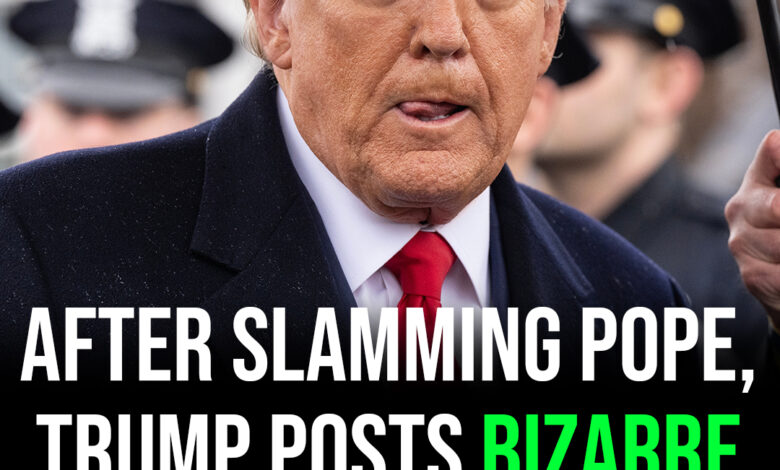
The intersection of politics, technology, and faith reached a fever pitch on April 13, 2026, as Donald Trump once again demonstrated his unique ability to dominate the global conversation through a single, highly provocative act. In a sequence of events that moved from scathing verbal rhetoric to startling visual symbolism, the former president and political powerhouse sent shockwaves through social media and religious communities alike. The controversy began not with an image, but with a direct and public confrontation with the papacy, specifically targeting Pope Leo XIV, the first American-born leader of the Catholic Church. Trump’s criticisms were sharp and characteristically blunt, labeling the Pontiff as weak on crime and terrible for foreign policy. These comments were largely sparked by the Pope’s recent moral stance against the escalating U.S.-Israeli conflict with Iran, during which the Holy Father condemned the absurd and inhuman violence taking place in the Middle East.
However, it was what happened immediately after these verbal broadsides that truly ignited a firestorm. On his platform, Truth Social, Trump shared an AI-generated illustration that bypassed words entirely to deliver a message steeped in messianic overtones. The image depicted Trump draped in flowing white and red robes, his hands glowing with a soft, ethereal light as they rested on the forehead of a man lying in a hospital bed. The composition was an unmistakable nod to classical Renaissance art and traditional religious iconography depicting Jesus performing miracles of healing. By choosing to share this specific visual without a caption, Trump allowed the ambiguity of the post to act as a megaphone, inviting both intense adoration and fierce condemnation from a public that remains deeply divided over his communication style.
The timing of the post served as a catalyst for the explosive reaction. Coming so close on the heels of his remarks about Pope Leo XIV, the imagery suggested a direct challenge to traditional spiritual authority. While the Pope had recently stated that he possessed no fear of the Trump administration and intended to speak loudly of the message of the Gospel regardless of political pressure, Trump’s post seemed to position him as a different kind of authority figure. The visual was layered with complex nationalistic cues that expanded the scope of the message beyond a simple religious metaphor. Surrounding the central figure of Trump were various witnesses: a doctor in professional attire, a woman caught in a moment of fervent prayer, and a soldier in full uniform. The background was a dense collage of American exceptionalism, featuring the Statue of Liberty, fighter jets streaking across the sky, fireworks, and the solemn architecture of the Lincoln Memorial. It was a fusion of the divine and the patriotic, suggesting a role for the former president that transcends traditional executive leadership.
Public response was instantaneous and predictably split into two warring camps. Critics were quick to label the post as a profound act of sacrilege, arguing that using imagery traditionally reserved for the Savior to boost a political brand crosses a line into the territory of idolatry. Many religious leaders expressed concern that such visuals degrade the sanctity of faith and turn sacred narratives into tools for digital engagement. For these detractors, the post was not just a provocative meme but a calculated attempt to blur the lines between secular power and spiritual devotion. They pointed to the potential consequences of such messaging, fearing it could further polarize a nation already struggling with the role of religion in the public square.
Conversely, his base of supporters saw the move through a completely different lens. For many of them, the image was interpreted as a bold piece of satire or a symbolic representation of his efforts to heal the country. They viewed the criticism from religious and political elites as proof of Trump’s willingness to break conventions and challenge the status quo. In their view, the AI-generated art was a creative way to express his commitment to American strength and his desire to rescue the nation from its current struggles. This divide underscores a broader pattern in modern political discourse where the exact same piece of content can be viewed as either a dangerous transgression or a heroic statement of truth, depending entirely on the political identity of the observer.
This incident is part of an increasingly frequent pattern of Trump utilizing cutting-edge AI technology to craft a larger-than-life digital persona. Over the last year, he has shared various portrayals of himself in roles ranging from a monarch in royal regalia to historical figures and cinematic icons. One particularly controversial moment occurred following the death of Pope Francis, when Trump shared an image of himself in papal vestments, a move that drew heavy fire from Catholic organizations at the time. These recurring visual experiments suggest a sophisticated understanding of the “meme economy,” where the goal is not necessarily to provide a factual policy update, but to create a viral moment that stays in the public consciousness long after the news cycle has moved on.
The broader question emerging from this latest Truth Social post concerns the future of political communication in an era where AI can generate any reality at the touch of a button. When a political figure adopts the visual language of the divine, it challenges the traditional boundaries of respect and tone that have historically governed public office. For some, this is merely the natural evolution of expression in a digital age where shock value is the primary currency. For others, it represents a breakdown in the quality of public discourse, where nuance and policy are sacrificed at the altar of provocation.
As the dust begins to settle on this specific controversy, the underlying tension between Trump and the Vatican remains a significant subplot in the 2026 political landscape. Pope Leo XIV’s firm stance on humanitarian issues and his willingness to directly counter the rhetoric of the Trump administration sets the stage for a prolonged ideological battle between the White House and the Holy See. While the Pope leans on the moral weight of the Gospel, Trump leans on the viral power of his digital platform, creating a conflict that is as much about the medium as it is about the message.
Regardless of one’s personal view on the appropriateness of the imagery, it is undeniable that Donald Trump remains a master of the attention economy. By blending humor, provocation, and deep-seated cultural symbols, he ensures that he remains at the center of the American story. The image of the “Healing Leader” will likely be debated for weeks, serving as yet another example of how modern leadership is being redefined through the lens of technology and the relentless pursuit of the spotlight. The search for a line that cannot be crossed continues, but as this latest post demonstrates, that line appears to be further away than many ever imagined. For now, the world is left to ponder the significance of a man who, after challenging the world’s highest religious authority, chose to present himself as the ultimate source of restoration and strength.