THE BLACK LEATHER REBELLION HOW ELVIS BORROWED BRANDOS EDGE TO SHATTER HIS HOLLYWOOD CAGE AND RECLAIM THE THRONE
History remembers Elvis Presley as a permanent fixture of American royalty, an immovable monument of charisma and talent. However, the reality of his mid-career existence was far more fragile and fraught with existential dread than the glittering jumpsuits of his later years might suggest. By the late 1960s, the man who had once terrified parents and electrified a generation with a single swivel of his hips had become a self-described laughingstock. Trapped in a grueling, soul-crushing cycle of formulaic Hollywood musicals, Elvis was a bird in a gilded cage, forced to sing lighthearted ditties to dogs and children while the cultural revolution of the sixties roared past him. He was a pioneer who had been sidelined by his own success, managed into a state of creative paralysis by a system that valued his bankability over his humanity. The story of his 1968 Comeback Special is not merely a tale of a successful television broadcast; it is a visceral narrative of a man fighting for his artistic life, channeling the raw rebellion of Marlon Brando to stage a coup against his own manufactured image.
To understand the magnitude of this moment, one must first look into the darkness that preceded the dawn. For seven long years, Elvis had not stood before a live audience. The stage, once his natural habitat, had become a source of profound terror. The new Netflix documentary, Return of the King: The Fall and Rise of Elvis Presley, paints a haunting portrait of a man who felt his dignity eroding with every frame of the thirty-one movies he had been pressured to film. He was painfully aware of the jokes being made at his expense. He saw the rise of The Beatles, The Rolling Stones, and the psychedelic movement, feeling like a relic of a bygone era. Priscilla Presley later remarked that watching him forced into those late-career film roles felt like witnessing a crime against his talent. Elvis had entered the industry with the burning ambition to be a serious dramatic actor, looking toward the brooding intensity of James Dean and the animalistic magnetism of Marlon Brando as his North Stars. Instead, Hollywood had groomed him into a safe, sterilized product.
By 1968, the tension had reached a breaking point. Elvis was not just dissatisfied; he was desperate. When the opportunity for a television special arose, the initial plan from his manager, Colonel Tom Parker, was a traditional, wholesome Christmas show. It was meant to be another layer of the “safe” Elvis brand. However, director Steve Binder saw something different. He saw a man who still possessed a dormant volcano of energy beneath the surface. The catalyst for the visual transformation that would define the era came from an unexpected source: a photograph of Elvis on a motorcycle, looking strikingly similar to Marlon Brando’s iconic character in The Wild One. This wasn’t the polished Elvis of Blue Hawaii; this was a shadow of the original rebel.
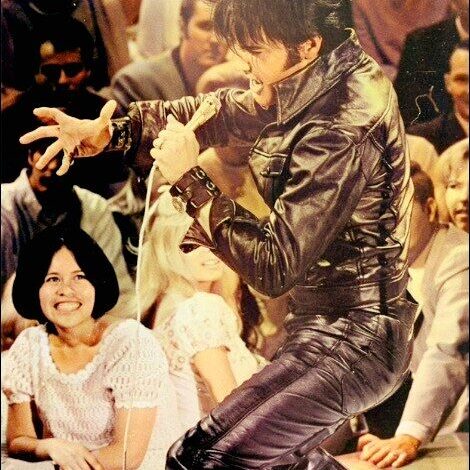
That spark of inspiration led to the creation of the most famous outfit in the history of rock and roll. Costume designer Bill Belew was tasked with creating a look that felt both contemporary and timeless—a suit that would signal a return to the danger of the mid-fifties. The result was the jet-black, second-skin leather suit. It featured a high, dramatic collar that framed the King’s face like a dark halo, paired with silk accents that added a touch of regality to the rugged texture of the leather. It was a masterpiece of symbolic engineering. By donning the leather, Elvis was not just imitating Brando; he was reclaiming the archetype of the American outlaw. He was signaling to the world that he was no longer a puppet for the movie studios. He was a man of flesh, blood, and sweat, ready to bleed for his craft.
The atmosphere in the dressing room on the night of the taping was suffocatingly tense. Director Jason Hehir describes an Elvis who was nearly paralyzed by stage fright, a man who almost refused to step out from behind the curtain. He was convinced that the world had moved on, that the audience wouldn’t accept him, and that the leather suit was a costume he could no longer fill. But when he finally walked onto that small, square stage, surrounded by fans and bathed in the harsh, unforgiving studio lights, something ancient and powerful took over. The leather suit, while physically grueling and incredibly hot under the stage lights, acted as a suit of armor. It allowed him to shed the “Hollywood Elvis” and inhabit the “Real Elvis.”
What followed was a performance of such raw, unadulterated power that it effectively reset the clock on his career. He wasn’t just singing songs; he was exorcising the ghosts of a decade’s worth of bad scripts and mediocre soundtracks. The “sit-down” sessions, where he played with his original bandmates, showed a vulnerability that had been absent from his public persona for years. He sweat, he laughed, he snarled, and he reclaimed his sexuality and his edge. The world watched in awe as the King proved that his crown hadn’t been lost; it had merely been buried under the weight of expectations. The special was a massive ratings success, but more importantly, it gave Elvis back his spirit. It served as the bridge that led him to his legendary residency in Las Vegas and the final, triumphant act of his life on the road.
The decision to channel the spirit of Brando was the ultimate act of defiance. Brando represented the “Method,” the truth, and the refusal to conform to the studio system’s whims. By stepping into that aesthetic, Elvis was declaring his independence. He realized that while Hollywood had broken his confidence as an actor, it could never touch the connection he shared with an audience through music. The leather-clad Elvis of 1968 remains the definitive image of the artist as a survivor. It serves as a reminder that even when the world thinks you are finished, you have the power to reinvent yourself, provided you are brave enough to face your fears and reclaim your own narrative. In that black leather suit, Elvis Presley didn’t just stage a comeback—he performed a resurrection, proving once and for all that while many might try to take the throne, there is only one King.