Teen Daughter Brings Starving Classmate Home for Dinner and Secret in Her Backpack Changes Our Lives Forever
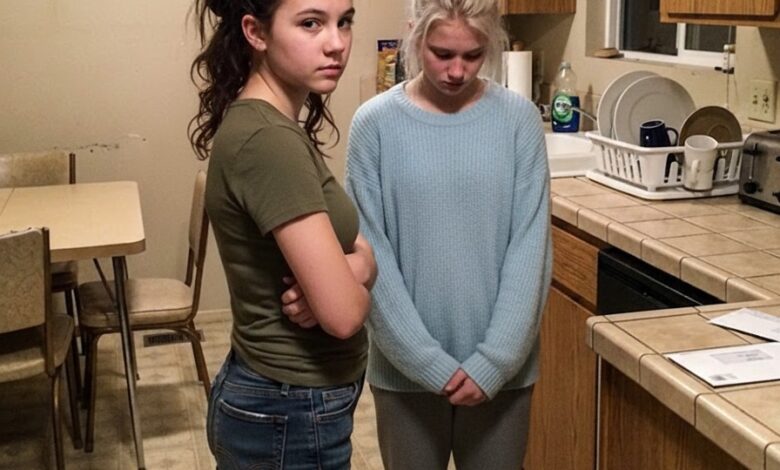
The math of my life was always calculated in grams, cents, and minutes. In our household, “enough” wasn’t a steady state of being; it was a fragile truce I negotiated daily with the utility companies and the local supermarket. On a Tuesday night in late March, that truce felt particularly thin. I stood at the kitchen counter, methodically slicing three chicken thighs to feed a family of three. If I cut the pieces small enough and bulked the dish with extra rice and the last of the carrots, I could ensure Dan and Samantha felt full, and maybe—if I was lucky—there would be a small container left for my lunch the next afternoon.
Dan walked in from the garage, the smell of sawdust and exhaustion clinging to his flannel shirt. He didn’t have to say anything for me to see the weight on his shoulders. The construction industry was slow, and his hands, calloused and perpetually stained with grease, told the story of a man working twice as hard for half as much. He dropped his keys into the ceramic bowl by the door with a weary clatter.
“Dinner soon, hon?” he asked, his voice low.
“Ten minutes,” I replied, not looking up from the stove. I was already mentally rearranging the plates. Dan would get the largest portion because his work was physical; Sam would get enough to fuel her teenage growth; and I would take whatever was left.
The front door swung open, and Sam burst in. Usually, she was a whirlwind of headphones and teenage angst, but tonight she was unnervingly focused. Behind her stood a girl I had never seen before. She was slight, almost fragile, with a faded purple backpack clutched against her chest like a shield. Her hoodie was oversized, but it couldn’t hide the sharpness of her frame, and her scuffed sneakers looked two sizes too big.
“Mom, Lizie’s eating with us,” Sam announced. It wasn’t a question. It was a manifesto.
I froze, the wooden spoon mid-stir. I looked at the pot of rice—carefully measured for three—and then at the girl whose eyes were glued to our linoleum floor. My first instinct was a flash of cold panic. I was already stretching a meal for three; a fourth plate felt like a physical impossibility. But then Lizie looked up, and the hollow look in her eyes silenced my inner accountant.
“Hi there,” I said, forcing a warmth I hoped didn’t sound as thin as our budget. “Grab a chair, sweetheart. There’s plenty to go around.”
It was a lie, but a necessary one. As we sat down, the atmosphere was thick with a tension I couldn’t quite name. Lizie didn’t eat like a normal thirteen-year-old. She didn’t complain about the carrots or pick at the chicken. She ate with a devastating, quiet precision. Every grain of rice was accounted for, every bite chewed slowly as if she were trying to memorize the sensation of being full. She flinched at the sound of Dan’s fork hitting the ceramic, her body coiled like a spring.
Dan, ever the bridge-builder, tried to fill the silence. “So, Lizie, Sam tells me you’re a bit of a track star?”
Lizie’s gaze flickered up for a fraction of a second. “I just like to run,” she whispered.
“She’s being modest,” Sam interrupted, her voice uncharacteristically fierce. “She’s the fastest in gym. She never stops.”
I watched my daughter. There was a protective edge to her that I hadn’t seen before. She was watching me, her eyes daring me to complain about the portion sizes or the extra dish to wash. I realized then that while I had been counting pennies, my daughter had been counting the ribs visible through her friend’s t-shirt.
After dinner, Lizie insisted on clearing the table. Her hands shook slightly as she handled the plates. When she moved to leave, Sam intercepted her, pressing a banana and a granola bar into her hands.
“House rule,” Sam said firmly. “Nobody leaves the house empty-handed.”
Once the door closed and Lizie faded into the twilight, my frustration bubbled over. “Sam, you can’t just bring people over without asking. We are barely making ends meet as it is.”
“She passed out in gym today, Mom,” Sam snapped back, her voice cracking. “The teachers told her she needs to ‘eat better,’ like it’s a choice. Her power is off. Her dad is working three jobs and they still can’t keep the lights on. We have a roof and a hot meal. How could I not bring her home?”
The air left my lungs. My petty concerns about chicken thighs felt grotesque in the face of my daughter’s clarity. I sat down at the table, the guilt washing over me in waves. I had been so focused on my own struggle that I had forgotten that “enough” is a relative term.
Over the next few days, Lizie became a shadow in our home. She was there for homework, there for dinner, and there for the quiet moments in between. She was a polite, ghost-like presence who tried to make herself as small as possible. But on Friday, the facade crumbled.
Lizie was sitting at the kitchen island, reaching for a textbook, when her backpack slipped from the stool. It hit the floor with a heavy thud, the zipper bursting open. I moved to help her, but as I knelt, my breath caught in my throat.
Out of the bag tumbled not just notebooks, but a frantic collection of reality. There were crumpled utility bills with “FINAL DISCONNECT” stamped in aggressive red ink. There was a small envelope filled with meager change—nickels and pennies. And then there was the notebook. It had fallen open to a page titled, in neat, heartbreaking script: What we take first if we get evicted.
The list included things like “Mom’s picture,” “Clean socks,” and “The canned beans.”
“Lizie,” I breathed, picking up the shutoff notice. “Why didn’t you say it was this bad?”
Lizie froze, her face turning a ghostly shade of white. She scrambled to gather the papers, her movements panicked. “My dad said not to tell. He said people look at you differently when they know you’re failing. He said we aren’t beggars.”
Dan walked in then, taking in the scene. He read the eviction notice over my shoulder, his jaw tightening. He didn’t offer platitudes. He simply sat on the floor next to this terrified child and said, “Pride is a luxury you can’t afford right now, Lizie. But family is something you never have to pay for. And you’re staying with us until this is sorted.”
The following hours were a whirlwind of phone calls and difficult conversations. We met Paul, Lizie’s father, that evening. He was a man hollowed out by grief and overwork, a widower trying to hold back the ocean with a plastic bucket. He didn’t want our help, but when he saw his daughter sleeping soundly on our sofa, the fight finally left him.
We didn’t have much, but we had a community. I called the food pantry where I sometimes volunteered; Dan spoke to a contractor friend who needed a reliable hand; Sam organized a clothing drive at school under the guise of a general charity event to protect Lizie’s dignity.
Slowly, the “enough” we had been fighting for began to expand. It turned out that “enough” wasn’t a finite resource like a gallon of milk or a box of rice. It was a living thing that grew the more you shared it. Lizie’s father found steady work through Dan’s connections, and their landlord agreed to a payment plan in exchange for repair work Paul could do on the building.
Weeks later, the atmosphere in our kitchen had shifted. The counting of meat slices had stopped. The tension that used to simmer over every bill had been replaced by a strange, resilient peace. Lizie was no longer a ghost; she was a girl who laughed at Sam’s jokes and helped with the dishes without being asked.
One evening, as I set four plates for a simple meal of pasta, I looked at Sam and Lizie huddled over a math textbook. I realized that my daughter hadn’t just brought a hungry girl home for dinner. She had brought a mirror into our home, forcing me to see that even when we feel we have nothing left to give, we are often wealthier than we imagine.
“Dinner’s ready,” I called out.
Lizie looked up, a genuine, bright smile breaking across her face. “Coming, Aunt Helena.”
I realized then that the math had finally changed. One plus one didn’t just equal two; sometimes, it equaled a life saved. And for the first time in years, I knew we finally had more than enough.