I Married A Dying Millionaire To Save My Son But The Wedding Night Revealed A Dark Conspiracy
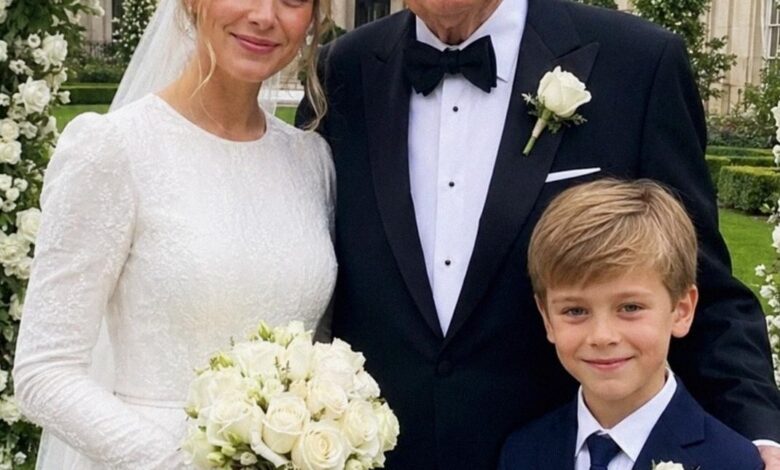
I stood at the altar in an ivory gown, my heart screaming in silent agony as I traded my future for the life of my dying boy. The media swarmed the gates of the mansion like vultures, desperate for a glimpse of the millionaire’s mysterious new bride, never knowing that I was nothing more than a desperate mother drowning in medical bills. I had sacrificed my freedom, my dignity, and my peace to secure the two hundred thousand dollars needed for a life saving heart surgery. But when the mansion doors finally clicked shut that night, the man I married changed everything.
Our marriage had been defined by a cold, transactional agreement from the very first meeting. Arthur, an eighty-one-year-old mogul with a fading heart and a mountain of enemies, needed a wife his power hungry children could not manipulate or bully out of his house. I was the caregiver he had hired to look after his stroke-stricken sister, Eleanor, and in his sharp, dying eyes, he saw a woman who was too exhausted by her own son’s terminal heart defect to be anything but loyal. He offered the money; I offered my hand. It was the only bridge across the chasm of my son’s inevitable death.
That night, Arthur led me into his dark, mahogany paneled office and slammed the door with a finality that made my blood run cold. He slid a thick, heavy folder across the polished desk, his face a mask of iron determination. He told me the doctors had already been paid in full, and my son was safe, but then he delivered the line that froze my heart in my chest. He informed me that this marriage was never about money, but about a war. He had married me to protect his sister, Eleanor, and to stop his own children from looting his massive estate.
The documents in the folder were not just marriage certificates; they were legal instruments that made me the executor of his entire estate and the legal guardian of Eleanor. I realized then that I had not just signed up for a life of convenience—I had signed up to be the shield between an elderly woman and the vultures circling her bedroom door. Arthur’s daughter, Vivien, had been treating Eleanor’s existence as a financial inconvenience, actively plotting to move her into a decrepit, low-cost facility to expedite the release of the family fortune.
The fallout was almost instantaneous. Vivien stormed into the office, her face a portrait of unhinged rage, flanked by lawyers who looked like they were ready to dismantle my entire existence. She accused me of elder abuse and manipulation, spitting insults about my background and threatening to have my son taken away by social services if I didn’t vanish by dawn. She was so consumed by the prospect of the inheritance that she didn’t even notice her father clutching his chest, his face draining of color as he collapsed onto the carpet.
The following weeks were a harrowing blur of hospital corridors, cold courtrooms, and the suffocating presence of Vivien’s legal team. She attacked me with every accusation in the book, painting me as a gold digging predator who had weaponized a dying man’s vulnerability. But she had made one fatal mistake: she had underestimated Arthur’s foresight. He had known exactly what she was capable of, and he had left a trail of evidence that rendered her arguments entirely moot. He had instructed his lawyers to reveal letters that Eleanor herself had written, documenting Vivien’s repeated, aggressive attempts to coerce her into unwanted facilities.
The courtroom fell into a stunned, heavy silence as those letters were read aloud. The judge, a man who had clearly seen the ugliness of inheritance disputes before, looked at Vivien with undisguised contempt. The evidence was damning. It wasn’t just about the money; it was about the systematic, cruel removal of Eleanor’s bodily autonomy for the sake of profit. Vivien’s claim to the estate was shredded, and the judge stripped her of all decision-making power, ensuring that I—the woman she called a brat—would remain the guardian of the woman she had tried to discard.
In the quiet aftermath of the court proceedings, my son finally began to recover. The color returned to his cheeks, and for the first time in years, the crushing weight of impending loss lifted from our home. Arthur passed away peacefully that winter, having achieved his final, calculated victory over the children who had viewed his life as nothing more than a delay in their financial planning. Eleanor lived on for four more years in the comfort of our home, cared for not as an obstacle, but as the person she truly was.
I eventually took the fortune I inherited and turned it into something lasting. I established a foundation dedicated to funding cardiac surgeries for children in desperate, impossible situations—mothers standing exactly where I once stood, staring into the abyss of a life they could not afford to save. The money that had once been the source of my enslavement became the source of my greatest purpose. People still ask if I regret marrying for money, expecting me to be ashamed of the choice that saved my son.
I tell them the truth, and I never look away. I didn’t marry for money; I married to save a life. But in the grand, sweeping irony of fate, the choice I thought would cost me my entire future became the exact reason I finally gained one. I learned that what we consider a surrender is often just the beginning of a different, more powerful chapter. When you are willing to lose everything to protect the ones you love, you are rarely left with nothing. Instead, you are given the chance to finally, truly live.