He Planned a Dream Proposal, Then Turned It Into a Cruel Test That Ended a 7-Year Relationship Overnight
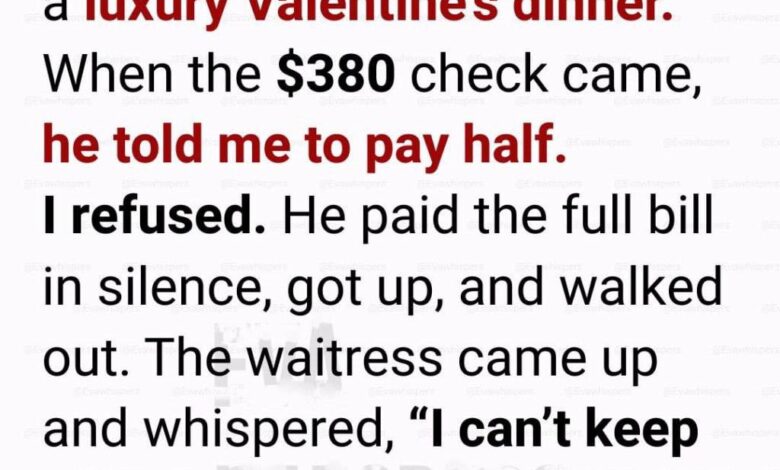
After seven years together, she walked into that Valentine’s dinner with something quiet but powerful—certainty.
Not the kind that demands anything. Not the kind that pressures or pushes. Just the steady belief that they had reached a natural point in their relationship. The kind of understanding that builds slowly over time, shaped by shared experiences, small routines, and years of choosing each other.
Seven years isn’t casual.
It’s history. It’s investment. It’s trust built across ordinary days and difficult ones alike.
So when he told her he had planned something “important” for Valentine’s Day, she didn’t question it. She didn’t need to. The tone, the effort, the intention—it all pointed toward something meaningful. Something that marked a shift.
He chose the place carefully. An upscale restaurant, the kind reserved for milestones rather than routine dinners. The lighting was soft, the atmosphere deliberate. Everything about the evening felt intentional, almost scripted in the best way.
From the moment they sat down, it unfolded exactly as she might have imagined.
They talked about where they started—how they met, the early days when everything felt uncertain but exciting. They laughed over shared memories, small details only they would remember. There was warmth in the conversation, a sense of looking back not just for nostalgia, but to recognize how far they had come.
It felt like arrival.
Not a finish line, but a transition. The kind of moment where something long built finally becomes something permanent.
She didn’t say it out loud, but she felt it.
This is it.
Then the bill came.
There was no tension at first. Just the natural pause that comes when a moment shifts from experience back to reality. But what happened next didn’t match anything that had come before.
He placed the bill between them.
And calmly asked her to split it. Equally.
Not as a light suggestion. Not as something casual or open to discussion.
As a statement.
She didn’t react immediately. Not because she couldn’t pay. That wasn’t the issue. It wasn’t about money.
It was about context.
This wasn’t just dinner. He had framed it as something significant. He had set the tone from the beginning—something important, something intentional. And within that context, the request didn’t feel like partnership.
It felt like a shift.
An unspoken change in the rules.
She paused—not out of refusal, but out of confusion. Something didn’t align. The meaning of the evening and the action in front of her didn’t match.
And in that pause, everything changed.
Instead of explaining, instead of clarifying what he meant or why he said it, he pulled back.
He didn’t ask what she was thinking. He didn’t try to bridge the moment.
He simply closed off.
He paid the bill himself.
Then he stood up and left.
No resolution. No conversation. No attempt to steady what had just been disrupted.
Just absence.
The kind that leaves more questions than answers.
She sat there, trying to understand what had just happened. The shift was too sudden, too sharp to process in real time. One moment, they were revisiting seven years of shared life. The next, she was alone at the table, unsure of what she had done—or not done.
The answer came later.
Not in person.
Not through a conversation.
But through a note.
He had brought a ring.
The dinner, he explained, had been a test.
Her hesitation—those few seconds of silence—had told him everything he needed to know. In his mind, it proved she wasn’t the partner he wanted to spend his life with.
And just like that, seven years were reduced to a single moment.
Not a conversation. Not a pattern. Not a shared history.
A reaction.
Measured against an expectation she had never been told existed.
That’s what made it so final.
There was no space to explain. No opportunity to say what she had been thinking. No recognition of context, emotion, or misunderstanding.
Just judgment.
There’s nothing wrong with wanting fairness in a relationship. Financial compatibility matters. Conversations about money, responsibility, and shared contribution are important—especially when a relationship is moving toward marriage.
But there’s a difference between building understanding and setting a trap.
One invites discussion.
The other waits for failure.
What he created that night wasn’t a conversation. It was a hidden evaluation, designed to produce a pass or fail result. And in doing so, he removed the very thing that makes a relationship work—communication.
A partner preparing for marriage doesn’t test silently.
They speak.
They ask questions.
They listen.
They allow space for confusion, for difference, for moments that don’t unfold perfectly.
Because real relationships aren’t built on perfect responses.
They’re built on how people handle imperfect ones.
What she felt in the aftermath wasn’t just heartbreak.
It was clarity.
Sharp, unexpected clarity.
She hadn’t failed anything.
She had been placed in a situation where the outcome was already decided, based on rules she didn’t know existed. And more importantly, she had been judged without being heard.
That realization changed everything.
Because if this is how conflict is handled before marriage—through silence, assumption, and sudden decisions—it doesn’t improve over time.
It deepens.
It becomes a pattern.
Walking away wasn’t just about losing a relationship.
It was about refusing a future shaped by conditions that appear without warning. Expectations that aren’t spoken until they’re used as a reason to leave. Judgments made without conversation.
Love cannot function that way.
It cannot grow in an environment where understanding is replaced by testing.
Where communication is replaced by interpretation.
Where a single moment outweighs years of shared life.
Seven years mattered.
They didn’t disappear.
But they revealed something she might not have seen otherwise.
That stability isn’t just about time.
It’s about how two people handle uncertainty, difference, and misunderstanding.
And in that moment, he showed her exactly how he would handle those things.
Not with openness.
Not with patience.
But with silence—and finality.
In the end, what looked like rejection became something else.
Protection.
Because not every ending is a failure.
Some are a form of clarity that arrives just in time.
A relationship meant to last cannot depend on hidden standards or silent expectations. It requires something much more grounded—something that can hold weight over time.
Clarity.
Respect.
And the willingness to meet each other honestly, without turning love into something that must be tested to be proven.