Check Your Wallet Now Because Your Two Dollar Bill Could Be Worth Thousands Of Dollars Instead Of Just Two
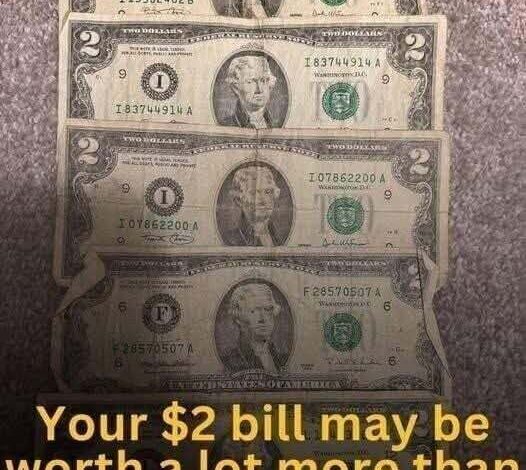
The two dollar bill has long occupied a strange, twilight zone in the American psyche. It is a piece of legal tender that exists in a state of perpetual misunderstanding, caught between being a common currency and a mythical relic. For generations, a bizarre aura of superstition has clung to the portrait of Thomas Jefferson. At one time, gamblers and the superstitious believed the two dollar bill was a harbinger of bad luck, a jinx that could ruin a winning streak or cast a shadow over a business deal. Some were so convinced of its negative energy that they would clip the corners of the bill to “release” the curse, a practice that ironically made the bills unfit for circulation. However, the tide of history and the passion of numismatics have flipped this narrative entirely. Today, owning a two dollar bill isn’t a sign of misfortune; it is a potential golden ticket that could bring a windfall of thousands of dollars to anyone who knows exactly what to look for.
The primary reason for the two dollar bill’s mysterious reputation is its perceived scarcity. Many Americans scoff when they receive one in change, or more likely, they tuck it away in a drawer, convinced they have stumbled upon a discontinued artifact. This has led to the bill being treated like the unloved stepsibling of the ubiquitous one dollar bill. Because people rarely see them in everyday transactions at gas stations or grocery stores, a collective delusion has taken hold that the U.S. Treasury stopped printing them decades ago. This could not be further from the truth. The two dollar bill is very much a living part of the United States currency system. It is still being printed, still being circulated, and still holds full face value at any bank in the country. The “rarity” isn’t a matter of production, but of behavior; people hoard them because they think they are rare, which in turn makes them disappear from cash registers, reinforcing the myth of their extinction.
However, while every two dollar bill is worth at least its face value, a select group of these notes is worth exponentially more. For the savvy observer, a trip to the attic or a glance through an old birthday card from a grandparent could reveal a fortune hiding in plain sight. The value of a two dollar bill beyond its printed number is determined by a perfect storm of three factors: age, condition, and serial number anomalies. Collectors, or numismatists, are a meticulous group. They aren’t just looking for money; they are looking for history and perfection.
The first thing to examine is the series year. While modern two dollar bills printed in the 2000s or 2010s are generally worth only two dollars, older iterations can command staggering prices at auction. Specifically, bills printed before 1976—the year the modern design was reissued for the Bicentennial—carry a premium. If you happen to find a bill with a red seal instead of the modern green one, you are holding a piece of history from the mid-20th century. United States Notes from 1928, 1953, or 1963 feature these distinct red seals and can be worth significantly more than their face value, especially if they have been kept crisp and uncirculated. Some rare versions from the late 19th century, featuring intricate engravings and large formats, have been known to sell for tens of thousands of dollars because so few have survived the passage of time.
Condition is the silent killer of value. In the world of currency collecting, a single fold, a microscopic tear, or a faded ink smudge can devalue a bill by hundreds of dollars. Collectors use a grading scale that rewards “uncirculated” notes—bills that look as though they just rolled off the printing press at the Bureau of Engraving and Printing. If you find an old two dollar bill that is perfectly flat, with sharp corners and vibrant ink, you are looking at a “gem” quality item. These pristine survivors are the ones that spark bidding wars at high-end auctions. Even a common bill from a recent series can be worth a premium if it is in flawless condition and possesses a “Star” in the serial number, indicating it was a replacement note for a sheet that was damaged during the printing process.
Perhaps the most exciting way a two dollar bill becomes a treasure is through its serial number. This is where the hunt becomes truly addictive. Every bill has a unique identifier, and certain patterns turn a standard note into a high-value collector’s item. For instance, “low serial numbers”—such as those starting with several zeros like 00000001—are the holy grail for many. Additionally, collectors look for “ladders,” where the numbers run in a sequence like 12345678, or “binaries,” which consist of only two repeating digits. Then there are “solid” serial numbers, where every digit is the same, such as 88888888. These anomalies are incredibly rare, and because they occur by chance during the massive production runs of the Treasury, finding one in your pocket change is like winning a mini-lottery.
Printing errors are another gateway to a lucky windfall. Despite the rigorous quality control of the U.S. government, mistakes occasionally slip through. Gaps in the ink, misaligned borders where the bill is cut off-center, or “doubled” seals where the ink was stamped twice can turn a two dollar bill into a one-of-a-kind oddity. To a regular person, a misprinted bill might look like a counterfeit or a piece of trash, but to a professional collector, that error represents a rare glitch in a billion-dollar system. These “error notes” are highly coveted and can easily fetch four-figure sums from those who specialize in the strange and unusual side of currency.
The story of the two dollar bill is a lesson in looking closer at the world around us. We often overlook the ordinary, assuming that something as common as a piece of paper in our wallet has no story to tell. But the two dollar bill proves that value is often hidden beneath a layer of myth and misconception. It transitioned from a “cursed” object that people were afraid to touch into a sought-after treasure that people are desperate to find. It serves as a reminder that the unloved stepsibling of the currency world might actually be the most interesting member of the family.
So, the next time you are cleaning out an old wallet, checking under the floorboards of an ancestral home, or receiving a strange-looking bill from a cashier, do not dismiss it. Do not let the old superstitions sway you into thinking it’s a bad omen. Instead, hold it up to the light. Check the color of the seal, trace the sequence of the serial number, and feel the crispness of the paper. That two dollar bill you are holding might have been printed last year, or it might have been sitting in a vault since the days of the Great Depression. With the right combination of history and luck, that “unlucky” piece of paper could be the very thing that changes your financial future. The value is there; you just have to know how to see it.