Can Dogs Really Sense A Good Or Bad Person
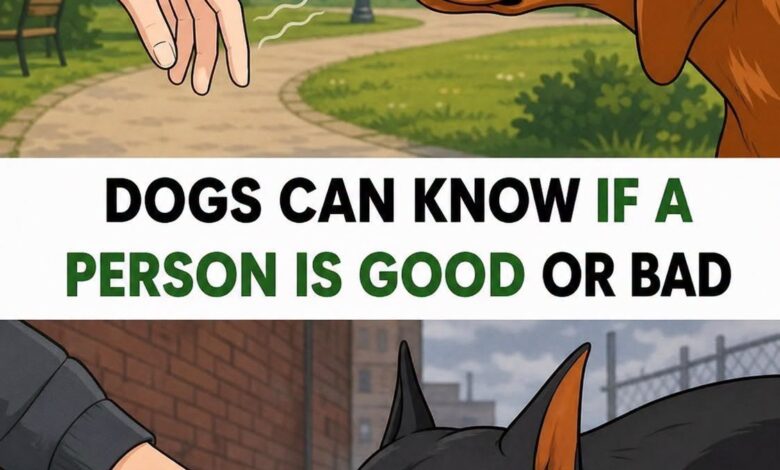
Dogs sometimes react to people in ways that feel almost supernatural. One visitor receives a loose body, a wagging tail, and an eager invitation to play, while another is met with stiff posture, retreat, or loud barking. It is tempting to believe that a dog has looked into each person’s character and decided who is good and who is bad. The more realistic explanation is still impressive, but it is not mind reading. Dogs are highly attentive observers that respond to signals, memories, and the emotional atmosphere around them.
A dog notices details that people often overlook. A stranger who leans directly over the animal, stares into its eyes, reaches suddenly, or speaks in a booming voice may seem threatening even when no harm is intended. Someone who turns slightly to the side, moves slowly, speaks softly, and allows the dog to approach can feel much safer. To humans these differences may seem small. To a dog that relies heavily on posture, movement, scent, and tone, they can be very loud messages.
Scent also matters. Dogs can detect changes associated with stress and can hear subtle shifts in breathing or speech. If a person is anxious, angry, or tense, the animal may become cautious in response. That does not prove the person is dangerous. A nervous guest may simply be afraid of dogs, tired after a difficult day, or uncomfortable in an unfamiliar home. The dog is reading the situation as it exists in that moment, not issuing a permanent moral judgment.
Past experience shapes these reactions too. A dog that was once frightened by a tall person in a hat may later hesitate around other tall people wearing hats. Another dog may associate a certain uniform, scent, gait, or type of voice with kindness because of repeated positive encounters. These learned associations can be powerful even when the new person has done nothing wrong. This is why a strong canine reaction should be taken seriously as information about the dog’s comfort, but not treated as proof about a stranger’s character.
Dogs can also learn by watching how people behave toward their owners. If someone argues, moves aggressively, grabs an arm, or ignores the animal’s warning signals, a dog may place itself between that person and a family member. In calmer situations, dogs may remember who shared food, played gently, or respected their space. Experiments suggest that dogs can notice helpful and unhelpful behavior, yet their choices are not perfect and do not amount to a human understanding of honesty, cruelty, or moral responsibility.
The safest response to a dog’s discomfort is neither to dismiss it nor to turn it into a dramatic accusation. Create distance, keep the leash loose if possible, and let the dog observe without being forced to interact. Ask visitors not to stare, bend over, or reach for the animal. Reward calm behavior and give the dog an easy way to leave. If fear or aggression is frequent, sudden, or intense, a veterinarian can rule out pain or illness, and a qualified behavior professional can help identify triggers.
Owners should also remember that protective behavior can be misunderstood. Barking may come from fear, frustration, excitement, territorial habits, or a lack of social experience. A quiet dog is not automatically relaxed, and a friendly dog is not automatically correct about everyone it approaches. Context matters more than any single reaction. Looking at the whole body, including the tail, ears, mouth, weight distribution, and willingness to move closer, gives a clearer picture.
So can dogs sense a good or bad person? They can sense a great deal about how a person moves, sounds, smells, and behaves. They can remember patterns and detect tension long before a human consciously notices it. What they cannot do is read a soul or deliver a reliable verdict on someone’s morality. When a dog reacts strongly, listen with curiosity, protect its space, and observe the situation carefully. The message is not necessarily that a person is bad. It is that, for reasons worth understanding, the moment does not yet feel safe to the dog.