What boy, 10, screamed as brother was decapitated on worlds tallest waterslide!
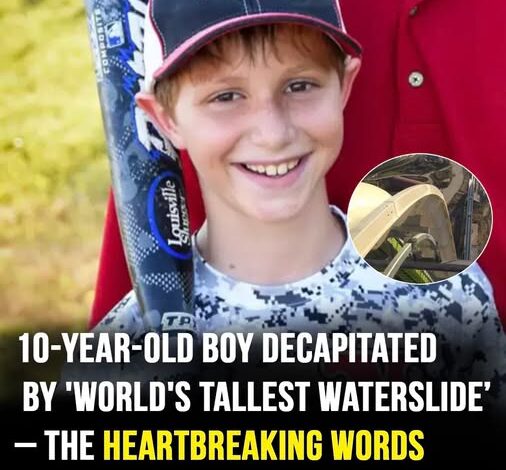
The pursuit of high-adrenaline thrills has always pushed the boundaries of engineering, but the story of the Verrückt waterslide stands as a stark, harrowing reminder of what happens when ambition outpaces safety. In 2016, a day of family fun at the Schlitterbahn Waterpark in Kansas City transformed into a national tragedy that redefined the standards of amusement park regulation. At the center of this nightmare was Caleb Schwab, a ten-year-old boy whose life was cut short in a manner so gruesome it remains one of the most cited cautionary tales in the history of structural engineering and public recreation.
The attraction itself was a marvel of modern marketing. Named “Verrückt”—the German word for “insane”—the slide was the brainchild of John Schooley and Jeff Henry. It was designed to be a record-breaker, standing at a staggering height of 168 feet and 7 inches. To put that into perspective, the drop was taller than both the Statue of Liberty and Niagara Falls. It was a seventeen-story vertical plummet followed by a secondary 55-foot rise that promised to launch riders at speeds reaching 70 miles per hour. The sheer scale of the structure was meant to evoke awe, but for those who understood the physics of such velocity, it was a source of mounting concern long before the fatal incident.
On August 7, 2016, the Schwab family—Scott, Michele, and their sons Nathan and Caleb—arrived at the park for a day of celebration. Scott Schwab, a Kansas state legislator, and his wife likely viewed the park as a safe environment for their children to enjoy the peak of summer. Caleb, a vibrant and athletic ten-year-old, was eager to experience the park’s premier attraction. However, the design of the Verrückt required a specific weight distribution to ensure the rafts remained glued to the flume. On the day of his ride, Caleb was placed in a raft with two adult women, a configuration intended to meet the minimum weight requirements.
The tragedy occurred during the transition between the initial massive drop and the secondary crest. Eyewitness accounts describe a scene of sudden, violent chaos. As the raft ascended the second hill at high speed, the physics of the ride failed. The raft became airborne, a phenomenon that had reportedly occurred during the testing phases of the slide’s development. In a desperate attempt to keep riders contained, the designers had installed a system of metal hoops covered in netting over the top of the chute. This safety feature, ironically, became the instrument of Caleb’s death. As the raft lifted off the slide, Caleb was propelled upward, striking the metal support bars at a velocity that made impact unsurvivable. He was decapitated instantly.
The immediate aftermath was a scene of visceral horror. Witnesses at the park that day described a transition from the typical sounds of splashing water and laughter to a hollow, haunting silence, followed by the screams of those nearby. Nathan, Caleb’s twelve-year-old brother, was waiting at the splash-down pool at the bottom of the slide. He had just finished his own ride and was looking back to see his brother finish. Instead, he witnessed the unthinkable. The trauma of that moment was captured in his frantic cries as he ran toward his parents, shouting that he had seen his brother fly from the ride.
The emotional weight of the event was compounded by the confusion on the ground. Michele Schwab later recounted the agonizing moments of uncertainty. As she tried to reach the base of the slide to find her son, a bystander intervened, physically blocking her path. His words—”Trust me, you don’t want to go any further”—carried the heavy realization that the situation was beyond the help of any first responder. The instinct of a mother to protect her child was met with the grim reality that there was nothing left to protect but a memory.
In the years that followed, the investigation into the Verrückt revealed a systemic failure of oversight and engineering. Reports surfaced suggesting that the slide had been rushed into production to meet a television filming deadline, skipping critical long-term safety testing that might have identified the “airtime” issue as a recurring flaw rather than a freak occurrence. The designers were eventually faced with serious legal repercussions, as the state of Kansas moved to tighten its previously lax amusement park regulations. The Verrückt was permanently closed and eventually dismantled, leaving behind only the concrete foundations and a legacy of grief.
The legal battle for the Schwab family was not about financial gain, but about accountability and the prevention of future tragedies. They reached a significant, undisclosed settlement with the park’s owners, but their pursuit of justice extended to the construction firms and consultants who had certified the ride as safe for public use. The family’s attorney emphasized that while the claims against the park and the manufacturer were resolved, the trauma remained a permanent fixture of their lives. Scott Schwab would later use his platform as a legislator to advocate for more stringent safety standards, ensuring that no other family would have to endure the same “horrible moment” that defined their 2016 summer.
Schlitterbahn Waterparks and Resorts, a company with a half-century of history, was fundamentally changed by the event. Their public statements reflected a blend of corporate contrition and disbelief. They claimed to take safety seriously, noting that many of their own staff and families had ridden the Verrückt. However, the evidence of structural instability and the decision to use metal netting—a feature that many experts argued should never be placed in the path of a high-speed rider—told a different story. The Kansas City location of the park never fully recovered its reputation and eventually ceased operations in 2018.
Today, the story of Caleb Schwab serves as a somber milestone in the industry. It sparked a global conversation about the limits of human-engineered thrills and the ethical responsibilities of those who design them. It forced a re-evaluation of how “tallest” and “fastest” are prioritized over “safest.” For the public, the tragedy stripped away the illusion of absolute safety that usually accompanies a ticket to a theme park. It reminded the world that behind every record-breaking attraction is a complex web of physics and human judgment that must be perfect every single time.
Caleb is remembered by those who knew him not as a headline or a victim of an engineering failure, but as a boy who loved his family and approached life with energy. The haunting screams of his brother Nathan and the quiet dignity of his parents in the wake of the accident remain a testament to the resilience of a family shattered by a moment that was supposed to be a highlight of their year. The Verrückt may be gone, but the lessons learned from its existence continue to influence safety protocols across the globe, ensuring that the cost of a thrill is never again measured in the life of a child.