Undercover Owner Visits His Diner, Overhears Cashiers Saying the Shocking Truth About Him!
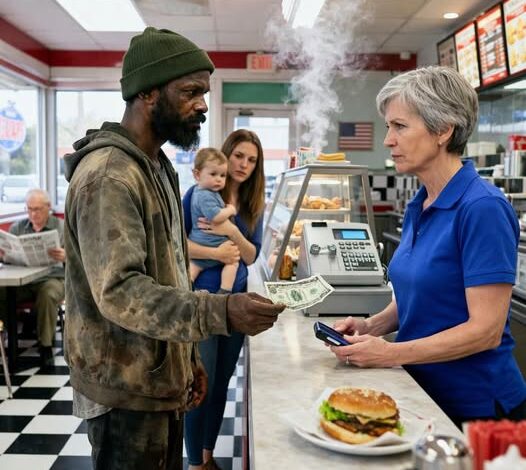
Downtown Springfield always began its day with a measured, predictable rhythm. The hum of early morning traffic on Main Street provided a steady bassline to the percussive hiss of city buses and the rapid footfalls of office workers clutching lukewarm lattes. Amidst this metropolitan awakening stood Carter’s Diner, a local institution that had traded in the currency of comfort for decades. Its red vinyl booths were worn to a soft patina, and the scent of seasoned bacon grease and toasted sourdough had long ago permeated the very walls. To the casual observer, it was merely a place to eat; to the regulars, it was a sanctuary where the world’s sharp edges felt a little more rounded.
Michael Carter, the man whose name flickered in the neon sign above the door, had built this empire from a single, struggling roadside stop. He had spent his youth at the grill, earning every scar on his hands and every dollar in his bank account through sheer, unyielding labor. Now, he oversaw seven flourishing locations from a polished executive suite thirty miles away. Yet, success had birthed a subtle, gnawing disconnect. While the spreadsheets showed glowing reviews, the flagship Springfield location was hemorrhaging profit through a leak he couldn’t identify. Worse, the veterans who had formed the diner’s soul were vanishing, replaced by a transient staff that seemed to lack the “Carter touch.”
The transformation Michael underwent to address this was meticulous. He traded his bespoke Italian wool for scuffed boots, faded jeans, and a weathered flannel shirt that smelled faintly of cedar. He capped the disguise with a construction company hat pulled low over his eyes and practiced a slower, heavier gait to mimic the weariness of a man who spent his days on a job site. When he finally stepped through the chime-adorned doors of his own diner, the brass handle felt foreign in his grip. The interior was visually unchanged, but the atmosphere had grown thin. The efficiency remained, but the warmth had become a practiced, shallow performance—a veneer of hospitality that didn’t reach the heart.
Sliding onto a squeaky vinyl stool at the far end of the counter, Michael began to observe. His eyes were immediately drawn to the service window, where an older man with silver hair and stooped shoulders was methodically washing dishes. Henry Lawson worked with a quiet, sacred focus, treating every porcelain plate as if it deserved his full, undivided attention. Michael struck up a casual conversation with Megan, a young waitress who barely bothered to look up from her station. When he asked about the man in the back, her response was a sharp, jagged needle of ageism. She dismissed Henry as a “relic” who constantly got in the way, suggesting he should have retired years ago. Michael watched Henry move with an understated grace, anticipating needs before they were voiced, anchored by a dignity that the younger staff clearly lacked.
The observation took a darker turn as Michael lingered through the frantic breakfast rush. He watched a young mother falter at the register, her face contorting with a sudden, sharp panic as her card was declined. He saw Megan and a cashier named Troy exchange mocking, conspiratorial glances. But before the humiliation could fully settle, Henry stepped forward. Without a word of fanfare, he pulled a few rumpled bills from his own pocket and covered the woman’s bill. As the mother hurried out with a whispered “thank you,” Troy let out a derisive, nasal laugh. He sneered that Henry was going to end up broke, and Megan chimed in, revealing a heart-wrenching truth: Henry was living out of his car, having lost his savings and his home to his late wife’s astronomical medical bills. They mocked his poverty and his kindness in the same breath, unaware that the man they were performing for was the architect of their employment. Michael felt a cold, crystalline fury settle in his marrow. His diner, a place built on the idea of belonging, had become a nest of entitlement and cruelty.
Over the next few days, Michael returned in varying disguises, documenting a pattern that went beyond mere apathy. He witnessed Troy and Megan systematically skimming cash from the drawer, voiding legitimate transactions after the customers left, and pocketing the difference. Worse, they were actively and maliciously framing Henry for the shortages. They whispered to the manager about Henry’s “confusing” behavior and his unauthorized generosity, planting the seed that he was stealing from the house to pay for strangers’ meals. It was a premeditated scapegoating of the most vulnerable man in the building, designed to cover their own tracks by exploiting a good man’s character.
The climax arrived on a humid Tuesday morning when Michael had arranged for a controlled crisis—a customer whose payment would intentionally fail. He sat at the counter, heart pounding against his ribs, as the scenario played out. Predictably, Henry stepped up with his usual quiet gallantry to cover the deficit. Immediately, Troy called for the manager, Patricia, claiming the register was short yet again and pointedly gesturing toward Henry.
“Henry,” Patricia said, her voice heavy with the weight of reluctant suspicion, “we need to talk in the back.”
The diner went quiet. The air grew heavy with the impending weight of injustice. It was then that Michael stood up. The scrape of his stool against the tile was like a gunshot in the silent room. He reached up, removed his cap, and stood tall, shedding the persona of the weary laborer as if it were a second skin.
“Stop,” he commanded. The authority in his voice was absolute and terrifying.
The shock was a physical presence. Megan’s mouth hung open; Troy turned a ghostly shade of ashen grey. Michael placed his phone on the counter, revealing the high-definition footage and the digital trail of voided transactions he had quietly gathered. He didn’t just announce his identity; he laid bare the rot they had invited into his house. He detailed the systematic theft and the malicious lies used to bury a man who was the only one truly doing his job.
“Henry used his own money,” Michael said, his voice echoing off the chrome fixtures and glass displays. “You used mine. And while Henry was protecting our customers, you were busy robbing me of the very soul of this business.”
The police arrived shortly after, escorting Troy and Megan out in handcuffs through a gauntlet of stunned patrons. The diner, once hollow, seemed to exhale a long-held breath of relief. Michael turned his attention to Henry, who stood by the dish pit in a state of dazed, blinking shock.
“Henry,” Michael said softly, placing a hand on the older man’s shoulder. “This place failed you. I failed you by not being here to see this. But that ends today.”
In front of the remaining staff and a room full of applauding regulars, Michael announced a life-altering series of reparations. He had already contacted his legal and financial teams to wipe out Henry’s medical debts in their entirety. Furthermore, he presented Henry with the deed to a small, furnished house just three blocks away—a permanent sanctuary to replace the cramped backseat of a sedan.
The final stroke was the appointment of Henry as the new Floor Manager. Michael realized that the diner didn’t need a better spreadsheet or a more complex security system; it needed a soul. Henry, with his clean button-down shirt and his newfound authority, became the living embodiment of the diner’s original values. He didn’t just manage shifts; he managed people, teaching the new hires that listening was as important as serving and that empathy was the most valuable item on the menu.
Michael continued to visit, no longer in disguise, watching as the diner regained its warmth and its luster. He had learned a difficult, humbling lesson: success can make an owner blind, but the truth is always there if one is willing to look where the light doesn’t usually reach. In the end, the diner thrived not because the profits were finally protected, but because the man who protected everyone else was finally, truly seen. The red vinyl booths were still worn, and the scent of bacon still filled the air, but the heart of Carter’s Diner was beating stronger than ever before.