Two Countries Announce Travel Ban on US Citizens, Citing Reciprocity After New American Restrictions!
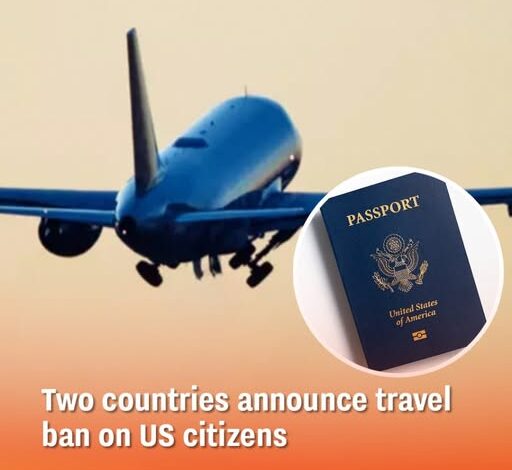
A new wave of global travel restrictions is reshaping international mobility and igniting diplomatic tensions, as two countries have formally announced travel bans on U.S. citizens in direct response to expanded American entry restrictions. The move marks a significant escalation in what analysts describe as a reciprocity-driven standoff, with consequences rippling across tourism, business travel, security cooperation, and foreign relations.
Since returning to the presidency, Donald Trump has once again placed immigration enforcement and border security at the center of U.S. policy. Earlier this month, the administration unveiled a sweeping expansion of travel restrictions, adding multiple countries to an already extensive list. With a total of 39 nations now facing either full or partial bans, the policy represents one of the most expansive travel restriction regimes in modern U.S. history.
The White House has framed the measures as a national security imperative, arguing that tighter controls are necessary to ensure travelers entering the United States do not pose security risks. Administration officials maintain that the restrictions are based on objective assessments of document security, information-sharing practices, and compliance with U.S. border standards. Supporters of the policy argue it pressures foreign governments to modernize their systems and cooperate more fully with American authorities.
Critics, however, see the situation very differently. Human rights organizations, international law experts, and foreign governments warn that the bans amount to collective punishment, disproportionately affecting ordinary civilians rather than political leaders. They also point to economic disruption, strained diplomatic relationships, and growing uncertainty for travelers, multinational companies, and humanitarian organizations operating across borders.
Under the expanded policy, full travel bans apply to citizens of countries including Afghanistan, Burma, Chad, Congo, Eritrea, Haiti, Iran, Libya, Somalia, Sudan, Yemen, and Syria, among others. These bans suspend nearly all visa categories, with only narrow humanitarian or diplomatic exceptions.
Partial restrictions affect additional nations such as Angola, Nigeria, Tanzania, and Zambia, limiting specific visa types including work, student, or tourist visas. U.S. officials say these measures address “deficiencies” in compliance, but foreign leaders have criticized the lack of transparency around how countries are evaluated or removed from the list.
The response from abroad was swift. Mali and Burkina Faso announced reciprocal restrictions on American citizens, citing the principle of reciprocity and the need to protect national sovereignty. In official statements, both governments argued that if their citizens face blanket restrictions, U.S. travelers should expect similar treatment.
Niger went further, declaring a permanent suspension of visa issuance to U.S. nationals. This decision follows earlier actions by Chad, which had already halted visa processing for Americans in a previous dispute. Together, these measures complicate U.S. diplomatic engagement and raise concerns for aid workers, journalists, contractors, and businesses operating in the region.
Beyond travel bans, the Trump administration has also introduced expanded biometric screening measures at U.S. ports of entry. New requirements include enhanced facial recognition technology at airports, with proposals under review for broader fingerprint collection and, in some cases, advanced biometric identifiers for non-citizens. Officials argue these tools strengthen border security and identity verification, but civil liberties advocates warn of privacy risks, data retention concerns, and the potential misuse of sensitive personal information.
The international response has not been limited to direct retaliation. Several European governments, including United Kingdom and Germany, have issued updated travel advisories. These notices caution citizens that holding a valid visa or ESTA approval does not guarantee entry into the United States, highlighting the growing discretion exercised by border officials under the new framework.
Internal diplomatic communications suggest that additional countries could be added to the U.S. restriction list if they fail to meet updated standards. This prospect has raised alarms among international travel associations and global corporations, which warn that unpredictable border policies disrupt supply chains, business planning, and international investment.
Economists also point to the potential impact on the U.S. tourism industry, a sector that relies heavily on international visitors. Reduced inbound travel could affect airlines, hotels, universities, and conference-based industries, while reciprocal bans threaten American travelers and companies abroad. For students, researchers, and professionals, the uncertainty surrounding visas and entry rules has become a major planning challenge.
At a strategic level, analysts argue that the unfolding situation represents more than a dispute over visas. It reflects a broader shift in how global mobility is governed—one where security-driven policies increasingly collide with diplomacy, economic interdependence, and international cooperation. Long-standing alliances are being tested, and newer partnerships face added strain as travel becomes a geopolitical bargaining tool.
As protests, negotiations, and legal challenges continue, the long-term consequences remain unclear. What is evident, however, is that the era of predictable international travel is being reshaped. Governments, travelers, and businesses now face a landscape defined by heightened scrutiny, reciprocal restrictions, and evolving border technologies.
In the months ahead, the direction of global mobility will depend on whether diplomacy can temper policy escalation—or whether travel bans and retaliatory measures become a permanent fixture of international relations. For now, uncertainty dominates, and the simple act of crossing borders has become a symbol of a much larger geopolitical shift.