Trumps Latest Financial Blueprint Sends Shockwaves Across America, What His Private Accounts Really Mean
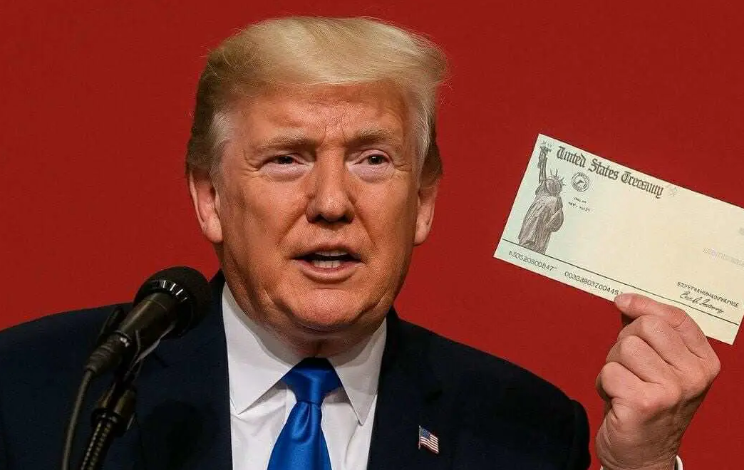
Rumors started swirling long before anything official was announced. Conversations behind closed doors, vague comments from economic insiders, and carefully worded hints in media interviews all suggested that something big was coming. Policy analysts claimed unusual patterns in internal planning documents. Political strategists whispered about a proposal unlike anything seen in recent economic debates. By the time Donald Trump finally stepped forward with his latest idea, the country was already braced — sensing that whatever he had in store wouldn’t be routine policy but something disruptive, highly controversial, and destined to spark nationwide debate.
His plan arrived with a bold name and an even bolder promise: the creation of “Trump Accounts,” a set of government-funded investment portfolios intended to give newborn American children a financial stake from the moment they enter the world. The announcement spread instantly across social media, talk shows, and news programs, with reactions ranging from excitement to disbelief. Supporters hailed it as a radical step toward leveling America’s growing wealth gap. Critics warned it was an experiment built on fragile ground.
The structure of the proposal was simple on paper but sweeping in impact. Every child born within a designated four-year period would automatically receive a $1,000 investment account funded by the federal government. This account wouldn’t sit idle like a savings bond. Instead, it would track with the stock market — compounding over years, theoretically growing into a meaningful nest egg by the time the child reached adulthood. The idea painted an enticing picture: turning 18 with thousands of dollars available for college, housing, business investment, or emergency support. For families shut out of wealth-building opportunities, the concept felt almost revolutionary.
For many Americans struggling to get ahead, the idea hit a nerve. Homeownership grows more unattainable every year. Wages lag behind inflation. Young people carry massive debt before they ever reach financial stability. To those who feel the system is rigged against them, the notion of an automatic financial foundation for every newborn sounded like the first hopeful concept to emerge from politics in a long time.
But as soon as the applause started, so did the questions — and they were heavy ones.
The biggest concern centered on the volatility of the stock market itself. Unlike traditional guaranteed programs, these accounts would rise and fall with market conditions. One year could bring record growth; the next could wipe out half the accumulated funds. Critics argued that tying a child’s future to Wall Street’s unpredictable movements was irresponsible. What happens, they asked, when the market crashes during a recession, a geopolitical crisis, or another pandemic-style event? Would millions of young Americans enter adulthood with empty accounts just because they were born at the wrong point in the economic cycle?
Then came questions about management. Who would oversee these accounts? Would private firms be contracted to invest and monitor funds? Would the government build a new bureau? What rules would govern the investments — high-risk, high-yield portfolios or safer, long-term strategies? Without answers, skeptics worried that “Trump Accounts” could become a magnet for mismanagement, political interference, or financial exploitation. Americans wanted to know who would be watching the watchmen.
Another concern, one raised quickly by policy experts, was political durability. Massive social programs often collapse or morph when administrations change. What would happen if a future president terminated the program halfway through? Would children born in a specific four-year window receive benefits that their younger siblings never could? That kind of uneven policy could introduce new divisions into a society already strained by inequality.
Despite all the red flags, one truth emerged clearly: Trump’s proposal had forced the country to confront its deep and growing wealth divide. For decades, the gap between the wealthy and the working class has widened at a pace that once seemed impossible. By offering a dramatic and unconventional proposal, Trump pushed that issue front and center in a way few political figures have dared.
Supporters called it a bold start — a way to help families who have been locked out of investment culture entirely. Critics saw it as a risky gamble that could backfire on the very people it was supposed to help. But both sides admitted the same reality: America’s approach to economic opportunity hasn’t changed meaningfully in generations, and the old structures aren’t working for millions of citizens.
Even those who dismissed the proposal outright acknowledged that it had sparked a national conversation long overdue. What should economic opportunity look like in the modern era? Should children begin life with some measure of financial support? Should generational wealth be accessible beyond families who already have it? And if not this program, then what replaces it?
The debate spilled across platforms — not just political talk shows but community forums, classrooms, workplaces, and family dinner tables. Teachers wondered whether students would one day rely on these accounts to pay for college. Parents questioned whether they should adjust their financial planning. Economists argued about whether the program would stimulate investment culture or destabilize future markets. Everyone had an opinion, and for once, the discussion stretched far beyond partisan lines.
As the story developed, analysts noted something important: regardless of whether this proposal ever becomes law, it has already shifted the national dialogue. Americans are being forced to rethink what economic fairness means in a world where opportunity is increasingly uneven. The conversation is no longer about small tweaks to tax codes or scattered social programs. It is about structural change — about reimagining what the country owes to its youngest citizens before they can fend for themselves.
Supporters see empowerment. Critics see danger. But no one denies that the stakes are high.
While the future of Trump Accounts remains uncertain, the controversy has cracked open a deeper truth. America is wrestling with fundamental questions about wealth, risk, responsibility, and the vision of a nation where every child begins life with something more than nothing. Whether the idea becomes a historic turning point or fades into political memory, it has already done what few policies manage to do: it forced a reckoning.
The country now waits — cautiously, anxiously, or optimistically — to see what comes next, knowing that whatever direction this debate takes, its impact on the American dream will echo long beyond this moment.