Trump finally responds to Mamdanis election-night jabs
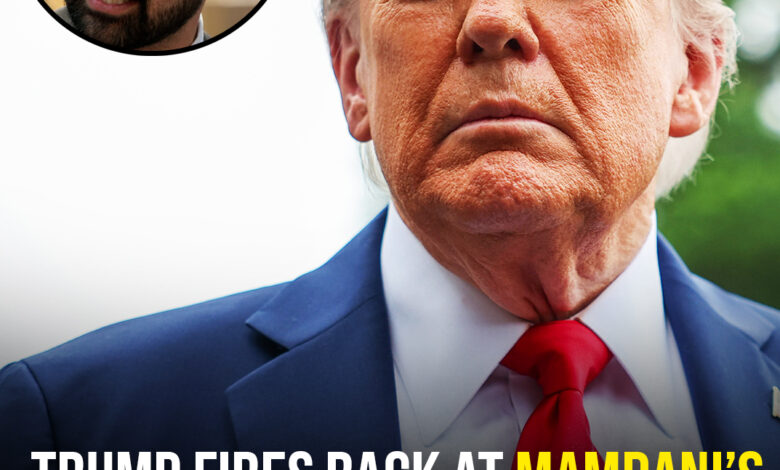
The tension between President Donald Trump and New York City’s newly elected mayor, Zohran Mamdani, erupted almost instantly after the results were announced — and if the first exchange between the two men is any indication, their relationship is heading straight into open confrontation.
Election night in Brooklyn carried an unmistakable charge. Supporters packed into the venue, waving flags, chanting Mamdani’s name, and celebrating a political moment that will be remembered for years. At thirty-four, Mamdani made history as the city’s first Muslim and South Asian mayor, a victory that signaled a generational and cultural shift in one of America’s most visible cities. When he finally took the stage, his tone was confident and unapologetic. “New York will remain a city of immigrants — built by immigrants, powered by immigrants, and as of tonight, led by an immigrant,” he declared. The room erupted in cheers and applause that shook the floor.
But it was what came next that guaranteed headlines. Looking straight into the camera, Mamdani delivered a line that would ricochet through cable news and social media for days: “Donald Trump, since I know you’re watching, I have four words for you: turn the volume up.”
The crowd roared. It was a bold, direct jab at the former president — a challenge wrapped in confidence and defiance. Within hours, clips of the moment flooded every social platform. Hashtags trended. Supporters celebrated his audacity, while critics accused him of courting unnecessary conflict. Pundits speculated that it marked the start of a political rivalry that could stretch well beyond city borders.
Trump, as expected, didn’t stay silent for long. By Wednesday, during an interview with Fox News anchor Bret Baier, the president had fired back. His tone was measured but unmistakably irritated. “Those remarks were angry toward me and very dangerous,” Trump said. “He has to be a little bit respectful of Washington, because if he’s not, he doesn’t have a chance of succeeding.”
The response carried a familiar mix of warning and condescension — Trump signaling both irritation and authority, reminding Mamdani that New York’s new leader still needed cooperation from the federal government. He went further, adding that the mayor’s tone “wasn’t the kind that wins you friends in Washington.”
This was not the first time Trump had gone after Mamdani. During the campaign, he repeatedly branded him a “communist,” a label meant to stir controversy among conservatives and moderates alike. Mamdani, a self-described democratic socialist, shrugged off the attacks as predictable and tired. But Trump’s rhetoric didn’t stop there. At a rally in late October, he warned that if Mamdani won, “New York City can expect the minimum from Washington — the bare minimum.” The remark was widely interpreted as a threat to limit federal cooperation, a move critics said would punish millions of New Yorkers for electing someone Trump opposed.
While political mudslinging is nothing new, Mamdani’s rise represents something Trump hasn’t faced often — a young, unapologetically progressive leader from his own city, one who combines charisma with a clear grasp of how to use modern media. The new mayor’s speech wasn’t just a victory address; it was a message to a national audience. His repeated references to “a nation betrayed by Donald Trump” framed his win as part of a larger ideological struggle, positioning New York as the symbolic counterweight to Trump’s America.
Trump, never one to let a slight pass unaddressed, used his next public appearance to pivot from anger to entertainment. Speaking later that day at a business event in Miami, he mocked another political rival, California Governor Gavin Newsom, before taking a detour back to his usual campaign theatrics. Pausing for effect, Trump looked out at the audience and said, “Maybe that should be his nickname — Slimy. Slimy Newscum, right?” The crowd burst into laughter and applause, the kind of reaction that has long fueled Trump’s rallies.
Newsom’s response came swiftly on X (formerly Twitter): “You lost.” Two words, clean and cutting. The post went viral in minutes.
Mamdani, however, stayed quiet. No tweets. No statements. No follow-up comments. His team declined interviews, saying the mayor was focused on “transition planning and policy groundwork.” That silence was strategic — a refusal to feed the media machine Trump thrives on. But the contrast between the two men was clear. One was loud, unpredictable, and combative; the other, deliberate, confident, and apparently unfazed.
Political observers immediately began drawing parallels between this brewing tension and the kind of rivalries that have defined American politics for generations — fiery clashes between local and federal power, personality versus principle. For New York, the stakes are especially high. The city depends heavily on federal funding for infrastructure, housing, and disaster preparedness. If Trump follows through on his “bare minimum” comment, that relationship could become strained, with real consequences for millions of residents.
Still, Mamdani seems prepared for the fight. His campaign platform emphasized self-reliance and reform, with promises to cut bureaucracy, expand affordable housing, and strengthen social programs. In his words, “New York doesn’t wait for permission. We lead.”
Trump, meanwhile, has made it clear that he intends to stay a dominant voice in national politics — and that he won’t tolerate public criticism without hitting back harder. His allies have already begun framing Mamdani as part of a “radical urban agenda,” echoing the same language used against progressives like Alexandria Ocasio-Cortez. Conservative outlets have leaned into that narrative, painting Mamdani as an ideological extremist whose policies will “bankrupt” the city.
Yet, inside New York, the tone feels different. For many voters, Mamdani represents a new generation of leadership — one that looks and sounds like the city itself. His immigrant background, his grassroots campaign, and his refusal to back down from power have earned him both admiration and enemies. In the wake of his win, he told supporters, “Our victory is not about one office. It’s about rewriting who gets to belong, who gets to lead, and who gets to be heard.”
The political divide between Mamdani and Trump is more than personal—it’s symbolic. It pits two visions of America against each other: one defined by inclusion and progressive reform, the other by nationalism and nostalgia. The coming months will reveal whether these two figures clash head-on or circle each other from their respective podiums, each feeding off the other’s energy.
For now, both camps are holding their ground. Trump’s allies insist that “respect must flow upward,” while Mamdani’s team quietly suggests that respect has to be earned, not demanded. The tension is palpable, and it’s already shaping headlines beyond New York.
What started as an exchange of words between two men may evolve into one of the defining rivalries of the next political cycle. Mamdani’s rise has challenged the status quo in one of America’s most influential cities, while Trump’s response reminds everyone that his influence remains formidable. Two figures, two ideologies, one collision course.
The city that gave rise to Donald Trump now has a mayor who isn’t afraid to call him out by name. And if both men stay true to form, the political noise coming out of New York won’t be fading anytime soon.