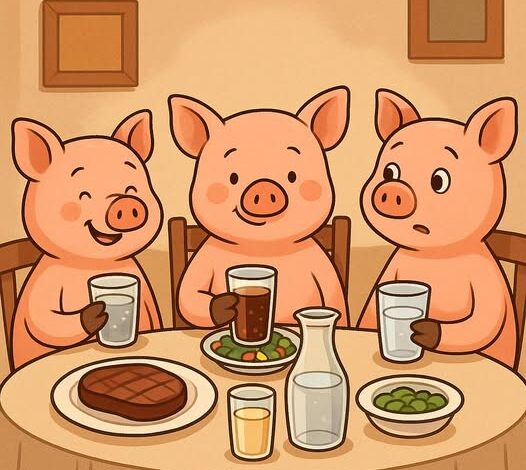
Three Little Pigs went out to dinner one night!
In the grand tradition of folklore and humor, few figures are as enduring or as versatile as the pig. From the industrious architects of the “Three Little Pigs” to the clever inhabitants of farmyard parables, these animals have long served as the perfect vessels for our jokes, our lessons, and our lighthearted observations about the human condition. When we look at the following tales, we see a blend of classic wordplay and sharp social commentary, reimagined to highlight the absurdity of modern life and the timeless joy of a well-timed punchline.
The first tale takes us to a surprisingly upscale bistro on a Tuesday evening, where three legendary brothers—the Three Little Pigs—decided to enjoy a night out on the town. These were not the frightened piglets of the old nursery rhymes, huddled behind walls of straw or sticks. These were sophisticated, modern pigs who enjoyed the finer things in life. As they were seated at a pristine corner table, a waiter approached, flickering his pen over a notepad, ready to take their drink orders.
The first little pig, a fan of classic carbonation, didn’t hesitate. “I’ll have a Sprite,” he said with a confident nod. The second little pig, preferring the caramel notes of a traditional cola, chimed in, “I’ll take a Coke, please.” Then the waiter turned his attention to the third little pig. This particular pig was leaning forward, eyes wide with a strange intensity. “Water,” he declared. “And not just a glass. I want lots and lots of water. Keep the pitcher coming.”
The waiter, used to eccentric diners, shrugged and delivered the beverages. When he returned to take the dinner orders, the pattern continued. The first pig ordered a massive, juicy steak, medium-rare. The second pig, perhaps watching his waistline or embracing a more leafy lifestyle, opted for a garden salad with vinaigrette. The third pig, however, didn’t even look at the menu. He simply tapped his empty glass. “More water,” he insisted. “Gallons of it. I want to be practically swimming in it.”
By the time dessert rolled around, the atmosphere at the table was a mix of festive indulgence and watery preoccupation. The first pig was happily tucking into a towering banana split, while the second enjoyed the frothy peaks of a root beer float. The third pig sat behind a veritable fortress of empty water carafes. “Water!” he shouted before the waiter could even open his mouth. “More water! Lots and lots of water!”
The waiter’s professional veneer finally cracked. He leaned in, his curiosity getting the better of him. “Sir, I have to ask. Your brothers are enjoying sodas, steaks, and sweets. You have consumed enough water to fill a small pond. Is there a medical reason? A spiritual fast? Why are you only drinking water?”
The third pig leaned back, a mischievous glint in his eye and a wide, toothy grin on his face. “Well,” he chuckled, “it’s quite simple. You know the old rhyme, don’t you? Someone’s gotta go ‘wee-wee-wee’ all the way home!”
The brilliance of the joke lies in its subversion of a childhood staple, turning a phonetic nursery rhyme into a literal, biological necessity. But the humor of the farmyard doesn’t end with puns; it often extends into the realm of bureaucracy and the impossible standards set by the world at large. This brings us to the story of a hardworking farmer who found himself caught in the crosshairs of global scrutiny, all because of his modest herd of swine.
This farmer was a simple man who believed in the traditional ways of the land. He raised his pigs with care, providing them with a steady diet of acorns, corn, and organic scraps from the harvest. To him, this was the natural order of things. One afternoon, a stern-looking man in a sleek charcoal suit arrived at the gate, clutching a clipboard like a shield.
“What exactly are you feeding these animals?” the man demanded, peering over the fence at the pigs rooting in the mud.
The farmer wiped his brow and smiled. “Well, I give them acorns, corn, and whatever bits and bobs are left over from the kitchen. Why do you ask?”
The man’s face reddened with indignation. “I am a representative from the Animal Protection Association! These animals are sentient beings, and it is a disgrace to feed them waste and scraps. They deserve a balanced, high-protein diet free from refuse.” Before the farmer could argue, the man slapped a heavy fine onto the gatepost and marched away.
The farmer, shaken but determined to comply, decided to upgrade his operations. He spent his life savings on the finest ingredients known to man. A week later, another official arrived—this one wearing a blue beret and carrying a briefcase embossed with a global insignia.
“Tell me,” the official said, looking at the pigs who were now lounging on silk bedding. “What is the daily regimen for these creatures?”
The farmer, proud of his newfound “compliance,” beamed. “Only the best for my boys! I feed them Atlantic salmon, Beluga caviar, tiger shrimp, and Wagyu steak. They drink nothing but sparkling mineral water.”
The official’s jaw dropped, but not in admiration. “I am from the United Nations! Do you have any idea how many people are suffering from famine across the globe? It is a moral atrocity to feed pigs like royalty while human beings go hungry. This is an insult to the global community!” He promptly issued a fine that was double the first one.
Distraught and confused, the farmer realized he was trapped in a “damned if you do, damned if you don’t” cycle of bureaucracy. He went back to his porch and sat in his rocking chair, contemplating his next move. A few days later, a third man walked up the driveway. He looked like a local census taker or perhaps just a curious neighbor.
“Afternoon, farmer,” the man said. “Nice looking herd you got there. Just curious—what do you feed them?”
The farmer sat in silence for several minutes, his eyes fixed on the horizon, his mind weighing the consequences of every possible answer. Finally, he let out a long, weary sigh.
“To be honest with you,” the farmer said, “I’ve given up on making those decisions. Now, I just walk out there every morning and give five dollars to each pig so they can go into town and buy whatever they want.”
In these stories, we find the two pillars of great humor: the playful manipulation of language and the pointed satire of a world that often makes no sense. Whether it’s a pig preparing for a very long walk home or a farmer navigating the conflicting demands of international organizations, the lesson is the same—sometimes, the only way to survive the absurdity of life is to meet it with a laugh. Humor is, after all, the most durable thread in the tapestry of our existence, allowing us to navigate our fears, our frustrations, and our interactions with the world with a bit more grace and a lot more joy.