They just drove off, leaving my six-year-old standing there soaked and crying!
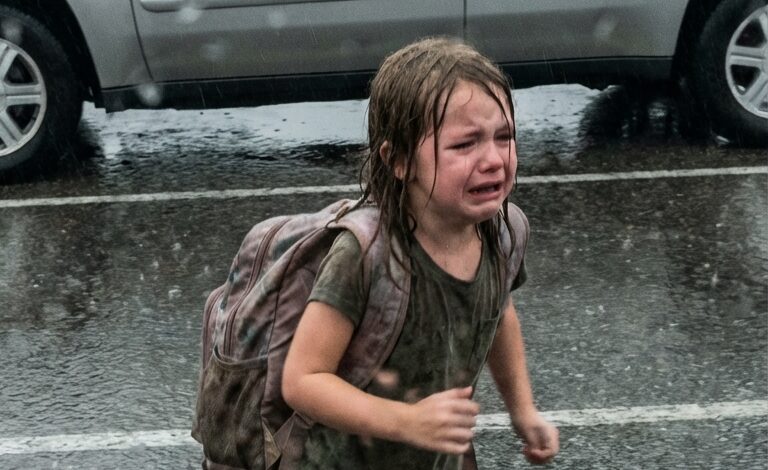
The rain didn’t fall that afternoon. It attacked.
Sheets of it slammed into the pavement so hard the world outside the boardroom windows blurred into gray streaks, like the city was being erased. Inside, the meeting dragged on—dry voices, stale coffee, meaningless metrics. I was half-listening when my phone buzzed against the polished table.
Mrs. Patterson.
My stomach dropped. She never called during school hours unless something was wrong. Very wrong.
I answered without thinking. “Mrs. Patterson?”
“Your daughter is outside the school gates,” she said, her voice strained, barely holding together. “She’s soaked through, shaking, and crying. I believe there was… a problem with pickup.”
“I’m coming,” I said, already standing.
I didn’t grab my bag. I didn’t excuse myself. I left everything behind and ran.
The drive should have taken twelve minutes. It felt endless. Rain hammered the windshield so hard the wipers couldn’t keep up. My hands were locked on the steering wheel, knuckles white, heart racing through worst-case scenarios I couldn’t shut off.
When I pulled into the pickup zone, I saw her.
My six-year-old, Lily, stood hunched beneath a too-small umbrella Mrs. Patterson was struggling to hold steady against the wind. Lily looked like she’d been pulled from a river—hair plastered to her face, clothes clinging, backpack sagging with water. She was shivering so hard her whole body trembled.
Something inside me cracked.
I parked crooked, jumped out, and ran. “Lily!”
She looked up, eyes red and hollow, and collapsed into my arms. “Mommy!” Her voice broke completely. She was ice cold.
I scooped her up, ignoring the rain soaking through my clothes, and rushed her into the car. I wrapped her in the emergency blanket from the trunk, cranked the heat, and waited until her breathing slowed enough to speak.
“Sweetheart,” I said gently, forcing my voice steady, “where are Grandma and Grandpa? They were supposed to pick you up.”
She sniffed hard. “They came.”
My chest tightened. “Then why were you outside?”
Her lips trembled. “I ran to the car. I was happy. But Grandma rolled the window down just a little.” She swallowed. “She said, ‘Walk home in the rain like a stray.’”
The words hit like a physical blow.
“And Grandpa?” I asked quietly.
“He said there wasn’t room for me.” Tears spilled again. “Aunt Miranda was in the front seat. She laughed. She said Bryce and Khloe deserved the comfortable ride more.”
My vision narrowed. Heat rushed through my body, sharp and cold at the same time. They had looked at my child—my six-year-old—standing alone in a freezing storm, and they had driven away.
I didn’t scream. I didn’t cry. I drove home in silence, rage coiled so tight it felt lethal.
At home, I went into autopilot. Hot bath. Fresh pajamas. Towels warmed in the dryer. Hot cocoa with extra marshmallows. I held Lily until her sobs faded into exhausted hiccups. I tucked her into bed, kissed her forehead, and stayed until sleep finally claimed her.
Only then did I let myself breathe.
The house was quiet except for the rain pounding the roof like a drumbeat. My husband was on a late shift. I went into my home office, turned on my laptop, and logged into my bank account.
For years, I had been the backbone of my family. The reliable one. The one who made things “work.” When my parents retired early—my father citing back pain that never interfered with golf—I stepped in. When my younger sister Miranda married a man allergic to responsibility, I stepped in again.
I opened a spreadsheet.
I titled it: The Cost of Loyalty.
Then I started listing.
My parents’ mortgage. Their SUV. Their health insurance. Utilities. HOA fees. A country club membership they “needed for networking.”
Then Miranda.
Private school tuition for her kids. The luxury car lease. Emergency loans that were never repaid. Vacations I funded but wasn’t invited on. Dental implants. A new roof. Birthday parties I paid for while being treated like background noise.
I scrolled. I added. I totaled.
$372,450.
Four years.
I stared at the number, nauseous. That money could have been Lily’s college fund. Our retirement. A safety net. Instead, it bought entitlement, cruelty, and a silver SUV that drove away from my crying child.
“A stray,” I whispered.
Something hardened inside me.
I opened the bill-pay section of my bank account.
Mortgage: canceled.
Car payment: canceled.
Tuition drafts: canceled.
Insurance: terminated.
Utilities: unlinked.
One by one, I shut it all down. Every financial artery I had built, severed cleanly.
Then I typed a single message to my parents and my sister.
“Today you left my six-year-old standing alone in a storm and told her to walk home like a stray. You showed me exactly who you are. Every payment I make for you has been stopped—effective immediately. Mortgage, cars, tuition, insurance. All of it. Do not contact me or my daughter again.”
I sent it.
Then I turned my phone off.
The rain kept falling. But inside the house, it was finally quiet.
The next morning, Lily ate breakfast wrapped in a blanket, calm but thoughtful. Before school, she looked up at me and asked softly, “I’m not a stray, right?”
I knelt in front of her and met her eyes. “No. You are my child. You belong. Always.”
She nodded, reassured in a way only truth can reassure.
Some people think money is leverage. Others think love is unconditional no matter the cost. I learned that day there is a line, and once it’s crossed, you don’t negotiate.
You protect your child.
And you never look back.