The young fathers card kept getting declined for baby formula and diapers, and nobody in line knew his wife was home bleeding!
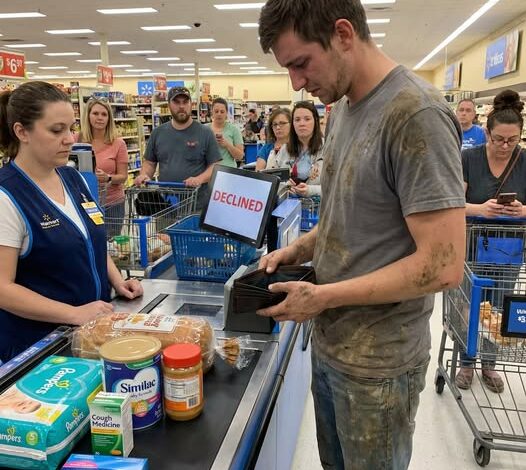
“Run it again,” the young father said, trying to keep his voice steady.
The cashier gave a small nod and slid the card through once more.
Declined.
It wasn’t loud, but it landed hard enough for everyone in line to hear.
He stood there frozen for a moment, shoulders tight, like maybe if he didn’t move, the outcome would change. He looked like he’d come straight from work—gray shirt worn thin at the seams, streaked with dirt, jeans stiff with dried mud, steel-toe boots leaving faint debris on the polished grocery floor.
His cart wasn’t full. That was the part that made it worse.
Two cans of baby formula. A box of diapers. White bread. Peanut butter. A bottle of cough medicine. A pack of sanitary pads.
Nothing unnecessary. Nothing extra.
The total wasn’t high. It was the kind of amount most people swipe for without thinking twice. But standing there, watching him, it was clear that for him, it might as well have been everything.
Behind me, the line started to shift with quiet impatience. People sighed under their breath. Someone checked their watch in an exaggerated way, as if he were personally stealing their time. A man farther back muttered something sharp and dismissive.
I wasn’t in the best mood either. My knees ached from standing too long, and the frozen food in my cart was already starting to soften. I’d done my own mental math before getting in line—I had just enough money to make it through the week if nothing unexpected happened.
So yes, I was irritated.
At first.
Then the young father reached forward and started removing items from the conveyor belt.
“Take off the peanut butter,” he said quietly.
The cashier paused but nodded, setting it aside.
“Take off the bread too.”
His voice got tighter with each word, like he was holding something back.
He hesitated when his hand reached the pack of sanitary pads. He stared at them for a second longer than necessary, jaw clenched, then pushed them away as well.
“And those.”
The cashier looked at him, uncertain now.
He let out a short laugh that didn’t sound like humor at all. It sounded like something breaking.
“My wife had the baby six days ago,” he said, not looking at anyone. “She’s still bleeding pretty bad. We ran out.”
The shift in the room was instant.
The quiet irritation dissolved into something heavier. Nobody sighed. Nobody checked their watch. Nobody said a word.
He kept talking, faster now, like once it started, he couldn’t stop it.
“The formula has to stay,” he said, pointing. “And the diapers. And the medicine. Our little girl’s got a fever, and my wife can’t drive yet. I just got off a double shift. I get paid tomorrow. There should’ve been money in there.”
He swiped the card again.
Declined.
That was when I noticed his hands.
They were rough in a way you don’t fake. Knuckles split open. Skin cracked along the fingertips. The kind of damage that comes from working hard in cold air, with materials that don’t forgive mistakes. Cement, wood, something like that.
Those weren’t the hands of someone careless.
Those were the hands of someone who had done everything right—or at least everything he knew how to do—and still ended up here.
And suddenly I wasn’t just looking at him.
I was looking at a memory.
Thirty years earlier, my husband standing in a checkout line just like this one, holding a pack of diapers, trying not to look as desperate as he felt. Our son was a newborn then, crying through the nights with colic, and the bills had piled up faster than the paychecks came in. I remember the look on his face when the numbers didn’t work.
Back then, nobody stepped in.
We managed. We always did. But it came at a cost. I remember tearing old towels into squares because we couldn’t afford enough diapers. I remember stretching meals, skipping things we needed, pretending it wasn’t as hard as it was.
Standing there now, watching this young man, it all came back with a clarity I hadn’t felt in years.
Before I could talk myself out of it, I reached into my wallet and pulled out the emergency cash I kept tucked behind my license.
A hundred dollars.
Money I had been saving for my own prescription refill.
I stepped forward slightly and tapped the edge of his cart.
“Sir,” I said, holding the bill out just enough for him to see, “you dropped this.”
He turned, confused at first, then looked at the money, then back at me.
His eyes were already red, but now something in them shifted.
“I didn’t drop that,” he said quietly.
“Yes, you did,” I replied, a little firmer this time. Not for me—for him. Because I knew what pride feels like in a moment like that, how easily it can shatter under the weight of being seen.
“It fell out when you grabbed your wallet. I saw it.”
For a second, he didn’t move.
We both knew exactly what was happening.
He knew I was giving it to him. I knew he knew.
And in that pause, there was a choice.
Then his jaw tightened, and he reached out, taking the bill with a hand that trembled so badly it nearly missed mine.
He didn’t argue again.
He turned back to the cashier.
“Put the bread back on,” he said.
There was a small pause, like he was deciding how much he was allowed to need.
“And the peanut butter.”
He glanced at the items he had pushed aside earlier, then nodded toward them.
“And those too.”
The cashier didn’t say a word. She just scanned everything back in, her movements slower now, more careful somehow.
When the transaction went through, he gathered his bags one by one, like he was trying to hold himself together at the same time.
He walked past me on his way out.
He didn’t say thank you.
He couldn’t.
Some things are too heavy for words in a moment like that.
But he gave a small nod. His chin dipped, eyes still bright, shoulders slightly hunched like he was carrying more than just groceries.
That nod said everything.
It said he understood. It said he would remember. It said he was doing his best in a world that doesn’t always make room for that.
I stayed in line, quieter now, with less money in my wallet than I had planned.
But something inside me felt settled in a way it hadn’t for a long time.
That week, I stretched what I had left. I made simple meals, ate more soup than usual, adjusted where I needed to.
And not once did it feel like a sacrifice.
Every bite felt earned in a different way—not because of what I gave up, but because of what I chose.
Because sometimes, the smallest act can reach further than anything else you spend your money on.
And sometimes, helping someone else carry a moment like that gives you something back you didn’t even realize you were missing.