The Silent General!
Seventeen years is more than just a passage of time; it is a transformative epoch. It is the duration required for a sapling to mature into a sprawling shade tree, for a child to navigate the complexities of becoming an adult, and for a jagged, emotional wound to settle into a numb, white scar. My name is Elias Davis, and for nearly two decades, I have existed as little more than a ghost in the hallowed history of the Davis family—a name whispered in hushed tones of disappointment, if it was mentioned at all.
I sat in the rear of a rented town car, watching the familiar, curated landscape of Connecticut unfurl beyond the glass. The iron gates, the impossibly manicured lawns, and the ancient oak trees that had witnessed the Revolution remained frozen in a state of terrifying stillness. It was a world preserved in amber, a testament to a social order that had rejected me the moment I chose a path that didn’t involve a ledger or a hedge fund. I checked my watch: 1800 hours. The reception was beginning.
I was never intended to return to this world. When I was nineteen, my father, Richard Davis, had presented me with a cold ultimatum in his study—a room that perpetually smelled of expensive scotch and cedar. I had told him I was enlisting in the Army, foregoing the Ivy League trajectory he had meticulously planned. He didn’t raise his voice; in his world, shouting was a sign of poor breeding. Instead, he looked at me with a devastating, clinical disappointment. He told me that if I walked out that door to be a “grunt,” I would be choosing to be nothing. I left that night with a single duffel bag, walking three miles through a torrential downpour to the bus station. I never looked back.
Two months ago, however, a heavy cream envelope reached my secure mailbox in D.C. It was addressed simply to “Mr. Elias Davis.” No rank, no title, just a name. It was an invitation to my younger brother Julian’s wedding. Julian had been a ten-year-old boy when I disappeared; now, he was the golden child who had followed the rules. I held no resentment toward him. The anger that once fueled me had burned out long ago in the arid deserts of the Middle East, replaced by the cold, hard discipline of command.
As I stepped out of the car at the Fairmont Estate, the air was thick with the scent of expensive perfume and the quiet hum of a string quartet. I adjusted my charcoal suit—tailored, but devoid of any visible medals or insignia. Tonight, I wasn’t a tactician or a commander; I was just a brother. Yet, as I walked toward the ballroom, my heart hammered against my ribs. I had led men through active fire zones and briefed the President in the Situation Room, but the judgment of my own father remained the one battlefield I hadn’t mastered.
The ballroom was a cavern of crystal and white roses, an elegant but suffocating space where silence was a weapon. I stood near the periphery, recognizing faces from a lifetime ago—neighbors and business associates who looked softer, older, and perpetually bored. I saw Julian at the front, looking happy but nervous. Then, I heard the voice that had haunted my youth.
“Elias?”
Richard Davis stood before me. He had aged, but he wore his years like bespoke armor. He didn’t offer a hand or a smile. He simply scanned me, looking for the failure he had predicted seventeen years ago. “I didn’t think you’d actually come,” he said, his voice smooth and laced with venom. He took a power step into my personal space, an intimidation tactic I had seen warlords use with less finesse.
“Hello, Father,” I said, my voice steady.
He smirked, glancing at my unpretentious attire. “Buying a suit off the rack? Trying to blend in? Let’s be clear, Elias: Julian begged for that invite. If it weren’t for pity, you wouldn’t be here. You’re just a curiosity—the prodigal son who amounted to nothing.”
I looked him in the eye, refusing to flinch. The boy he was insulting had died in boot camp. “Enjoy the wedding, Richard,” I replied. I turned away, denying him the confrontation he craved.
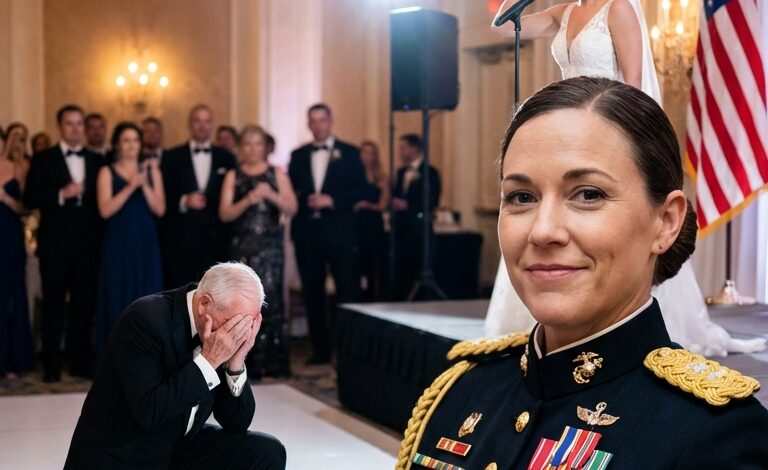
The ceremony was a blur of tradition until I saw the bride, Sophia Miller. Her family was “old money,” but as she stood at the altar, I noticed the way she carried herself. Her back was ramrod straight; her chin was perfectly level. When her eyes swept the room, it wasn’t the gaze of a debutante—it was the high-stakes situational awareness of a soldier. Then, the realization hit me: Captain Sophia Miller. Three years ago, during the Kabul evacuation, she had been the logistics officer who had successfully navigated a civilian convoy through a lethal blockade. I had been the one-star General who signed her commendation.
Our eyes met across the room. For a fraction of a second, her composure wavered. I gave her a nearly imperceptible nod. She swallowed hard, her hands trembling slightly against her bouquet. She knew exactly who was sitting at Table 24—the “overflow” table near the kitchen doors where my father had relegated me.
During the reception, the air was filled with speeches about legacy and bloodlines. Then, Sophia took the microphone. She looked at the head table, specifically at Richard, and her voice took on a sharp, authoritative edge. “My father-in-law spoke about legacy tonight,” she began. “But legacy isn’t just about what we inherit. It’s about what we serve. It’s about sacrifice.”
The room went silent. This was not the expected bridal toast. Sophia turned away from the head table and looked directly at me. “There is one person here who embodies that sacrifice more than anyone I have ever known. A man whose reputation is built on the lives he has saved.”
Across fifty feet of polished floor, the bride of the Davis dynasty snapped a crisp, perfect military salute. “Please raise your glasses,” she announced, her voice booming through the hall, “to celebrate Major General Davis.”
The silence that followed was heavy and physical. The title “Major General” hung in the air like a thunderclap. My father’s preening smile didn’t just fade; it petrified. He looked like a statue that had just sustained a structural crack. I stood up by instinct—you never leave a fellow soldier hanging—and returned the salute with the slow, deliberate precision of my rank.
“General,” she said, “it is an honor to have you here.”
“The honor is mine, Captain,” I replied.
The whispers began instantly, a frantic current of shock and realization. Senator Blaine, a man my father had spent years unsuccessfully courting, stood up and buttoned his jacket. He ignored my father entirely, stepping away from the head table to walk toward the back of the room, toward the man my father had called “nothing.” In that moment, the iron gates of the Fairmont Estate didn’t seem quite so impenetrable, and the ghost of Elias Davis finally took his place among the living.