The Hidden Meaning of SSSS on Your Boarding Pass!
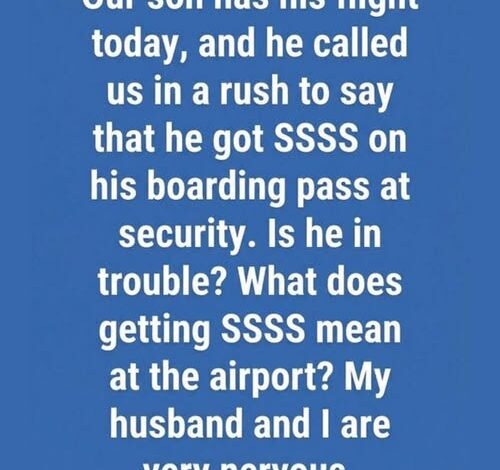
The modern airport experience is a choreographed dance of logistics, caffeine, and mild anxiety. You navigate the labyrinth of check-in kiosks, drop your luggage into the abyss of the conveyor belt, and finally secure that rectangular slip of thermal paper: your boarding pass. Usually, you scan it for the essentials—gate number, boarding group, seat assignment. But occasionally, a traveler will look down and find four bold, capitalized letters printed near their name that seem to hum with a quiet, bureaucratic menace: SSSS.
While most frequent fliers may go their entire lives without seeing this code, its appearance can trigger a wave of confusion or even panic. Is it a mistake? Are you being watched? Has a clerical error landed you on a government list of suspicious characters? The reality is rarely that cinematic, but the presence of SSSS is a significant indicator that your journey through the terminal is about to become considerably more complicated. To navigate the experience smoothly, it is essential to understand the mechanics of the “Secondary Security Screening Selection.”
Deconstructing the Code: What Is SSSS?
At its core, SSSS is an acronym for Secondary Security Screening Selection. It is a designation used primarily by the Transportation Security Administration (TSA) in the United States, operating under the broader umbrella of the Department of Homeland Security (DHS). When these letters appear on your boarding pass, the automated “Secure Flight” system has flagged your profile for an enhanced level of scrutiny that goes far beyond the standard walk-through metal detector or body scanner.
It is important to dispel the most common myths immediately. Being flagged for SSSS does not mean you are on the “No-Fly List.” If you were truly barred from aviation, the system would prevent the issuance of a boarding pass entirely. It also does not necessarily mean you are a criminal suspect or that you have done something “wrong.” Instead, it indicates that your specific travel profile for this specific flight has triggered a requirement for a deeper, more invasive layer of security.
The Anatomy of the Secondary Screening Process
If you find those four letters on your pass, the “normal” airport experience effectively ends at the check-in counter. One of the first signs of a flag is the inability to use mobile boarding passes or home printing. Most SSSS travelers are forced to check in at the airport desk so an agent can verify their physical ID and travel documents.
Once you reach the security checkpoint, the process shifts into high gear. While the standard passenger might spend two minutes in the screening lane, an SSSS passenger should prepare for an additional 10 to 30 minutes of intense inspection. This typically involves:
- Detailed Pat-Downs: A more thorough manual search of your person conducted by a TSA officer of the same gender.
- Explosive Trace Detection: Swabbing of your hands, the waistband of your clothing, and the interior of your bags to test for microscopic residue of explosive materials.
- Full Luggage Inspection: Every item in your carry-on may be removed, opened, and inspected. This includes flipping through books, opening toiletry kits, and examining the linings of suitcases.
- Electronic Verification: You may be asked to power on every electronic device you possess—laptops, tablets, cameras, and even external batteries—to prove they are functioning devices and not disguised threats.
The Algorithm’s Logic: Why Me?
The most frustrating aspect for many travelers is the seeming randomness of the selection. While the TSA does not publish the exact “weights” assigned to different risk factors, aviation experts point to several common triggers.
1. Random Selection
A vital component of effective security is unpredictability. If only “suspicious-looking” people were screened, a sophisticated threat could easily bypass the system. Therefore, the algorithm intentionally selects a percentage of passengers completely at random to ensure that no one—regardless of their background—feels entirely exempt from scrutiny.
2. Unusual Travel Patterns
The “Secure Flight” system looks for anomalies. Booking a high-priced international flight with cash, purchasing a one-way ticket to a foreign destination at the last minute, or traveling to regions currently experiencing geopolitical instability can all act as “tripwires” for the algorithm. These aren’t illegal actions, but they mirror historical patterns associated with security risks.
3. Name Similarity and Watchlists
This is perhaps the most common reason for “repeat offenders.” If your name is “John Smith” or “Mohammad Khan,” and a person with a similar name and date of birth is on a government watchlist, the system may struggle to differentiate you from the intended target. Until the bureaucracy can definitively “de-conflict” your identity from the person on the list, you may find yourself flagged every time you fly.
The Redress Process: Breaking the Cycle
For the one-time traveler, SSSS is a nuisance. For the business traveler who gets flagged on every trip due to name confusion, it is a professional hurdle. Fortunately, the Department of Homeland Security provides a solution known as the DHS Traveler Redress Inquiry Program (DHS TRIP).
By submitting a redress request, you provide the government with additional identifying information—such as a copy of your birth certificate or a detailed travel history—that allows them to distinguish you from a person of interest. If successful, you are issued a Redress Control Number. Including this number in your airline profile for future bookings acts as a “clearance” signal to the Secure Flight system, significantly reducing the likelihood of future SSSS markings.
The Layered Defense Philosophy
To understand why SSSS exists, one must look at the “Swiss Cheese Model” of aviation security. No single layer—not the cockpit doors, the air marshals, nor the x-ray machines—is perfect; each has “holes” or vulnerabilities. By stacking multiple layers of defense, the goal is to ensure that the holes never align.
SSSS serves as the “unpredictable layer.” It is a deterrent designed to make potential bad actors realize that even if they pass the initial check, a secondary, much more rigorous inspection could occur at any moment. While the experience can feel like an intrusion of privacy or an inconvenience, it is a pillar of the post-9/11 security apparatus intended to keep the “sterile” environment of an aircraft truly safe.
How to Navigate an SSSS Flag
If you look down and see the four letters, the best approach is pragmatism. Arrive early—at least an extra hour before your flight—to account for the manual check-in and the time spent at the gate. Stay cooperative and calm; the officers are following a mandated protocol, and hostility will only prolong the inspection. Finally, keep your electronics charged, as a dead laptop that cannot be turned on might be confiscated or prevent you from boarding.
In the end, SSSS is a temporary hurdle rather than a permanent stain. It is a reminder of the complex, invisible systems that govern modern travel—a blend of data science, national security, and procedural rigor. While it may delay your arrival at the airport lounge, it is simply a brief chapter in the long, complicated story of global aviation safety.