The Day My Daughter Spoke Up in Court and Changed Everything!
My husband filed for divorce with the surgical precision of a corporate liquidator closing a redundant account. There were no midnight kitchen-table discussions, no tearful attempts at reconciliation, and no gradual drifting apart. There was only the sterile reality of legal papers delivered to my office on a Tuesday afternoon, accompanied by a note that requested I not make the process “difficult.” In his eyes, our twelve years of marriage had been reduced to a balance sheet that no longer added up, and I was simply an entry he intended to strike through.
He didn’t just want a dissolution of the marriage; he wanted a total victory. He requested full custody of our ten-year-old daughter, Harper, utilizing a strategy as cold as his departure. He presented himself as the paragon of stability—the steady, dependable provider—while quietly and systematically casting me as the “unstable” element in Harper’s life. In the courtroom, he was a masterpiece of curated composure. He sat neatly dressed, speaking in measured, reasonable tones, never once meeting my gaze. To him, the life we had built was already archived, and I was merely a lingering litigation risk.
I sat at the petitioner’s table, stunned into a state of hollowed-out silence. I tried to reconcile the man I had loved with this stranger who spoke about our partnership as if it were a failed merger. I wanted to scream, to explain the years of late nights I spent working to ensure our bills were paid, the careful budgeting I managed so Harper never felt the pinch of his impulsive spending, and the way I absorbed every ounce of his volatile stress just so she wouldn’t have to. But courtrooms are not designed to reward the messy, emotional reality of motherhood. They reward the appearance of order. Every time I felt my throat tighten with the urge to defend myself, I bit my lip and stayed silent, feeling more invisible with every passing minute under the judge’s unblinking, unreadable stare.
Harper sat beside me, a small, fragile figure in the cavernous room. Her hands were folded neatly in her lap, her feet dangling several inches above the floor in a way that made her look even younger than she was. I had fought to keep her out of that room, fearing the psychological toll of watching her parents tear one another apart, but her father had insisted. He claimed it would “help the court see the truth,” likely believing that his daughter’s silence would be interpreted as his own endorsement.
The air in the room was thick with the scent of old paper and the sharp, clinical arguments of his attorney. They spoke of the “conflict” that supposedly surrounded Harper while she was in my care, painting a portrait of a household in disarray. I felt the walls closing in, the weight of his lies beginning to feel like fact simply because I lacked the “composure” to refute them without breaking down.
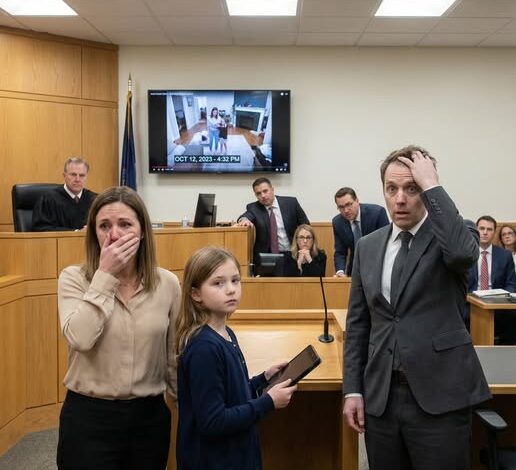
Then, the atmosphere shifted. Harper moved. It was a small gesture—a straightening of her shoulders—but it felt seismic. She raised her hand with the tentative but certain grace of a child who knows the answer in a classroom. Her voice, when she spoke, was soft, but it lacked the tremor of fear I expected.
“Your Honor?” she asked. “May I show you something? It’s on my tablet.”
The room went into a sudden, icy stasis. My husband’s lawyer was on his feet instantly, his voice a sharp bark of objection, claiming that a child had no place introducing evidence. But Harper didn’t sit down. She stood, holding her resolve with both hands, looking directly at the judge. She explained that she had been documenting things for a long time—things she had been told by her father to keep “just between us.”
The judge leaned forward, his expression softening for the first time. Over the vehement protests of my husband’s counsel, he allowed a brief recess to review the files Harper provided. My heart didn’t just race; it thundered. I hadn’t known she had the tablet with her, let alone that she had been using it as a silent witness to our crumbling lives.
The videos were not what anyone expected. There were no scenes of physical violence or explosive, cinematic drama. Instead, they were powerful because they were profoundly ordinary. The footage consisted of dozens of short clips captured over the last year. There was a video of her father promising to pick her up from play practice, only to show her sitting on the curb an hour later while his car never arrived. There were recordings of his voice, sharp and biting, echoing through the hallway as he berated me for minor perceived slights while I tried to keep my voice low so as not to wake her.
Most damaging were the “instructions.” The tablet had captured several instances where he sat Harper down and told her exactly what to say to the “nice lady from the court.” He coached her on how to describe my “sadness” and how to tell people she felt “scared” at my house. He spoke to her not as a father, but as a handler preparing a witness.
When the screen finally went dark, the silence in the courtroom was no longer clinical; it was heavy with the weight of exposure. My husband, for the first time in the entire proceeding, looked small. The curated mask of the “dependable provider” had slipped, revealing the manipulative architect beneath.
The judge didn’t rule immediately, but the temperature of the case had changed. He thanked Harper for her honesty, noting that “truth often arrives without noise, but it always arrives with clarity.” He reminded the room that children are not passive observers in their own lives; they are the primary stakeholders, and they possess a moral compass that often points truer than that of the adults around them.
That day didn’t instantly fix my life. It didn’t erase the years of emotional exhaustion or the pain of betrayal. There was still a long road of legal mediation and healing ahead of us. However, it fundamentally shifted the ground beneath my feet. I realized that for years, I had been trying to protect Harper by staying quiet, thinking that my silence was a shield. I hadn’t realized that Harper had been forging her own shield.
She wasn’t just a child caught in the crossfire of a divorce. She was a witness. She was a moral presence. She was a reminder that integrity doesn’t require a booming voice or a polished legal team to be heard; it only requires the courage to speak the truth when it matters most. As we walked out of the courthouse, Harper reached up and took my hand. She didn’t say anything, and she didn’t have to. The brave truth had already been spoken.
The legal fallout resulted in a significant shift in the custody arrangement. Statistics show that while mothers receive primary custody in approximately 79% of cases nationally, the introduction of documented evidence regarding “parental alienation” or coaching can drastically alter these outcomes. In cases involving high-conflict divorces, research indicates that children who are empowered to have a voice in the proceedings—when handled with therapeutic oversight—often show better long-term psychological resilience than those who are shielded from the truth but subjected to the lies.
I stopped seeing my daughter as a victim that day. I saw her as a person of immense character. My husband had tried to close our account with efficiency, but he forgot that the most valuable asset we had wasn’t a bank balance or a house. it was the trust of a child who had been watching all along.