The Christmas Moment That Showed Me What Real Support Looks Like!
For years, my visits to my in-laws’ home during the holidays were governed by a rigid, invisible architecture of politeness. It was a carefully maintained stage where we all performed our roles: the dutiful daughter-in-law, the gracious hosts, and the harmonious family unit. We lived by an unspoken script that prioritized the “peace” above all else—a peace that was usually bought at the cost of my own comfort. I had learned to navigate the subtle undercurrents of tension, to smile through the backhanded compliments, and to ignore the quiet hum of disapproval that seemed to vibrate beneath the tinsel and the warm glow of the Christmas tree. But that particular Christmas, the facade didn’t just crack; it dissolved entirely, revealing the true strength of the man I had married.
The evening began like any other, wrapped in the sensory comforts of the season. The house smelled of roasted pine and expensive spices, and the dining table was a masterpiece of heirloom china and flickering candles. Yet, despite the festive atmosphere, I felt a familiar, nagging sense of displacement. I felt like a guest in my own life, waiting for the inevitable moment when the conversation would turn into a subtle interrogation. When my mother-in-law stood at the head of the table and suggested we pause for a family prayer, I bowed my head, expecting the usual platitudes about health, happiness, and gratitude.
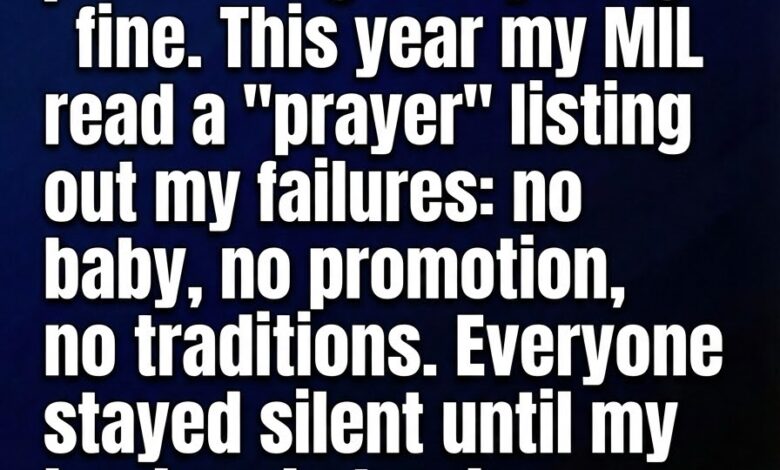
Instead, the prayer became a weapon. Her voice, usually soft and melodic, took on a rhythmic, pointed quality. As the room fell into a heavy stillness, her words began to weave a narrative of “correct” living. She prayed for the lost to find the “proper” path, for stalled careers to finally move forward into “respectable” territories, and for families to grow in the “right and traditional” ways. She spoke of expectations unmet and the wisdom of following the footsteps of those who came before. With every carefully curated phrase, the air in the room grew thinner. I didn’t need to look up to know that her eyes were not closed in spiritual devotion, but were likely fixed on me. The “hopes” she was articulating were not general petitions to the divine; they were specific, pointed indictments of my life, my choices, and our marriage.
When she finally finished, the silence that followed was suffocating. It was the kind of silence that signals complicity. No one at the table challenged the subtext. My father-in-law began to serve the potatoes, and the clinking of silverware against porcelain sounded like small explosions in the quiet. Eyes remained lowered, fixed on napkins and empty plates, as if by ignoring the elephant in the room, they could pretend it didn’t have its foot on my chest. I felt a wave of profound isolation wash over me. In that moment, I wasn’t just being judged; I was being erased. I debated the merits of my usual strategy: endure, swallow the lump in my throat, and wait for the car ride home to cry. I glanced at my husband, expecting to see the same resigned stoicism I felt.
Then, the script changed. My husband didn’t reach for his fork; he reached for the back of his chair and stood up. There was no theatrical flare, no slamming of hands on the table, and no surge of visible anger. Instead, there was a quiet, granite-like resolve in his posture. He reached for his coat, which was draped over the chair behind him, and looked around the room with a steady, unflinching gaze.
In a voice that was calm, measured, and entirely devoid of malice, he addressed the assembly. He spoke about the true meaning of the holidays—not as a time for the enforcement of tradition or the airing of grievances disguised as piety, but as a time for unconditional unity. He stated, with a clarity that felt like a bell ringing in a foggy canyon, that every life unfolds at its own pace and according to its own internal logic. He gently but firmly reminded his family that love, in its truest form, does not come with a checklist of requirements. He explained that a family is not a mold meant to shape people into identical versions of a prehistoric ideal, but a safety net that catches you as you are.
The room remained silent, but the quality of that silence had shifted. It was no longer the silence of complicity; it was the silence of people being forced to confront a truth they had spent decades avoiding. His words didn’t just defend me; they redefined the boundaries of our relationship with his family. He wasn’t asking for permission to live our lives; he was informing them that the time for seeking approval had passed.
We left shortly after that. The departure was brief and polite, but the air outside felt like a different world. The winter night was crisp and biting, yet as we walked to the car, the cold felt refreshing rather than harsh. The weight that had been pressing on my shoulders for years—the weight of trying to fit into a space that was too small for me—had simply vanished.
During the drive home, the heater hummed softly against the backdrop of the dark highway. My husband reached across the center console and took my hand. He didn’t offer a grand apology for his family’s behavior, nor did he ask for praise for his intervention. He simply told me that our life, as we had built it together, was enough. He reminded me that we didn’t need the validation of a dinner table prayer to know that our choices were valid and our path was sound.
That Christmas didn’t end with a movie-style reconciliation or a tearful apology from his mother. In fact, things remained strained for a long time. But for me, it was the most successful holiday of my life. It was the moment I realized that real support isn’t about the grand, public declarations of loyalty that we see in cinema. It is found in the quiet, inconvenient moments when someone chooses to stand beside you, even when it means standing against the people they have known their entire lives. It showed me that respect is a much more valuable currency than tradition, and that being “chosen” by your partner is a daily act of courage.
I walked into that house feeling like an outsider looking in, but I walked out knowing exactly where I belonged. I realized that the “peace” I had been so desperate to keep wasn’t peace at all—it was just the absence of conflict. True peace, I learned, comes from the security of knowing that someone has your back, even when the arrows are disguised as prayers. That night, my husband didn’t just give me a holiday memory; he gave me the freedom to stop performing, and in the quiet of our own home, we finally found the “proper” path—the one we carved for ourselves.