She Fought Her Own Father for the Right to Decide Her Fate, What Happened Next Divided an Entire Country
For years, her life was not just her own.
It became a battleground—legal, emotional, and deeply personal. A struggle that unfolded not behind closed doors, but in courtrooms, headlines, and public debate. At the center of it all was a young woman who had spent most of her life fighting to be heard.
Her name was Noelia Castillo Ramos.
She was 25 years old when her story reached its final chapter. But what led her there wasn’t a single moment—it was years of pain, trauma, and a fight for autonomy that few could fully understand.
Her case didn’t just raise questions.
It forced an entire country to confront them.
From a young age, Noelia’s life was already marked by instability. Around the age of 13, as her parents separated, she entered psychiatric care. Over time, she was diagnosed with obsessive-compulsive disorder and borderline personality disorder, conditions that shaped much of her adolescence and early adulthood.
Her life became a cycle of treatment, institutions, and attempts to find stability in a system that never fully gave it to her.
By 2022, she was living in a state-supervised center for vulnerable young people in Barcelona. It was supposed to be a place of protection.
Instead, it became the setting for one of the most devastating moments of her life.
That year, she was assaulted by three men—a trauma that would permanently alter the course of everything that followed.
It wasn’t the first time.
Before that, she had endured abuse in a relationship that lasted years. There were other incidents, other moments where her sense of safety was taken from her in ways that are difficult to fully comprehend.
The accumulation of those experiences became something overwhelming.
Something she couldn’t escape.
In October 2022, she made a decision that would change her life forever. She jumped from a fifth-floor rooftop.
She survived.
But survival came with a cost.
The fall left her paraplegic, living with constant physical pain layered on top of everything she had already endured.
From that point on, her suffering wasn’t just emotional—it was physical, relentless, and inescapable.
In the final days of her life, she spoke openly about what that felt like.
She described a reality where even basic things—eating, sleeping, going outside—felt impossible. Where pain wasn’t occasional, but constant. Where exhaustion didn’t come from effort, but from simply existing in that state.
“I don’t feel like doing anything,” she said. “Sleeping is very difficult for me, and I have back and leg pain.”
Her words were direct.
Unfiltered.
She didn’t speak in abstract terms or softened explanations. She spoke about her life exactly as she experienced it—without trying to make it easier for others to hear.
And that’s what made her story impossible to ignore.
At the center of her final decision was something deeply personal: the desire to end her suffering on her own terms.
She chose euthanasia.
In Spain, where the procedure is legal under specific conditions, her case moved through the system with intense scrutiny. Every step required evaluation, confirmation, and legal approval.
And even then, it wasn’t straightforward.
Because her family didn’t agree.
Her mother, despite her pain, chose to stand beside her.
“I do not agree,” she said, “but I will always be by her side.”
It was a position rooted in love, but also in acceptance.
Her father took a different path.
He fought.
He challenged the decision legally, arguing that her mental health conditions compromised her ability to make such a choice. His case moved through courts, reaching the highest levels, including the European Court of Human Rights.
At every stage, the ruling was the same.
Noelia had the capacity to decide.
The courts recognized her autonomy, concluding that she met the legal requirements to make that decision for herself.
But legal approval didn’t resolve the emotional conflict.
For Noelia, the legal battle wasn’t just about rights—it was about being heard.
And she didn’t hold back when speaking about it.
“The happiness of a father or a mother… shouldn’t come before the happiness of a daughter,” she said.
It was a statement that resonated with some—and deeply unsettled others.
Because her case wasn’t just personal anymore.
It had become national.
Across Spain, people debated what her decision meant. Some saw it as a fundamental right—the ability to choose dignity in the face of unbearable suffering. Others questioned whether more support, more intervention, or different choices could have changed the outcome.
There was no single answer.
Only perspectives.
In her final days, what stood out most wasn’t just the decision itself—but how she approached it.
She planned it.
Carefully.
Thoughtfully.
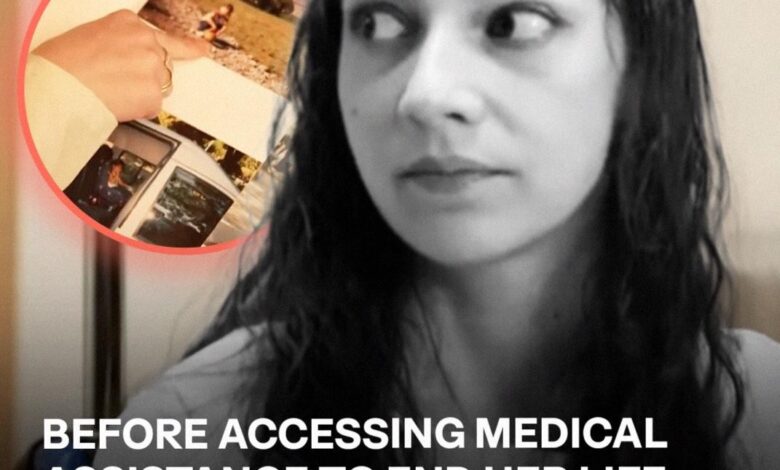
She chose four photographs to be beside her—moments from her life that represented happiness, memory, and identity. A childhood image. A memory of her dog. A moment of creativity. Pieces of a life that had once felt different.
She chose what she would wear.
“I want to die looking beautiful,” she said.
It wasn’t about appearance.
It was about control.
About deciding how her final moment would look, feel, and be remembered.
She allowed her family to say goodbye.
But when the procedure took place, she chose to be alone with her doctor.
That, too, was part of her decision.
On March 26, 2026, her life came to an end.
And with it, a story that continues to raise questions long after it ended.
Because what happened wasn’t just about one person.
It was about the boundaries between autonomy and protection. Between suffering and intervention. Between the right to choose and the responsibility to care.
Her story didn’t resolve those questions.
It amplified them.
For some, she became a symbol of personal freedom.
For others, a sign of a system that failed to offer enough support before reaching that point.
But beyond the debate, beyond the headlines, there remains something simpler.
A young woman who spent years trying to be heard.
Who made a decision based on her experience of pain.
And who, in the end, was given the right to make it.
Whether people agree or disagree, her story stays.
Not because it provides easy answers.
But because it doesn’t.