SAD! B-2 Spirit was shot down to!
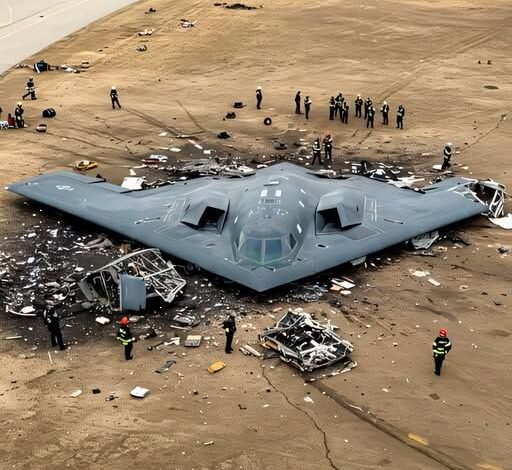
The B-2 Spirit exists in a category of its own—an aircraft wrapped in secrecy, engineering brilliance, and a reputation for near-invisibility. Over the years, countless rumors, conspiracy theories, and whispered stories have circulated about one being shot down, often fueled by misunderstandings or misreported events. But across three decades of service, no credible evidence has ever confirmed a B-2 being destroyed by enemy fire. What has happened are a handful of rare crashes—tragic, costly, and thoroughly investigated, but never the result of hostile action.
Understanding the B-2’s true operational history means looking closely at the few incidents we know about and the technology that has kept the aircraft nearly untouchable in hostile skies.
The most significant event involving the aircraft happened on February 23, 2008, at Andersen Air Force Base in Guam. It was early morning when the massive flying wing began its takeoff roll, a routine departure that spiraled into disaster within seconds. Unknown to the flight crew, moisture had seeped into the aircraft’s air data sensors—critical components responsible for feeding the flight computer precise information about speed, angle of attack, and other essential parameters.
When those sensors delivered corrupted data, the onboard computers reacted as if the aircraft was flying differently than it actually was. The B-2 rotated far too early, lifting off before reaching the necessary speed. As the engines strained and the aircraft clawed at the air, it stalled—a deadly situation for any plane, but catastrophic for one as huge and aerodynamically unconventional as the Spirit. Within moments, gravity won. The aircraft plunged back onto the runway and burst apart. Flames engulfed the wreckage.
Miraculously, both pilots ejected in time and survived. But the aircraft was gone—one of the most advanced machines ever built, lost to a mistake born of faulty data and a vulnerability no one had fully anticipated. The investigation later determined that neither pilot had committed an error. Instead, the tragedy was rooted in a software logic failure and the way the aircraft responded to incorrect sensor inputs. This marked the first time a B-2 had ever been destroyed, and its price tag—an estimated $1.4 billion—made the loss one of the most expensive aviation accidents in history.
Another serious incident unfolded years later, on September 14, 2021, at Whiteman Air Force Base in Missouri. That day, a B-2 suffered a crash landing that still remains only partially explained. Details released publicly were minimal, but what is known is that mechanical or technical issues occurred during landing, leading the aircraft to veer off the runway and sustain substantial structural damage. Once again, rumors quickly circulated—claims of enemy interference, cyberattacks, or a secret shootdown—none of which withstood scrutiny. The Air Force confirmed that no hostile action or external threat was involved.
The truth was simpler: even the world’s most advanced aircraft can suffer failures, and even with immense redundancy, things can go wrong.
These incidents illustrate something important. The B-2 Spirit, despite being designed for penetrating the most dangerous airspace on Earth, is still a machine—complex, sensitive, and unforgiving when systems fail. But when it comes to being shot down, the facts remain unchanged: no adversary has ever successfully brought one down. And there are compelling reasons why that is.
The B-2’s design begins with its iconic flying wing shape—a silhouette engineered explicitly to scatter radar waves instead of reflecting them. Conventional aircraft create large radar signatures due to vertical stabilizers, protruding engines, or uneven surfaces. The B-2 has none of that. Its smooth, flowing surfaces reduce detection dramatically. Combined with radar-absorbing materials baked into the skin of the aircraft, its radar cross-section becomes comparable to that of a small bird, even though the aircraft spans 172 feet from wingtip to wingtip.
Its infrared signature is equally suppressed. By embedding the engines deep within the wing structure and channeling heat through carefully shaped exhaust systems, the aircraft hides the thermal cues missiles usually lock onto. The B-2 doesn’t just avoid radar—it avoids heat-seeking systems as well.
Electronic warfare capabilities strengthen that invisibility even further. The aircraft carries advanced systems capable of jamming, confusing, or spoofing enemy radar and missile guidance. Even if a sophisticated air defense system manages to detect a faint trace of the bomber, keeping lock on it becomes a near-impossible challenge. The aircraft is constantly shifting its electronic footprint, altering its appearance to enemy sensors.
Altitude also plays a role. The B-2 flies high—far above the range of many surface-to-air missiles and outside the envelope of most interceptors. And unlike other large bombers, the Spirit does not rely on brute force or speed. Its greatest strength is the ability to slip through airspace without anyone ever realizing it was there.
But the real magic lies in the mission planning. Before a B-2 even leaves the ground, analysts map out the flight path with extraordinary precision. Satellites, intelligence databases, and predictive modeling pinpoint every radar system, every potential threat, and every angle from which the aircraft might be exposed. The result is a tailor-made route that avoids danger zones entirely. The aircraft isn’t just stealthy—it’s strategic.
This combination of stealth shaping, materials engineering, thermal masking, electronic deception, altitude, and planning makes the idea of shooting down a B-2 more fantasy than feasibility. Even modern, highly advanced air defense systems struggle to track it. Older systems don’t stand a chance.
That is why, in decades of missions—from training flights to combat operations—the B-2 has flown deep into hostile territory without being touched. It isn’t invulnerable. No aircraft is. But it is engineered to be as close to uncatchable as anything built by human hands.
Crashes have happened, and each one led to deeper understanding and refinement. But being shot down? Despite the rumors, despite the conspiracies, despite the dramatic speculation—it has never happened. And given the aircraft’s capabilities, the chances of such an event remain extraordinarily slim.
The B-2 endures not as a myth, but as a testament to what meticulous engineering, strategic foresight, and relentless innovation can create: a machine that redefines what it means to be unseen, and a legacy that continues to influence modern stealth aircraft to this day.