Popes unsettling one-word message!?
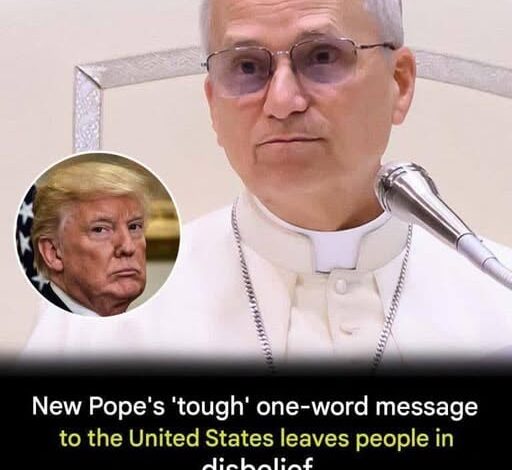
In the rapidly evolving digital landscape of 2026, where political discourse is often characterized by exhausting verbosity and carefully focus-grouped rhetoric, the papacy of Leo XIV has introduced a startling new economy of language. On March 1, 2026, the global media cycle was arrested by a single word posted from the pontiff’s official account. Responding to a query regarding the challenges currently facing the United States and the broader Western world, Pope Leo XIV—formerly known as Cardinal Robert Francis Prevost—replied with a solitary, unsettling word: “Many.”
This viral interaction has done more than just trend on social media; it has functioned as a theological and political “x-ray,” exposing the raw nerves of contemporary society. In an era where leaders often over-explain to the point of obfuscation, Leo XIV’s brevity stood out as a masterfully crafted provocation. It was a signal that the Vatican remains not only acutely aware of the complexities of the American experience but is also prepared to address them with a moral seriousness that transcends partisan soundbites.
The Architect of Modern Moral Clarity
To understand the weight of this one-word message, one must look at the man behind the ring. Before ascending to the Chair of St. Peter, Robert Francis Prevost was a figure defined by his vocal and often courageous advocacy for the marginalized. As the former head of the Dicastery for Bishops, he developed a reputation for prioritizing pastoral care over bureaucratic rigidity. His history is deeply rooted in the defense of migrant rights and a rigorous application of social justice principles that frequently put him at odds with the political establishment in Washington.
Leo XIV’s previous criticisms of the policies of the second Trump administration—particularly those concerning immigration and the deportation of international students—established him as a leader willing to confront secular power in the name of human dignity. For this Pope, the defense of a migrant is not a political talking point; it is a non-negotiable theological imperative. By responding with “Many,” he was not deflecting a complex question, but rather opening a cavernous door to a discussion about the sheer volume of societal fractures he observes from the Vatican.
The Power of Intentional Ambiguity
The brilliance of the reply “Many” lies in its refusal to be confined by partisan expectations. In the polarized environment of 2026, a specific list of grievances would have allowed various political factions to either claim the Pope as an ally or dismiss him as an adversary. Instead, Leo XIV utilized a form of “intentional ambiguity” that functions as both a subtle rebuke and a universal invitation to reflection.
When the Pope says “Many,” he is acknowledging the breadth of the crisis: the erosion of economic justice, the rising tide of global conflict, the environmental emergency, and the decay of civil discourse. It is a whisper with the weight of an encyclical. This approach allows him to resist simple ideological labels. While he has consistently challenged right-wing rhetoric on xenophobia and nationalism, he has been equally unsparing in his critiques of the Democratic Party, particularly regarding its stances on the sanctity of life and its occasionally narrow focus on secular materialism.
A Lineage of Nuance: From Leo XIII to Leo XIV
The choice of the name Leo is itself a profound signal of intent. The current pontiff is widely seen as the spiritual and intellectual heir to Pope Leo XIII, the 19th-century leader who authored Rerum Novarum. Like his namesake, who navigated the turbulent waters of the Industrial Revolution by balancing the rights of labor with the legitimacy of personal ownership, Leo XIV represents a deeply Catholic, nuanced approach to social ethics.
He is a Pope who understands that the modern world cannot be saved by slogans. In his 2026 interactions, he consistently emphasizes that the solutions to “Many” problems will not be found in the victory of one political party over another, but in a fundamental reorientation of the human heart toward the common good. His digital presence reflects this mix of moral clarity and political engagement, proving that the ancient institution of the Church can still command the attention of the modern, screen-saturated world.
The Global Reaction: Silence and Scrutiny
The “unsettling” nature of the message has prompted emergency sessions among diplomatic advisors and religious scholars alike. In America, where the 2026 landscape is dominated by the “student deportation campaign” and military coalitions, the Pope’s “Many” was interpreted as a direct commentary on the country’s spiritual and social health. It told the world that the papacy is paying attention, but it will not be used as a tool for partisan warfare.
Critics on both the left and the right have struggled to categorize this papacy. To the right, he is a “radical advocate” for the displaced; to the left, he is a “traditionalist” who refuses to yield on core moral doctrines. Leo XIV seems comfortable in this crossfire, viewing it as evidence that he is successfully treading the narrow path of the Gospel. By refusing to over-explain, he forces his audience to look inward—to ask themselves which of the “many” challenges they are contributing to, and which they are helping to solve.
Conclusion: A Pastoral Force in a Volatile Era
As the news cycle moves on to the next crisis—whether it be a stealth bomber loss in Guam or a military helicopter crash—the echo of the Pope’s one-word message remains. It serves as a haunting reminder that in the face of overwhelming complexity, the first step toward a solution is an honest acknowledgment of the scale of the problem.
Pope Leo XIV has announced himself as a force that will be impossible to ignore. His papacy is proving to be pastoral in its concern for the individual, provocative in its challenge to the powerful, and profoundly unpredictable. In just one word, he has signaled that the Church will not be a silent spectator to the upheavals of 2026. Instead, it will be a constant, nagging voice of conscience, reminding a fractured world that its problems are indeed many, but the call to dignity is singular and absolute.
The weight of “Many” will likely define the coming years of his leadership. It is an opening gambit in a long-term strategy of moral engagement, suggesting that while the challenges are numerous, the Vatican’s readiness to speak to them with moral seriousness is equally vast. In the silence that followed his post, the world was left to contemplate its own reflection, guided by a Pope who knows that sometimes, the loudest way to speak is to say almost nothing at all.