Patel Heaps Praise On FBI Agents Over Uptick In Arrests!
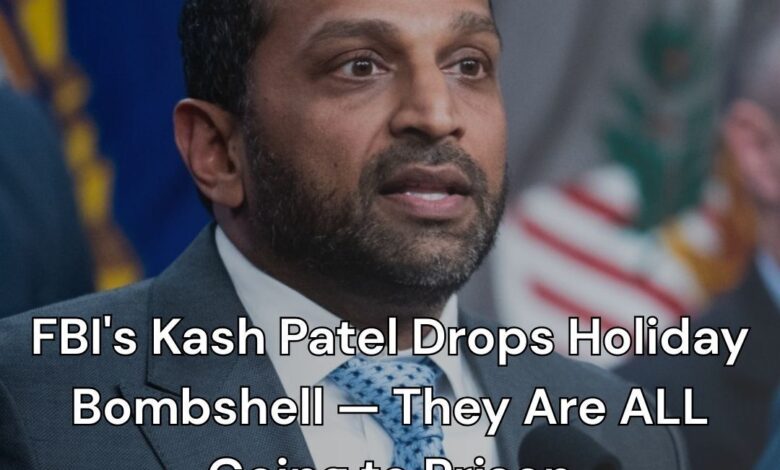
In the dense, winter fog of Illinois, a localized mission known as Operation Safe Christmas transitioned from a standard tactical maneuver into a rare, high-profile moment of public validation for federal law enforcement. FBI Director Kash Patel, stepping into a spotlight that often burns with the friction of political scrutiny, utilized the success of the operation to heap significant praise upon his agents. This wasn’t merely about the numbers—though the numbers were formidable, with more than 60 suspects apprehended—it was about the symbolic reclamation of the streets. The sweep removed a lethal cocktail of narcotics and illegal cash, the twin fuels that drive the engine of everyday urban violence, from the hands of those who profit from chaos.
Director Patel and his team framed the Illinois operation as a definitive case study in modern policing. The narrative they projected was clear: coordinated law enforcement is not a relic of the past, but an essential shield for the present. The success of Operation Safe Christmas was attributed to a seamless synchronization between federal, state, and local agencies. By dismantling the bureaucratic silos that so often hinder information sharing, these entities were able to move in a tactical lockstep that overwhelmed criminal networks before they could adapt. For a public weary of rising crime statistics and the perceived inertia of the justice system, the operation served as a visceral reminder that when the machinery of the state is properly calibrated, it still possesses the power to push back against the tide of lawlessness.
However, while the victory in Illinois was being celebrated in the morning headlines, a far more chilling reality was unfolding in the shadows of the West Coast and the Deep South. In a frantic race against the clock, FBI agents were simultaneously working to neutralize a threat that existed on an entirely different scale of catastrophe. Spanning the vast distance between California and Louisiana, a quiet but intense intelligence operation led to the interception of an alleged terror plot with deep, radical roots.
Prosecutors have identified the suspects as being tied to a militant, pro-Palestinian offshoot of a group known as the Turtle Island Liberation Front. This was not a plan for petty crime or localized drug distribution; this was a vision of large-scale, coordinated devastation. The group allegedly envisioned a series of New Year’s Eve bombings—attacks designed to turn a night of global celebration into a theater of carnage. Furthermore, the plot included targeted assaults on Immigration and Customs Enforcement (ICE) facilities, suggesting a sophisticated ideological motive aimed at the very heart of federal infrastructure.
The juxtaposition of these two narratives—the domestic cleanup of Operation Safe Christmas and the high-stakes interception of a terror cell—presents a singular, sobering message to the American public. It reveals that the thin line between ordinary security and absolute catastrophe is far more fragile than most citizens realize. While one team of agents works to clear narcotics from a neighborhood in the Midwest, another is working in a feverish, silent struggle to prevent a coordinated bombing campaign that could alter the national psyche forever.
In the world of the FBI, success is often measured by what doesn’t happen. A city that wakes up to a quiet New Year’s Day rarely stops to consider the countless hours of surveillance, the perilous undercover work, and the frantic midnight warrants that kept the peace. The California-Louisiana plot highlights the evolution of modern threats; they are no longer confined to a single geography or a simple ideology. Instead, they are fluid, radicalized in digital Echo chambers, and capable of mobilizing across state lines with terrifying speed.
The praise offered by Director Patel in Illinois was likely intended to serve a dual purpose. On the surface, it was a necessary morale boost for a workforce that has been under intense pressure. Beneath that, it was a tactical communication to both allies and adversaries. To the public, it was a reassurance that the federal government remains a potent force for good. To the criminal and extremist elements watching from the sidelines, it was a warning that the “lockstep” of modern policing is becoming increasingly difficult to evade.
The details of the Turtle Island Liberation Front offshoot remain a primary focus for federal prosecutors. The group represents a growing trend of intersectional extremism, where various radical ideologies converge to create a volatile and unpredictable threat profile. By targeting ICE and planning bombings during a high-profile holiday, the group sought maximum psychological impact. The fact that agents were able to intercept the plot “quietly” is a testament to the sophistication of current counter-terrorism protocols, which prioritize the neutralization of threats long before they reach the stage of execution.
As the legal proceedings begin for the suspects in both the Illinois sweep and the terror plot, the broader conversation around public sector efficiency and law enforcement continues to evolve. Critics often point to the high costs of federal agencies, but proponents of the current leadership argue that the “ROI” of an averted terror attack or a cleaned-up neighborhood is immeasurable. The narrative coming out of Washington is one of aggressive proactivity. The goal is no longer just to respond to crime, but to anticipate and dismantle the networks that produce it.
Operation Safe Christmas may have been the story that captured the public’s imagination with its tangible results and local impact, but the silent victory in California and Louisiana is arguably the more significant achievement for national stability. It underscores the dual reality of the modern FBI agent: they are simultaneously the local beat cop on a global scale and the silent guardian against existential threats.
The thin line of security is maintained through a relentless cycle of intelligence gathering and tactical execution. It is a world of constant vigilance where a single missed signal could lead to disaster. As Director Patel continues his push for a more efficient and integrated federal response, the successes of the past week will likely serve as the blueprint for future operations. The message remains steadfast: whether the threat is a street-level drug ring or a multi-state terror cell, the goal is to move faster, smarter, and with more coordination than the forces that seek to undermine the social order.
In the final analysis, these two stories are not separate incidents, but different fronts in the same ongoing struggle. They reflect a nation that is constantly being tested, protected by a machinery of law enforcement that must remain invisible to be effective. The praise heaped on the agents in Illinois was a rare moment where the curtain was pulled back, allowing the public to see the faces of those who stand on that thin line every day, ensuring that for most Americans, the transition from one year to the next remains a celebration rather than a tragedy.