My Neighbor Dumped a Bucket of Paint over My Car at 2 AM By Breakfast, Three Police Cars Were Outside Her House
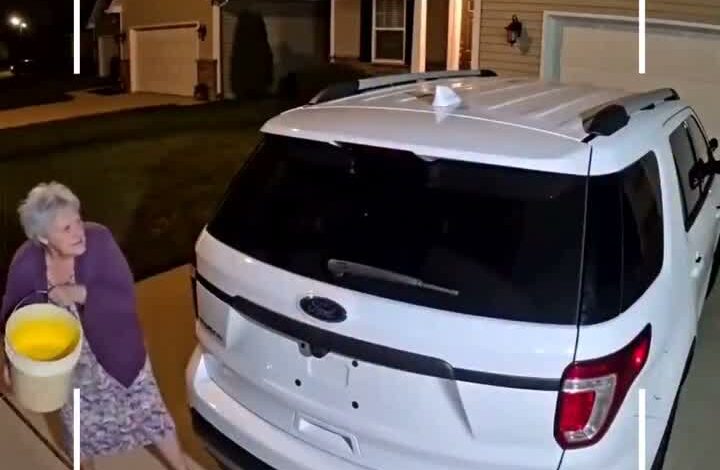
My neighbor dumped yellow paint over my SUV in the middle of the night after I had her car towed. By breakfast, police were already searching her garage, but the paint she used exposed something far more serious than vandalism.
The first thing I noticed was the color: bright yellow.
The kind of yellow that looked almost unreal against my SUV’s white paint.
At 2:13 that morning, I had woken to a metallic clang outside.
I remember checking the clock because I was irritated before I was scared.
Then I looked through the bedroom window.
She disappeared toward her house before I even processed what I was seeing.
I threw on a robe and went downstairs.
There was an empty bucket beside my car.
Yellow paint covered the hood, windshield, driver’s side door, and part of the rear quarter panel.
For a few seconds, I just stood there.
Then I started laughing because the whole thing was so absurd that my brain didn’t know what else to do.
The space beside my garage was narrow, but it was mine.
It was clearly on my property, and I used it whenever I needed to park my SUV outside instead of in the garage.
Linda had decided, for reasons known only to her, that the strip was “basically shared.”
She would park there when visitors came over.
She would let her adult son, Tyler, leave his truck there.
Once, I came home and found a landscaper she’d hired using the space to unload equipment.
“Linda, can you please move your car?”
She would sigh. “You’re not even using the garage side.”
“That’s not the point.”
“Then what is the point?”
“It’s my driveway.”
That never seemed to satisfy her.
She laughed when she saw it. “You are unbelievable.”
“I’ve asked you six times.”
“You have plenty of room.”
“So do you.”
Her driveway was larger than mine.
This wasn’t about space.
It was about Linda deciding she should be able to do something because nobody had stopped her yet.
Last week, I finally stopped asking.
I came home from work and found her SUV parked beside my garage again. Linda wasn’t home.
I called a towing company. Forty minutes later, her SUV was gone.
I heard her before I saw her.
“What did you do?”
I stepped outside.
“I had it towed.”
Her face went red.
“You had my car towed?”
“You could’ve called me.”
“I have called you.”
“I mean today.”
“I didn’t know where you were.”
She pointed at me. “You’ll regret this.”
I remember thinking the threat sounded ridiculous.
Running away from my ruined SUV.
I had no camera facing the driveway and no witness.
Nothing except what I’d seen from the window.
I took pictures.
A lot of them.
I also photographed the bucket.
I planned to call the police first thing in the morning because I knew a vandalism report at 2:30 a.m. might not get immediate attention unless someone was still outside.
By 7:20 a.m., I didn’t have to call anyone.
Someone pounded on my front door.
I assumed Linda had come over to deny everything in person.
Instead, when I opened the door, three police cars were outside her house.
Two officers were walking in and out of her garage.
“I didn’t do anything!”
I stepped onto my porch.
The officer who had knocked noticed me.
He moved towards my car.
“Ma’am, is the damaged vehicle yours?”
“Yes.”
“I wasn’t planning to.”
“Good.”
“Why are the police searching Linda’s house?”
He glanced toward her garage.
“That’s a separate matter.”
Before I could ask anything else, another officer emerged carrying a half-empty paint can.
It was the same bright yellow color.
Neither officer smiled.
One of them looked back at my SUV.
Then at the paint can.
Then back at the SUV.
“This isn’t about your car,” he said.
He ignored me.
Meanwhile, the older officer pointed toward the rear.
“When did you buy it?”
“Three years ago.”
“Was it new?”
“No, it was used.”
“A dealership on Route 8.”
He walked around the vehicle.
I followed.
Near the rear bumper, something in the yellow mixture had damaged part of the white finish.
I hadn’t noticed it in the dark.
Not primer. Older white paint.
The officer crouched.
Then he leaned closer.
“What is it?” I asked.
He didn’t answer.
Letters and numbers.
At first, I thought they were random.
The officer took out a small cloth and carefully wiped an edge.
More text became visible.
Two letters and then a number.
Then what looked like part of another marking near an old repair line.
He touched the radio at his shoulder.
“Get her away from the vehicle.”
My stomach dropped. “What?”
The younger officer looked at me.
“Ma’am, step back, please.”
“Why?”
I did.
He spoke quietly into his radio.
A few words and a number.
Then something about a cold case.
I felt lightheaded. “What is going on?”
He looked at me. “What’s your name?”
“Claire.”
“No.”
“Any repainting?”
“Not since I owned it.”
“You said you bought it used.”
“Yes.”
“Do you still have the purchase documents?”
“I think so.”
“Why?”
He hesitated.
Then he said, “This vehicle may be connected to an old investigation.”
“What kind of investigation?”
He looked toward the SUV.
“Possibly an old fatal hit-and-run I’ve worked on.”
He asked me to go inside and find the paperwork.
My hands shook while I searched through the filing cabinet in the kitchen.
I found the bill of sale, dealership paperwork, financing documents, and a copy of the title.
When I came back outside, there were more officers.
Linda had stopped yelling.
I handed the folder over.
The older officer introduced himself as Detective Harris.
He flipped through the papers.
“Is this dealership still open?”
“Yes.”
I waited.
“Six years ago, a nine-year-old boy named Caleb was struck and killed while crossing a residential street about 15 miles from here.”
I covered my mouth.
“The driver didn’t stop.”
He nodded. “We had traffic-camera footage from two intersections away. Poor quality. It was nighttime.”
He looked back at my SUV. “But we could make out a white SUV of this general model, along with part of a distinctive fleet marking. Same make.”
“I’m saying it may be.”
“Why?”
Harris pointed toward the exposed markings.
“After the collision, the vehicle would have had damage on the right rear side. In the footage, there was also a partial commercial fleet marking on the back quarter panel.”
I looked at the scratches.
“The letters?”
“Maybe.”
That explained his face.
He didn’t look excited.
He looked haunted.
“We enhanced every frame we could. We circulated images to repair shops. Dealers and salvage yards. Nothing.”
“Why not?”
“We don’t know yet.”
“But if someone repainted the vehicle quickly and changed paperwork, that could explain why we never found it.”
I stared at my SUV.
I had driven it to work.
To grocery stores and on vacations.
I had washed it, vacuumed it, and changed tires.
Complained about the gas mileage.
I felt nauseated.
“Am I in trouble?”
Harris looked at me immediately.
“Not based on what you’ve told us.”
“I bought it from a dealership.”
“WE’LL VERIFY THAT.”
“Please do.”
He nodded. “We will.”
Then I remembered Linda. “What are you doing at her house?”
Harris glanced over. “Her son was arrested last night.”
“Tyler?”
“Yes.”
“FOR WHAT?”
He hesitated, then answered because it would become public anyway.
“Stolen property.”
That surprised me less than it probably should have.
Tyler worked at a large commercial construction site.
According to Harris, the company had reported high-value metals missing over several months.
Copper, specialty wiring, and metal fittings.
Investigators had been watching Tyler.
He was arrested after trying to sell part of the stolen material.
Then he confessed.
He told police the rest was stored in Linda’s garage.
That was why officers were there before I reported the paint.
While searching the garage, they found the stolen materials.
And the yellow paint.
The same paint now covering my SUV.
“So she really threw paint on my car?” I said.
Harris looked at the can.
Linda was arrested later that morning on the vandalism charge.
Tyler was already in custody.
My SUV was towed too.
Not because I had done anything.
Because it was now evidence.
By lunchtime, my driveway was empty.
Linda’s house was quiet.
And I was sitting at my kitchen table trying to understand how a stupid feud over parking had turned into this.
The next few weeks were exhausting.
Detectives interviewed me twice.
The dealership owner initially insisted there was nothing unusual about the SUV.
Then investigators pulled old sales records.
The vehicle had come into the dealership shortly after the hit-and-run, a few years before I bought it.
The seller had taken far less than market value in exchange for a quick cash sale.
According to the paperwork, the dealership had listed the vehicle as having “cosmetic body damage.”
Harris called me one afternoon.
“We found the previous owner.”
I sat down. “And?”
“We’re bringing him in.”
The man’s name was Darren.
He also had ties to a contracting company that used fleet markings on several vehicles.
The partial letters under my paint matched that company.
The repair marks matched the area investigators believed had struck Caleb.
Then came the part nobody had managed to prove before.
After a grueling interrogation, Darren confessed.
He said Caleb ran into the road.
When he hit him, he panicked.
He kept going.
He told himself he would call the police later.
He never did.
Then he took it to a dealer known for buying vehicles cheaply without asking many questions.
The dealer did shoddy repair work and repainted the panel.
The dealer cleaned up the paperwork enough to make the vehicle appear ordinary.
Years later, I bought it.
When Harris told me, I cried.
I didn’t know his family.
But something about it broke me anyway.
A nine-year-old child died.
His parents spent six years not knowing who had hit him.
And the answer had been parked beside my garage.
“They finally know,” he said.
I asked, “Does it help?”
He was quiet. “Not enough.”
I understood.
Nothing would make their son come back.
At least now there was a name.
There would be charges.
There would be a courtroom.
There would be something resembling accountability.
The dealership became part of a separate investigation.
The owner claimed he didn’t know Darren had been involved in a fatal collision.
Maybe that was true.
Maybe not.
But investigators found enough irregularities in how the title and repair history were handled that the dealership faced serious consequences.
Because I had bought the SUV in good faith and investigators found serious problems with its sale history, my lawyer helped me pursue compensation from the dealership.
IT TOOK TIME.
Eventually, after the case against the dealership worked its way through the legal process, I was awarded compensation.
The SUV itself never came back.
It stayed as evidence for months and was later handled as part of the case.
Strangely, I didn’t want it back.
I couldn’t imagine sitting behind the wheel again.
She pleaded guilty to vandalism and received fines, restitution, and community service.
The irony was almost impossible to ignore.
She poured paint over my car because she was furious that I had her SUV towed.
That paint stripped away the newer finish.
That exposed the original markings.
And now a family finally knew who had killed their child.
Tyler had it worse.
The stolen construction materials were worth a lot of money.
He ended up taking a plea and serving time.
Linda blamed everyone for that.
The police, his employer, and his “bad friends.”
I’m still not sure how I entered that equation.
She never parked in my driveway again.
Mostly because after all of it, she barely spoke to me.
That was fine.
About eight months later, I saw Detective Harris at a grocery store.
“Detective.”
We stood awkwardly beside a display of canned soup.
I asked the question I’d been afraid to ask.
“How is Caleb’s family?”
He nodded slowly.
“Was there a conviction?”
“Yes.”
He told me Darren had accepted responsibility as part of a plea.
There had been a sentencing hearing.
Caleb’s parents spoke.
I swallowed. “I hope it helped.”
“What?”
“She said she could finally stop looking at every white SUV on the road.”
That sentence stayed with me.
I thought about all the years she must have spent doing exactly that.
Watching traffic. Wondering.
Searching every vehicle for some clue.
Eventually, I bought another car.
Nothing fancy.
A gray sedan with good mileage.
It was reliable.
The salesman kept trying to upgrade me to a better car.
One with leather seats, a bigger engine, and a premium package.
I wanted ordinary.
Ordinary felt wonderful.
I still live in the same house.
Linda still lives next door.
Our relationship is now mostly limited to nodding if we happen to see each other outside.
Sometimes I think about how ridiculous the chain of events was.
If Linda hadn’t parked in my driveway, I wouldn’t have called the tow company.
If I hadn’t called the tow company, she might not have gotten angry enough to vandalize my SUV.
If she had used something other than that paint, maybe the old layer would never have dissolved.
Maybe the fleet marking would still be hidden.
None of that makes what Linda did good.
It was petty, destructive, and illegal.
But consequences don’t always stop where people expect them to.
Linda thought she was ruining my week.
Instead, she exposed her own crime, drew police attention to evidence connected to an old investigation, and accidentally opened the door to solving a child’s death that had gone unsolved for six years.
I LOST A CAR.
The dealership had to pay me back.
Linda got community service.
Tyler went to jail.
Darren finally faced the law.
And Caleb’s parents got an answer they should have received years earlier.
I still can’t quite believe it.