Museum issues response after mom claims she saw sons skinned body displayed! Wow!
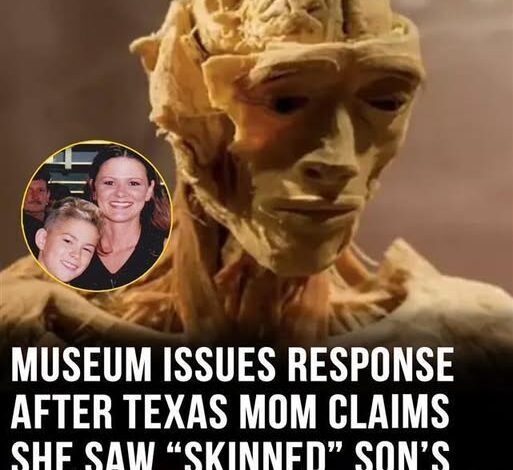
A Las Vegas anatomy exhibition has firmly rejected allegations made by a Texas mother who believes one of the plastinated human specimens on display is the body of her late son. The accusation, which has circulated online multiple times over the years, stems from a long-running and deeply personal dispute over the circumstances of her son’s death—an event she says she has never been able to fully accept.
Kim Erick’s son, Chris Todd Erick, died in 2012 at the age of 23. He was found unresponsive at his grandmother’s home in Midlothian, Texas. According to official reports at the time, medical authorities determined that Chris had suffered two heart attacks caused by an undiagnosed heart condition. The death was ruled natural, and no criminal wrongdoing was identified. His father and grandmother arranged for his cremation, and Kim later received a necklace containing what she was told were a portion of his ashes.
However, Kim has long expressed doubts about the official account. She has publicly stated that she believes aspects of the case were overlooked and that the explanation given for her son’s death did not align with her own observations. Her concerns reportedly deepened after reviewing police photographs that showed bruising and marks on Chris’s body. She interpreted those marks as possible signs of restraint or mistreatment, fueling suspicions of foul play. In 2014, a homicide investigation was opened to address her concerns. After reviewing available evidence, authorities concluded there was no basis to alter the original ruling, and the case remained classified as a natural death.
Years later, Kim’s grief and unanswered questions took a new direction. In 2018, she visited the Real Bodies anatomy exhibit in Las Vegas, a traveling educational display featuring plastinated human specimens preserved through a process that replaces bodily fluids with polymers. The technique, commonly known as plastination, allows anatomical structures to be displayed for educational purposes and has been used in similar exhibits worldwide.
During her visit, Kim became convinced that one of the figures—an anatomically posed seated specimen often referred to as “The Thinker”—closely resembled her son. She focused on specific physical details, including what she believed to be a skull fracture similar to an injury documented in Chris’s medical records. She also claimed that an area where her son once had a tattoo appeared to have been removed or altered on the displayed body. To her, these perceived similarities felt too strong to dismiss.
Exhibit organizers have consistently denied the allegation. Representatives stated that the specimen in question was legally obtained in China and had been part of the exhibit’s collection since 2004—eight years before Chris’s death. They emphasized that plastination is a lengthy and highly documented process that would make such a substitution implausible. Archived photographs, exhibition records, and timelines were cited as evidence that the displayed specimen predated the events surrounding Chris’s passing.
Kim formally requested DNA testing of the specimen to settle the matter. Museum officials declined, citing legal ownership, documentation, and prior verification of the specimen’s provenance. They maintained that all human remains displayed in the exhibit were sourced and documented according to applicable laws and ethical guidelines at the time of acquisition. Without evidence supporting her claim, organizers have stood by their records and rejected any connection to her son.
The situation intensified when “The Thinker” was eventually removed from the Las Vegas exhibition. According to museum representatives, the removal was unrelated to Kim’s allegations and part of standard exhibit rotation. Traveling anatomical displays frequently change specimens based on logistics, preservation needs, or curatorial decisions. However, for Kim, the removal heightened her suspicions. She stated publicly that the inability to track the specimen’s current location felt unsettling and reinforced her determination to pursue answers.
In 2023, unrelated developments once again reignited her concerns. Authorities in Nevada discovered hundreds of unidentified cremated remains in a desert area, prompting renewed media attention. Although investigators did not connect the discovery to the anatomy exhibit, the news deeply affected Kim and revived her fears about what may have happened to her son’s remains. She has continued to speak publicly about her doubts, driven by a conviction that she has yet to receive full clarity.
Museum officials and investigators have reiterated that documented evidence contradicts her theory. They emphasize that plastinated bodies used in educational exhibitions are subject to extensive processing timelines and recordkeeping that do not align with her claims. Legal experts have also noted that altering an existing specimen or substituting remains without documentation would be highly improbable given the logistical and ethical scrutiny surrounding such exhibits.
At the heart of the controversy lies a mother’s unresolved grief. The loss of a child can leave profound emotional wounds, particularly when questions linger about the circumstances of death. Experts in grief counseling often note that uncertainty can prolong mourning, especially when families feel excluded from decisions or doubt official conclusions. In Kim’s case, the combination of perceived inconsistencies and the visual impact of seeing a plastinated human figure intensified her distress.
Anatomical exhibitions such as Real Bodies have long been the subject of ethical debate. Supporters argue that they provide valuable educational insight into human anatomy, disease, and health. Critics question sourcing practices and consent standards, particularly in earlier decades when international regulations were less transparent. Although museum representatives insist that their collection complies with legal requirements, controversies surrounding human remains in exhibits have persisted globally.
Despite the official rebuttals, Kim continues to seek what she describes as definitive proof. Her efforts underscore the complex intersection of personal grief, institutional records, and public exhibition. While authorities and museum officials maintain that there is no evidence linking the specimen to her son, the emotional dimension of the dispute remains powerful.
The case illustrates how unresolved loss can evolve into broader questions of trust and accountability. For institutions, maintaining transparent documentation is essential. For families coping with tragedy, the need for certainty can feel urgent and deeply personal.
As of now, no evidence has emerged to support the allegation that Chris Todd Erick’s remains were ever part of the Real Bodies exhibit. Officials continue to stand by their documentation, while Kim remains steadfast in her pursuit of answers. The situation serves as a reminder that beyond legal conclusions and institutional statements, the human element of grief can shape narratives long after official investigations have closed.