Melania Trump mocked over awkward 2-word greeting to Navy sailors in rare speech
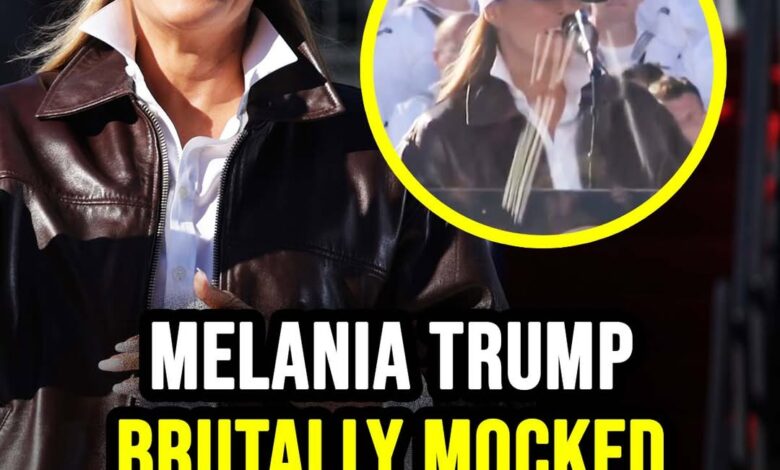
Melania Trump has once again become the center of online mockery — this time for what was meant to be a simple, spirited greeting to members of the U.S. Navy. The former First Lady appeared alongside her husband, Donald Trump, at an event commemorating the Navy’s 250th anniversary at Naval Station Norfolk in Virginia on Sunday. While many attendees praised her presence and speech, a brief moment in her introduction sparked a wave of criticism and ridicule across social media.
The event was intended to be a patriotic celebration of the Navy’s long-standing service and tradition. However, the atmosphere was reportedly strained even before it began. Donald Trump arrived over an hour later than scheduled, forcing attendees — including active-duty sailors and their families — to wait under the hot Virginia sun. When the program finally started, both he and Melania took the stage wearing their now-familiar matching caps. The former president donned his trademark red MAGA hat, while Melania wore a white version emblazoned with the word “USA.”
Melania’s outfit drew attention — a sleek brown bomber jacket paired with tailored beige pants — giving her a subtle “Top Gun” aesthetic that seemed intentionally chosen for the naval setting. Her appearance was striking, her delivery poised. But what caught everyone off guard wasn’t her attire — it was her opening words.
Stepping up to the microphone, Melania smiled at the crowd and began confidently: “Hooyah, Navy.”
The greeting — a spirited military expression commonly used by sailors and SEALs — hung in the air for a moment. A few claps followed, but then came an awkward pause that lasted longer than anyone expected. The energy in the room seemed to shift instantly.
While some in the audience responded politely, social media wasted no time reacting once clips of the moment surfaced online. Many users mocked what they saw as an awkward attempt by Melania to sound relatable or patriotic.
“Please make it stop,” one X (formerly Twitter) user wrote, sharing a video of the exchange that quickly went viral. Another added, “Cringe. Who told her this was a good idea?” A third asked sarcastically, “Did her communications team really think saying ‘Hooyah’ would win people over?”
The backlash didn’t stop there. Some commenters went further, poking fun at Melania’s famously guarded demeanor. “Now she speaks Navy,” one user quipped. “She can add that to her list of six languages.”
Others took a darker, more cynical tone. “We’ve become a sitcom,” one post read. Another joked, “ICE, we’ve got one! She’s trying to blend in!” — a jab referencing Melania’s immigrant background.
Still, not everyone was unkind. A number of supporters praised her for making an effort to connect with the military audience. “She said ‘Hooyah’ with respect and sincerity,” one commenter wrote. “People are just looking for reasons to hate her.”
After the initial reaction subsided, Melania continued her speech, striking a more traditional tone. “Generations of sailors have kept America free because of your presence on the high seas,” she said. “Your strength, bravery, and sacrifice inspire us all.” Her words were met with applause, and by the end, the room had largely recovered its composure.
But the internet never forgets — and by the time the event ended, screenshots, memes, and edited clips were already spreading across every major platform.
Critics accused the former First Lady of being “out of touch” and “rehearsed,” while supporters saw her as an easy target. It was a familiar cycle — Melania, elegant yet distant, trying to show warmth in a setting where every word is scrutinized.
For many observers, the “Hooyah” moment symbolized the ongoing struggle between her image and her actions. Melania has long been portrayed as both fiercely private and somewhat detached from the role of First Lady — a contrast to her husband’s bombastic public persona. While she often delivered speeches emphasizing unity, respect, and patriotism, her critics claimed she lacked the authenticity to make those messages resonate.
Her defenders, on the other hand, argue that Melania’s stoicism and restraint are misinterpreted as coldness. They point out that English is not her first language, and that her manner — deliberate and measured — is often mistaken for disinterest. “She’s elegant, she’s not a showman,” one supporter wrote online. “That’s Donald’s job.”
This isn’t the first time Melania has faced public ridicule for her speaking moments. During her time in the White House, she was frequently criticized for her delivery and tone. Whether it was her “Be Best” campaign — which aimed to combat online bullying — or her controversial decision to wear a jacket that read “I really don’t care, do u?” while visiting a migrant child detention center in 2018, her actions and words have consistently sparked debate.
To her fans, she’s misunderstood — a First Lady who never sought the spotlight but handled it with dignity. To her critics, she’s emblematic of everything they find disingenuous about the Trump brand — polished on the surface, but hollow underneath.
The Navy event only added to that divide. One political commentator wrote, “If Michelle Obama or Jill Biden had greeted service members that way, it would have been framed as a warm gesture. But when Melania does it, it’s automatically mocked. That says more about us than her.”
Others disagreed, saying the issue wasn’t the greeting itself but the delivery. “It’s not what she said,” another user commented, “it’s that she said it like she was reading it off a teleprompter for a toothpaste commercial.”
Still, amid the online chaos, several attendees at the event reported that Melania’s speech was well-received in person. “She was gracious and respectful,” said one Navy officer who attended the ceremony. “People clapped. It wasn’t a big deal. The internet made it sound worse than it was.”
The truth likely lies somewhere in the middle — a small, awkward moment magnified by the constant churn of online outrage.
For her part, Melania did not address the backlash. She left the stage with her husband after the ceremony, smiling and waving to the crowd before boarding a motorcade.
Donald Trump later delivered his own speech, praising the Navy’s “unmatched strength and American spirit,” though his remarks, as usual, ran over time and veered into campaign-style rhetoric.
By Monday morning, “Melania’s Hooyah” was trending online, with thousands of posts dissecting the moment frame by frame. Some called it another example of performative patriotism; others dismissed the controversy altogether, saying it was harmless.
Whether it was awkward or endearing depends on who you ask — but one thing is certain: in the age of viral soundbites, even a two-word greeting can spark a nationwide debate.
In the end, Melania’s “Hooyah” will likely join the long list of moments that define her public image — polished, poised, and perpetually caught between sincerity and spectacle.
As one commenter put it succinctly, “She tried. The crowd hesitated. The internet pounced. That’s modern politics in a nutshell.”