Meaning behind the WC sign outside bathrooms!
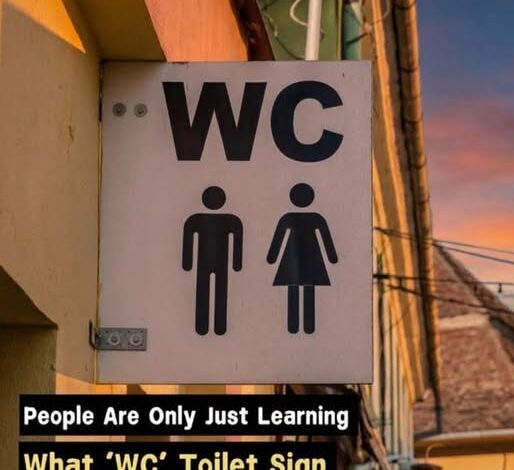
The letters “WC” posted outside a bathroom door can catch people off guard, especially when traveling abroad. For some, it’s instantly recognizable. For others, it prompts a brief pause and a moment of decoding. The abbreviation is short, clinical, and slightly old-fashioned sounding. Yet despite the confusion it occasionally causes, “WC” remains one of the most widely used and internationally understood bathroom labels in the world.
“WC” stands for “water closet,” a term that dates back to a time when indoor plumbing was still a novelty and home layouts looked very different from what we consider standard today. Historically, houses often separated washing and bathing areas from the toilet itself. The “water closet” referred specifically to a small, enclosed room that housed a flush toilet. It was not a bathroom in the modern sense. It was literally a closet-sized compartment with running water—hence the name.
Understanding this historical context clears up much of the confusion. In the late 19th century, indoor toilets were considered a luxury, primarily available in wealthier homes. When they were installed, they were often placed in a compact, private room separate from the bathing space. At that time, a “bathroom” was a room with a bathtub. A “water closet” was where the toilet was located. These were two distinct functions.
Over time, architecture evolved. As plumbing systems became more common and practical, the two spaces were merged. The modern bathroom—containing a sink, toilet, and bathtub or shower—became standard in the 20th century. Yet the terminology did not evolve uniformly across countries. Some regions adopted new words, while others retained older ones.
That’s why travelers encounter such a variety of terms today. In the United States, “bathroom” is the dominant word in everyday conversation, even when there is no bath present. Public spaces often use “restroom,” a softer, more indirect term that doesn’t literally describe what happens inside. In Canada and parts of the American Midwest, “washroom” is common, emphasizing the presence of a sink rather than the toilet. In the United Kingdom, “loo” is widely used in casual speech, while “lavatory” appears in more formal contexts. Meanwhile, much of Europe continues to rely on “WC” as a practical label.
The persistence of “WC” internationally has a lot to do with its efficiency. It is short, easy to print on signage, and widely recognized regardless of native language. In airports, train stations, hotels, and tourist attractions, clarity matters more than linguistic precision. A two-letter abbreviation avoids translation issues and crosses borders smoothly. Even if someone doesn’t know the literal meaning of “water closet,” repeated exposure makes the sign familiar.
The debate over what to call this essential space resurfaced online in recent years, including in viral social media videos where people questioned the logic behind words like “washroom” or “restroom.” Critics pointed out that most people don’t actually rest in a restroom, and not every bathroom contains a bath. The discussion highlighted how loosely language can map onto function. Words often persist not because they are perfectly logical, but because they are culturally embedded.
Language surrounding bathrooms is also shaped by social etiquette. Many English-speaking cultures prefer euphemisms over direct references to bodily functions. That preference has influenced the development of softer, less literal terms. “Restroom,” “washroom,” and even “powder room” reflect attempts to avoid bluntness. In contrast, “water closet” sounds more mechanical and technical, which may explain why it has remained common on signage but faded from casual conversation in some regions.
Architecture and technology also played a role in shaping terminology. When plumbing was new, the emphasis was on water as an innovation. A “water closet” distinguished a modern, indoor facility from older outdoor privies. The phrase signaled progress. Today, flush toilets are standard in most developed countries, so the technological marvel has become invisible. The language lingers as a historical artifact.
Cultural habits further complicate the picture. An American traveler in Europe may wonder why a bathroom sign reads “WC,” while a European visitor to the United States may question why a small public facility with only a toilet and sink is labeled a “bathroom.” Neither term is inherently more accurate. Each reflects its own historical pathway.
Online forums frequently host spirited debates about which word is “correct.” Some argue that “lavatory” is the most precise, as it refers specifically to washing. Others defend “bathroom” as the simplest and most widely understood in American English. Canadians often stand by “washroom” as a neutral, practical term. These discussions reveal how language is shaped by regional identity as much as by function.
Despite these variations, “WC” continues to serve a practical purpose in global environments. In multilingual spaces, symbols and abbreviations reduce confusion. Pairing “WC” with universally recognized restroom icons ensures clarity. In that sense, the abbreviation has become less about literal meaning and more about international usability.
Understanding the origin of “WC” adds a layer of appreciation to what might otherwise seem like a cryptic sign. It is a small reminder of how architecture, technology, and culture intertwine to shape everyday language. A simple two-letter label carries with it over a century of design evolution and shifting social norms.
What began as a technical description of a small, water-equipped compartment has become a global shorthand. The term may sound outdated in casual speech, but on doors around the world, it remains functional and effective. For travelers navigating unfamiliar cities, spotting “WC” often brings instant relief—no translation app required.
In the end, the meaning behind “WC” is less mysterious than it appears. It is a relic of architectural history that survived because it works. While debates over “bathroom,” “washroom,” and “restroom” will likely continue, the water closet endures quietly, guiding millions of people every day to the same basic destination.