Major US Airline can now remove passengers for barebeating! bajib
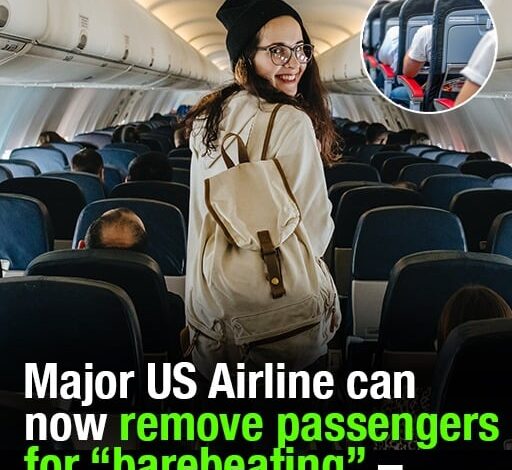
The days of subtle glares and passive-aggressive sighs in the economy cabin are officially over. United Airlines has sent a clear message to the flying public: the era of the “barebeater” has met its match in the fine print. In a move that has sent ripples through the travel industry and sparked a wildfire of debate across social media, the major carrier has formally updated its contract of carriage to address one of the most polarizing and pervasive nuisances of modern travel—the act of playing audio through device speakers at 35,000 feet.
Known colloquially as “barebeating,” the habit involves passengers streaming movies, scrolling through TikTok, or engaging in high-volume mobile gaming without the use of headphones. While once considered a mere lapse in social etiquette, United has reclassified this behavior as a significant disruption to the cabin environment. The airline’s updated policy now places the refusal to use headphones on the same legal shelf as public intoxication, verbal harassment, or interfering with crew member duties. For the first time, a major US airline has granted its flight attendants the explicit authority to remove a passenger from a flight specifically for noise pollution.
The shift in policy is a direct response to a changing technological landscape within the aircraft. For decades, the primary complaints on long-haul flights involved seat reclining or crying infants. However, as airlines roll out high-speed satellite internet services like Starlink, the aluminum tube of the fuselage has transformed into a high-bandwidth echo chamber. With the ability to stream 4K video and engage in real-time gaming, the temptation for passengers to treat their tray table like their living room sofa has become an epidemic. The serenity of the cabin, once protected by the physical limitations of offline devices, has been shattered by an endless barrage of viral soundtracks, digital explosions, and overlapping dialogue.
The legal mechanism for this crackdown is found in the “Refusal of Transport” section of the airline’s service agreement. By defining barebeating as a failure to comply with crew instructions, United has created a streamlined escalation process. If a flight attendant observes a passenger broadcasting audio, they are instructed to issue a formal warning. If the passenger persists or becomes combative, the crew now has the backing of federal regulations to deny transport. This can manifest as being barred from boarding a connecting flight or, in extreme cases of non-compliance that lead to a security concern, a diverted landing to remove the offender.
The public response to the “No Speaker” rule has been overwhelming and deeply divided. On one side of the aisle, frequent flyers and travel purists have hailed the move as a long-overdue restoration of basic human courtesy. Travel forums are filled with stories of “headphone-less nightmares”—passengers forced to endure six hours of a stranger’s true-crime podcast or a toddler’s repetitive cartoon theme songs. For these travelers, the cabin is a shared public utility where silence is the only equitable standard. They argue that in an age where high-quality earbuds are available for less than the cost of an airport sandwich, there is no excuse for invading the auditory space of 200 other people.
On the other side of the debate are parents and accessibility advocates who worry the policy lacks nuance. Parents of neurodivergent children or toddlers who struggle with sensory issues related to wearing headphones fear that a strict, zero-tolerance approach could make air travel impossible for their families. They argue that a child’s iPad might be the only thing preventing a full-scale meltdown, which is arguably louder and more disruptive than the audio from a low-volume game. While United’s official stance remains blunt—the rule applies to everyone to ensure the comfort of the collective—crew members are expected to exercise professional judgment, though the threat of removal remains the ultimate deterrent.
Psychologists suggest that the rise of barebeating is a symptom of “main character syndrome,” a psychological phenomenon where individuals in public spaces act as though they are the protagonists of their own story, with others serving merely as background extras. In the confined, high-stress environment of an airplane, this lack of spatial and auditory awareness can lead to “air rage” incidents. By formalizing the ban, United is attempting to de-escalate these tensions before they reach a boiling point. Instead of a passenger confronting another passenger—a scenario that often leads to viral videos and diverted flights—the responsibility is now firmly in the hands of the crew and the law.
The industry is watching United’s experiment with keen interest. History suggests that when one major carrier successfully implements a behavioral policy that improves the customer experience for the majority, others quickly follow suit. Delta and American Airlines have already begun internal discussions regarding similar updates to their contracts of carriage, recognizing that as Wi-Fi speeds increase, the problem will only intensify. The “quiet car” once reserved for Amtrak trains may soon become the standard for the entire sky.
Furthermore, the policy shift highlights a broader trend in the travel sector: the commodification of silence. As cabins become more crowded and seats become smaller, the only remaining luxury for many travelers is a sense of peace. Airlines are beginning to realize that protecting the “soundscape” of the aircraft is just as important as maintaining the cleanliness of the lavatories or the punctuality of the arrival. It is a move toward reclaiming the cabin as a professional, communal space rather than a free-for-all digital playground.
For the modern traveler, the takeaway is simple: your screen time is no longer a private affair when it bleeds into the ears of your neighbors. The “Barebeating Ban” serves as a digital-age addendum to the classic safety briefing. Just as you are expected to stow your tray table and return your seat to the upright position, you are now legally required to keep your digital world contained within your own ears.
As this policy goes into full effect, travelers can expect to see more signage at gates and perhaps even reminders during the pre-flight safety video. The goal is not necessarily to kick people off planes, but to reset the social contract of flying. In a world that is louder than ever, United is betting that passengers are willing to pay for a little bit of enforced quiet. For the barebeaters who refuse to adapt, the next flight might just end at the gate before the wheels even leave the tarmac. The message is loud and clear: plug in, or get out.