Kid Rock responds after being mercilessly mocked for Redneck halftime show!
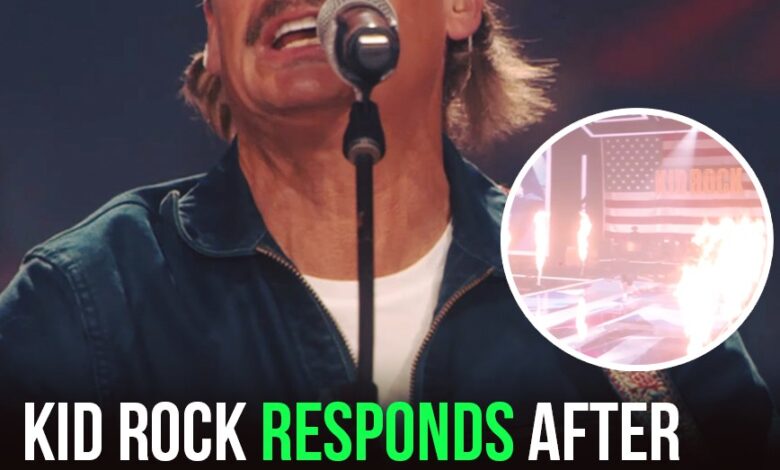
While the electric energy of Bad Bunny’s Super Bowl LX halftime show vibrated through Levi’s Stadium on February 8, 2026, a different kind of cultural frequency was being broadcast from an alternative stage. Orchestrated by Turning Point USA (TPUSA), the “All-American Halftime Show” was positioned as a counter-narrative to the mainstream spectacle, featuring Kid Rock as the headliner alongside country stalwarts Brantley Gilbert, Lee Brice, and Gabby Barrett. However, what was intended to be a defiant celebration of “faith, family, and freedom” quickly became a lightning rod for digital derision, sparking a viral firestorm that pitted cultural traditionalism against modern pop sensibilities.
The backlash was swift and unapologetic. Within minutes of the livestream’s commencement, social media was flooded with mocking epithets. Critics labeled the production the “Temu Halftime” and “Dollar Tree parking lot energy,” suggesting that the event lacked the polish and prestige associated with a global sporting climax. Yet, beneath the layer of internet sarcasm, the raw data told a far more complex story. The TPUSA alternative broadcast reportedly drew over five million concurrent viewers, peaking near six million on YouTube. While these numbers remain a fraction of the NFL’s staggering global reach, they represent a significant, concentrated audience that suggests Kid Rock and his cohorts were speaking to a massive, underserved demographic.
The emotional core of the evening was a tribute to the late Charlie Kirk, the influential conservative leader whose passing in September 2025 left a profound vacuum in the movement. Host Jack Posobiec opened the set with a somber dedication: “This one’s for you, Charlie!” Kid Rock then took the stage, kicking off with a truncated, high-energy version of his 1999 anthem Bawitdaba before transitioning into a far more subdued, acoustic cover of Cody Johnson’s ’Til You Can’t. During the performance, Kid Rock added an original verse specifically honoring Kirk’s legacy, weaving together religious imagery and political conviction in a way that resonated deeply with the viewers on the TPUSA platform.
Despite the sincerity of the tribute, the internet’s critical eye was focused elsewhere. Accusations of lip-syncing began to circulate almost instantly, gaining traction through viral clips that pointed out perceived mismatches between the audio and the artist’s movement. The commentary was ruthless; one viral post compared the performance to “handing toddlers an iPad so they stop melting down,” a sentiment that captured the sarcastic and dismissive tone of the mainstream reaction. For many online observers, the alternative show felt like an amateurish attempt to mimic the scale of the Super Bowl without the necessary infrastructure or artistic innovation.
True to his decades-long brand of polarization, Kid Rock’s response the following day was a masterclass in deflection. Rather than engaging with the lip-sync allegations or launching a defensive tirade against his detractors, he pivoted to a strategic business move. He announced on X that his studio version of ’Til You Can’t would be available at midnight, extending a formal thank you to Cody Johnson and the song’s writers for their blessing. He emphasized that “NOTHING is more powerful than a great song,” effectively ignoring the noise of the critics in favor of promoting his new release. It was a classic move for an artist who has built a career on the philosophy that any publicity—even the “Temu” kind—is an asset.
The reaction from the broader public and fellow celebrities highlighted the deep cultural schisms currently defining the American landscape. Prominent conservative voices like Pete Hegseth and Megyn Kelly offered vocal support, praising the event for its focus on traditional values and its heartfelt tribute to Kirk. Supporters in the comment sections described the performance as “beautiful” and “necessary,” with many claiming they felt moved by the obvious conviction on the performers’ faces.
Conversely, the mainstream music world was less than impressed. Kacey Musgraves delivered one of the most widely shared jabs of the night when she posted on X that the TPUSA event made her feel “more proudly American than anything Kid Rock has ever done.” Her comment was a sharp critique of the “Redneck Halftime” brand, suggesting that true patriotism and cultural pride shouldn’t feel so forced or antagonistic. Even more stinging to the alternative camp were reports that Donald Trump, despite his previous criticisms of the official halftime selection, had admitted to watching Bad Bunny’s performance, a move that some interpreted as a subtle snub to the TPUSA effort.
As the dust settled, the conversation shifted from the quality of the vocals to the significance of the event’s existence. At its heart, the alternative halftime show was about cultural positioning. It was a strategic effort by TPUSA to create a parallel entertainment universe for those who feel that mainstream media has drifted too far from their worldviews. To the critics, the show was a failed, cringeworthy experiment that only highlighted the gap between “MAGA-culture” and global pop standards. To the millions who tuned in, however, it was a vital act of cultural defiance—a way to say that their values still deserved a platform, even if it was one built in a digital “parking lot.”
One blunt social media user summed up the situation by asking if anyone truly expected the performance to be “good” by conventional standards. This observation suggests that for Kid Rock’s audience, “quality” is secondary to “authenticity” and “alignment.” The “All-American Halftime Show” wasn’t designed to win over Kacey Musgraves or the critics at Rolling Stone; it was designed to reinforce a specific brand of identity for a specific group of people.
In the end, Kid Rock’s “Redneck” halftime show achieved exactly what it set out to do. It generated millions of views, sparked a massive national conversation, and provided a rallying point for a movement still reeling from the loss of a major leader. Whether it was a “failed” performance or a strategic success depends entirely on which side of the digital fence one stands on. Kid Rock, meanwhile, is likely unbothered by the mockery, moving forward with his new single and the secure knowledge that in a polarized world, being hated by the “right” people is just as profitable as being loved by everyone. He continues to operate as a singular figure in the industry—an artist who doesn’t need the official Super Bowl stage to ensure the whole country is talking about him the next morning.