I Shared My Coat with a Young Mother and Baby, What Happened the Next Week Surprised Me!
Eight months after losing my wife of forty-three years, I thought the worst grief could do was leave the house hollow and too quiet to bear. At seventy-three, my days were stitched together from memory more than purpose. I still brewed two cups of coffee out of habit. I still set out two mugs even though the second stayed untouched. When the evenings settled in, the hum of the refrigerator felt like the closest thing to company. Ellen used to joke, “It’s you and me against the world, Harold,” and for decades that had been enough. But when the person who fills your life disappears, even the walls seem to pull away from you.
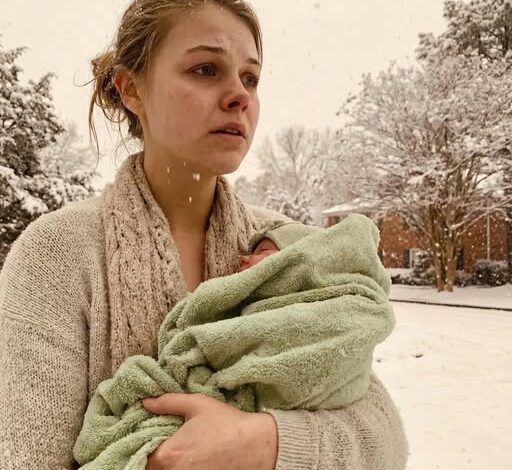
On a freezing Thursday afternoon, when the wind cut straight through my bones, I wandered into Walmart for groceries I didn’t really need—anything to avoid another empty afternoon at home. As I stepped back outside, I saw a young woman standing near the carts, holding a baby wrapped in a thin, worn towel. Her sweater was barely more than fabric stitched together. Her lips were almost purple, and the baby’s tiny fists trembled against the cold. Something in her posture—fear mixed with stubborn determination—pulled at me. Before my mind caught up with my feet, I was already shrugging off my heavy winter coat and draping it over her shoulders. I didn’t ask if she needed it. I could see she did.
I guided her back inside to the little seating area near the deli. She hesitated but followed, clutching the child tight. I bought her a hot coffee and a bowl of soup. When her hands finally stopped shaking, she told me her name was Penny and that her baby, Lucas, was only six months old. She had walked out of an unsafe home that morning and hadn’t looked back. She didn’t know where she was going—she only knew she couldn’t stay. She hadn’t eaten since the day before. As she fed the baby and took small sips of coffee, she kept apologizing for taking my coat. I told her to keep it. A coat is replaceable. Safety isn’t.
When I got home that evening, I set the table for one like always, but for the first time in months, the empty chair across from me didn’t make my chest cave in. I told Ellen’s chair about the girl—how young she was, how scared, and how hard she tried to keep herself together for her child. Ellen always had a soft spot for people trying to climb their way out of hard places. She would’ve liked Penny.
A week later, just when I’d convinced myself I’d never see her again, a loud knock shook my front door. The kind of knock that makes your stomach drop. When I opened it, two large men in black coats stood on my steps, their expressions dead serious. One of them asked if I was Harold Greene. Then he said they needed to talk to me about “what happened last Thursday.” My heart started doing somersaults. My mind raced through every possible misunderstanding. Before I could stammer out a single explanation, Penny stepped into view from behind them, bundled warmly, looking healthier, and smiling just a little. The tension drained out of me so fast my knees nearly gave out.
The men were her brothers.
She had gone straight to the police after leaving that day. My coat, my name, and the details of our conversation became part of her statement about the home she was fleeing. Her brothers had spent days looking for her, terrified she’d vanished for good. When they finally found her at a women’s shelter, she insisted they come with her to thank me properly. They stepped inside, filling my quiet living room with the kind of protective energy only family can bring. They told me Penny had survived far more than she let on, and that my small kindness had given her the push to ask for help.
They offered to repay me, to fix anything in my house, to cover costs I didn’t even have. I waved them off, uncomfortable with the fuss. That’s when Penny stepped closer and asked softly if she could do something for me instead. I didn’t know what to say, so I mentioned—half joking, half hoping—that I hadn’t tasted a good apple pie in years. Ellen used to bake one every autumn, and the scent alone could drag me back to better days. Penny smiled like she’d just been handed a mission.
Two days later, she showed up at my door carrying a warm pie that smelled like cinnamon, butter, and everything good. She looked steadier now, the kind of steady you only get when you finally feel safe. We sat in my kitchen. I pulled out the old “company plates” Ellen always insisted on using for guests she liked. Lucas slept in his carrier while Penny and I ate slices of pie that melted on the tongue. She told me about the court hearings ahead, the shelter helping her, the way her brothers refused to let her face anything alone now that they understood what she’d survived. She talked about fear like someone who had carried it for too long but was finally learning to put it down.
At one point she looked at me and asked if I really believed she could rebuild her life. I told her the truth: I’d seen parents who didn’t give a damn about their children. She was not one of them. She had walked into the cold with nothing but a baby in her arms and the courage to leave. That alone proved she deserved a new beginning.
Before she left, she promised to bring a berry pie on Saturday. I told her I hadn’t looked forward to a Saturday so much in years. When the door closed, the house felt different. Not full—nothing could fill the space Ellen left—but no longer hollow either. Grief hadn’t vanished, but it softened around the edges. The silence wasn’t sharp; it felt like room waiting to be filled.
I put on a pot of coffee for Saturday, letting the smell drift through the kitchen the way it used to when life was simpler. And for the first time in a long stretch of lonely months, I felt something warming its way back into my chest. Maybe hope arrives in small gestures—a coat on a freezing day, a slice of pie shared at a kitchen table, a new voice breaking through the quiet. Maybe kindness echoes louder than loss. Whatever it was, it made me believe that even at seventy-three, life still had a few surprises left for me.