I Gave $4 to a Tired Mom at the Gas Station – A Week Later, an Envelope Arrived for Me at Work!
I didn’t think much of it at the time. It was just four dollars—barely enough to notice, let alone remember. A small, automatic decision at the end of a long shift. But that night, something shifted in a way I didn’t understand until much later.
My name is Ross. I’m forty-nine years old, married to a woman who has stood by me through more than I deserve, and a father to two kids who seem to outgrow everything faster than I can keep up with. We live in a house that feels too small for our needs and too big for our budget, but it’s ours, and that’s enough to keep going.
A few years ago, everything changed.
I had worked at the same factory for over two decades. It wasn’t glamorous work, but it was steady, honest, and predictable. Then one day, without warning, it was gone. We showed up like any other morning, only to find the gates locked and a notice taped to the fence announcing bankruptcy. Twenty-three years of my life ended before lunchtime.
I did what anyone would do. I searched. I applied. I knocked on doors and made calls until it felt like I was speaking into empty space. But at my age, options were limited. The good jobs went to younger people, and what remained didn’t come close to what I had lost.
Eventually, I took what I could get.
Now I work the night shift at a gas station off Highway 52. It’s the kind of place people pass through without remembering. The lights flicker sometimes, the air smells like burnt food from the roller grill, and the same songs repeat on the radio until they fade into background noise. Most nights are quiet. Predictable. Manageable.
That night started no differently.
A few customers came and went—truck drivers grabbing coffee, a teenager stocking up on energy drinks, nothing out of the ordinary. By 11:30 p.m., the place had settled into that familiar stillness.
Then the door chimed.
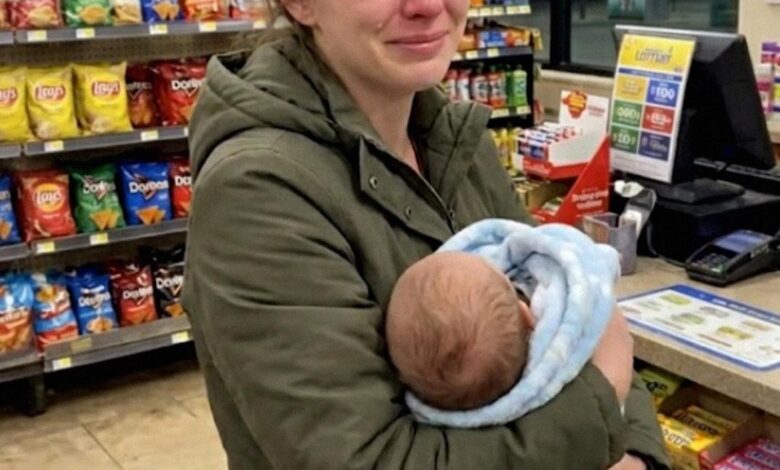
She walked in carrying a sleeping child.
The boy’s arms hung loosely around her neck, his face pressed into her shoulder. She moved carefully, like even the smallest shift might wake him. Her clothes were worn, her hair tied back without much effort, and her face… it told a story she wasn’t ready to say out loud.
She didn’t speak at first. Just moved through the aisles, picking up only what she needed—milk, bread, diapers. No extras. No hesitation.
When she reached the counter, I scanned the items.
“Fourteen seventy-two,” I said.
She started searching her purse, one hand holding the child steady while the other dug through crumpled bills. I watched the moment her expression changed—the quiet realization that she didn’t have enough.
“I’m short by four dollars,” she said softly. “Can I put the diapers back?”
There wasn’t time to think.
“It’s fine,” I said, already pulling money from my wallet. “I’ve got it.”
She looked at me like she wasn’t sure if she had heard correctly.
“It’s late,” I added. “Just get home safe.”
For a second, it seemed like she might break down. Instead, she nodded quickly, took the bag, and left without another word.
I watched her through the window as she carefully placed the boy in the car and drove off.
Then the night returned to normal.
Or at least, it seemed that way.
The week passed like every other. Work, home, bills, routine. Life didn’t pause just because something small had happened. At least, not on my side of it.
Then, the following Thursday, my manager called me into his office.
“Did you cover someone’s groceries last week?” he asked.
My stomach tightened. I thought maybe I’d broken some rule.
“Yeah,” I said. “I used my own money.”
He shook his head and handed me an envelope.
“This came for you.”
It had my name written on it.
No return address.
No explanation.
I opened it carefully.
Inside was a check.
Five thousand dollars.
I stared at it, convinced I had read it wrong. Then I read the note.
It was from the woman’s parents.
They explained that her name was Emily. That she had been in a difficult situation, trapped in a relationship that had isolated her from her family. That night, she had finally found the courage to leave, taking her son and whatever she could carry.
She had almost turned back over four dollars.
But she didn’t.
Because someone helped her.
I sat there, unable to process what I was holding.
When I got home, Lydia knew something was wrong before I said a word. I handed her the envelope, and as she read the note, her eyes filled with tears.
“You have to go meet them,” she said. “And you need to understand something—you didn’t do that for a reward. That’s what makes it matter.”
Sunday came faster than I expected.
The address led me to a part of town I wasn’t used to—wide streets, large houses, everything clean and quiet in a way that felt almost unreal.
They were waiting for me.
An older couple stood on the porch, as if they had been watching for my car. They welcomed me inside like I belonged there, like what I had done had already made me part of something.
Over lunch, they told me everything.
How Emily had been isolated. How she had lost confidence, support, and nearly her sense of self. How that night was the first step toward something different.
“She almost gave up,” her mother said. “But you didn’t let her feel like she had to.”
I didn’t know what to say.
“I was just helping,” I replied.
Her father shook his head.
“No,” he said. “You gave her dignity when she needed it most.”
I tried to refuse the money.
They insisted.
We talked for hours—about their daughter, about my family, about how life can take turns you never see coming.
When I left, her mother hugged me tightly.
“Don’t forget who you are,” she said.
Driving home, I kept thinking about how small that moment had felt at the time.
Four dollars.
A few words.
That was all it took.
But for someone else, it was everything.
I deposited the check a couple of days later. It helped more than I can explain—caught us up on bills, fixed things we had been putting off, made life a little less heavy.
But the money wasn’t what stayed with me.
What stayed was the understanding that small moments matter more than we realize.
I still work those same night shifts.
The same lights flicker. The same songs play. The same routine repeats.
But now, when someone walks in looking like life has worn them down, I pay attention.
Because sometimes, all it takes is a small act—something simple, almost forgettable—to change the direction of someone else’s life.
And you never know when that moment will come.