I Found a Lonely Boy Crying Outside the Oncology Ward – When I Learned the Truth, I Knew I Had to Step In
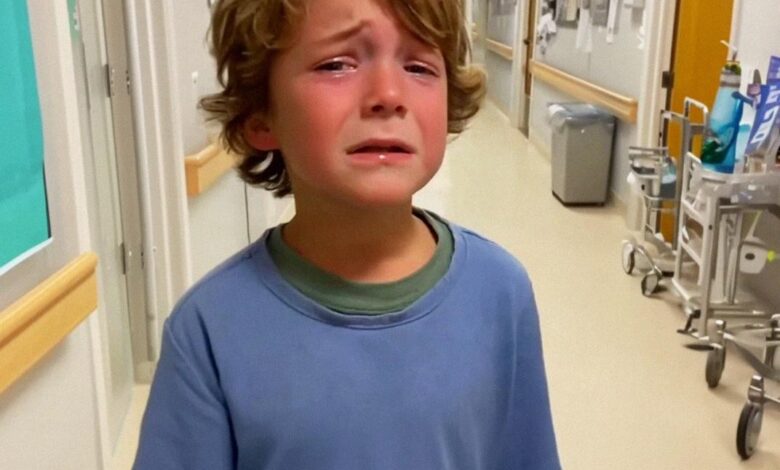
I went to the hospital that morning to pick up paperwork. Nothing emotional, nothing dramatic — or so I thought. But life rarely asks for permission before changing everything.
The oncology department had become a ghost of my past. My mother had passed there just a month earlier, and walking those sterile hallways again felt like scraping an open wound. I only needed to collect her final pathology report — one sealed envelope that marked the end of her story.
I just wanted to get it and leave.
But then I saw him.
He was sitting on the floor outside the oncology ward, no older than eight. His knees were pulled to his chest, his backpack hugged tight like a life preserver. His face was red from crying, and he kept glancing toward the double doors like he was waiting for someone who wasn’t coming.
Everyone walked past — nurses, visitors, doctors — eyes forward, too busy to see him. But I couldn’t. Grief recognizes grief.
I crouched beside him. “Hey there,” I said softly. “You okay, buddy?”
He didn’t answer right away. Then, in a trembling whisper, he said, “I don’t want my mom to die.”
My heart dropped.
“She went inside and told me to wait,” he continued. “But I’ve been waiting a long time. I think she’s really sick.”
I sat beside him right there on the cold tile. “What’s your name?”
“Malik.”
“Hi, Malik. I’m Millie. I know hospitals can feel scary. You’re not alone, okay?”
He blinked at me with those big, tear-glazed eyes. “It’s just us now. My mom lost her job because she got sick. I tried to help. I sold my toys and put the money in her purse when she wasn’t looking.”
That’s when I broke. My throat tightened, my eyes stung. He was just a child trying to hold the world together with his tiny hands.
I didn’t ask more questions. Sometimes what people need isn’t answers — it’s someone to sit with them until the world feels less cruel.
When he leaned against me, I wrapped an arm around him and let the silence speak for both of us.
A nurse eventually stepped out and called his name. Malik shot up, his eyes bright with hope. Then she appeared — a thin woman in a faded hoodie, pale and exhausted. Her face had the hollow look of someone fighting both illness and survival.
“Mom!” Malik cried, running into her arms.
I stood, smiled awkwardly. “Hi. I’m Millie. I was just keeping Malik company while you were in your appointment.”
Her eyes softened. “Thank you. They don’t let kids in, and… well, there’s no one else.”
There was a beat of quiet. Then I heard myself say, “Would you mind if I visited you both tomorrow? I think I can help.”
She hesitated, unsure, but Malik tugged her sleeve and said, “Mom, she’s nice. Like a fairy.”
She gave a weary smile. “Alright. Ten a.m.?”
That night, I couldn’t sleep. I brewed tea, stared at the sealed envelope from the hospital, and thought about my mother — about how helpless I’d felt. I couldn’t save her. But maybe I could help someone else.
The next morning, I stopped by a bakery. Blueberry muffins for her, chocolate croissants for Malik.
Their apartment was small — one couch, one table, mismatched chairs, but spotless. The woman introduced herself as Mara. In daylight, she looked even more fragile.
We sat at the table while Malik ate his croissant like it was Christmas morning. Mara’s voice shook as she told me everything. Stage 2 lymphoma. Treatable, but her insurance had lapsed. She was skipping doses to stretch her meds. Malik sold toys and did odd chores for neighbors to help her afford them.
That little boy wasn’t just surviving — he was holding the line between life and death for his mother.
“Let me help,” I said.
She froze. “You don’t even know us.”
“I know enough,” I said. “You’re fighting, and you’re tired. Let me carry this one for you.”
Tears rolled silently down her cheeks. She tried to argue, but I didn’t let her.
That night, I called the oncologist who had treated my mom — Dr. Chen. She agreed to take Mara as a patient. I paid for her initial tests and treatments anonymously.
A few days later, Malik called me. “Miss Millie,” he said, his voice trembling, “what if something happens while she’s inside? What if she doesn’t come out?”
“She will,” I told him. “And I’ll be right there with you until she does.”
We started meeting at the hospital café during Mara’s treatments. Malik told me stories about his old toys, his dreams of being an astronaut, and the smell of his mom’s pancakes before she got sick. Each time he smiled, I felt my mother’s presence — not in memory, but in action.
Weeks passed, and Mara began responding to treatment. Her color returned. She even laughed again. Malik noticed every change. “She didn’t throw up this time!” he shouted one afternoon, beaming with pride.
That’s when I said, “You know what you both need? A day off from being brave. No doctors. No needles. Just fun.”
“Fun?” Malik tilted his head.
“Disneyland,” I said.
His eyes went wide. “For real?!”
“For real,” I said.
Mara resisted at first, saying she was too tired, but I convinced her. “It’s one day,” I said. “One day to live.”
That Saturday, I rented a wheelchair and packed snacks. Malik wore a cap three sizes too big and talked nonstop from the parking lot to the gate.
He screamed on every ride. Mara laughed until she cried. We ate churros and took selfies with sticky faces. At one point, Malik rested his head on her arm and said, “This is nice.”
Mara looked at me, her eyes glistening. “Yeah, baby,” she said. “This is what normal feels like.”
We stayed until the fireworks. Malik sat on my lap, wrapped in a hoodie, whispering, “I wish this could last forever.”
“Me too,” I said, watching the sky explode in color.
A month later, Mara called me in tears. “Millie… the scans are clear. No more chemo. I’m in remission.”
I drove straight to their apartment. Malik opened the door, holding a drawing of three stick figures — his mom, himself, and me — all smiling under a bright yellow sun.
“You’re the one on the right,” he said proudly.
It’s been a year now. Mara volunteers at the hospital every Friday. Malik’s in fourth grade with straight A’s. They adopted a stray cat named Niblet. Every month, I get a letter or a drawing from him. The last one read, You’re my favorite miracle.
But the truth is, he was mine.
I still keep that sealed envelope from my mom’s oncologist in my glove box. I haven’t opened it — I don’t need to. Some stories don’t need closure. They need continuation.
That day in the hallway, when I found Malik crying alone, reminded me that kindness isn’t complicated. It’s a pause. A hand on a shoulder. A decision to sit down instead of walking past.
If you ever see a child alone, afraid, waiting — stop. Sit with them. Listen.
You might just become someone’s miracle.