Harmful if made wrong! a hidden risk in a globally popular food
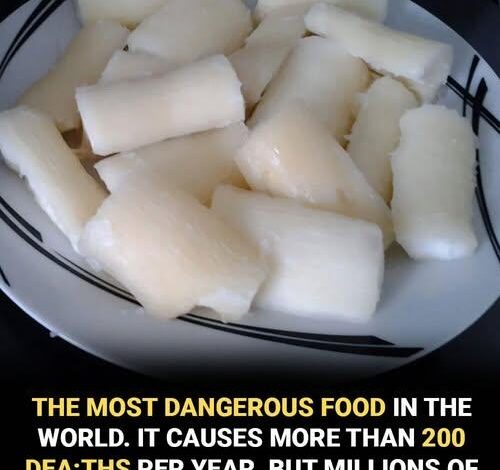
Cassava is one of the most heavily consumed staple foods on the planet — a root that feeds entire regions, anchors cultural dishes, and thrives in soils where almost nothing else will grow. Yet buried inside this familiar ingredient is a danger most casual consumers never think about. Prepared correctly, it’s nourishing, dependable, and endlessly adaptable. Prepared poorly, it can release enough cyanide to poison a family, a village, or, in extreme situations, an entire generation. The contradiction is striking: a food that keeps millions alive can also quietly harm them if the steps that make it safe are ignored.
The risk isn’t obvious at first glance. Cassava looks like an ordinary tuber — rough skin, starchy flesh, mild in flavor. But inside certain varieties, especially the “bitter” strains, are high levels of cyanogenic compounds. These chemicals sit dormant until the plant is damaged. Grating, slicing, even chewing triggers an enzymatic reaction that liberates cyanide. In small amounts, the body can neutralize it. In larger concentrations, cyanide becomes the same toxin associated with assassins and survival thrillers. For most people in industrialized countries, cassava arrives already processed into flour, tapioca pearls, or packaged chips. But in regions where fresh cassava is harvested and cooked daily, the responsibility for making it safe falls entirely on the household.
Poisonings typically occur not because people don’t understand the danger, but because conditions force them to cut corners. Cassava requires time, water, firewood, and attention — resources that can disappear during drought, conflict, or poverty. Families struggling through famine often harvest roots too young, skip soaking or fermentation, or reduce cooking time to conserve fuel. Emergency shortcuts have consequences. Cyanide that should have leached out stays inside the food. Over time, repeated exposure can overwhelm the body’s detox systems, especially in children and people whose diets lack protein. Protein contains sulfur-based amino acids that help neutralize cyanide; without them, the toxin lingers longer in the bloodstream.
One of the most tragic outcomes linked to chronic consumption of poorly processed cassava is konzo. The disease appears abruptly: a child or adolescent wakes up unable to walk properly, their legs stiff and weak. In severe cases, the paralysis becomes permanent. Entire clusters of konzo outbreaks have been recorded in rural areas during periods of hardship. The pattern is heartbreakingly consistent — families forced to rely almost exclusively on cassava, limited access to protein, and diminishing resources for proper preparation. Neurologists studying these cases describe konzo as a preventable catastrophe tied not to culture, but to circumstance.
Despite the risk, cassava remains essential, and for good reason. When handled with the full traditional process, the toxins are removed and the root transforms into a safe, reliable food with surprising nutritional benefits. The steps are simple but non-negotiable. First: peel completely. The peel holds the highest concentration of cyanogenic compounds. Leaving even a thin layer increases risk. Next: soak or ferment. Grating or slicing exposes the flesh to water, allowing cyanide to leach out over a day or two. In northern Brazil, this method forms the base of farinha d’água — a tangy, coarse flour central to local cuisine. In West Africa, grated cassava is fermented into garri or fufu. Fermentation isn’t just chemical; it’s cultural knowledge passed through generations.
Cooking is the final safeguard. Boiling cassava for at least twenty minutes destroys lingering traces of cyanide. There is no safe shortcut. Raw cassava should never be eaten. Even lightly cooked cassava is a risk if the soaking step was skipped. But when all three stages — peeling, soaking, cooking — are respected, cassava becomes exactly what millions rely on it to be: a hearty, filling, gluten-free carbohydrate rich in fiber and easy to digest. It forms the base of breads, cakes, porridges, and crispy fried dishes. Tapioca, one of the world’s most popular gluten-free flours, comes directly from this transformation.
Public health experts emphasize that the worst cassava-related tragedies occur in places where tradition has been disrupted. When war forces families to flee. When drought kills crops and cassava becomes the only surviving food. When young generations migrate and cultural knowledge thins. Safe preparation depends on continuity — mothers teaching daughters, neighbors teaching neighbors, communities sharing wisdom as essential as the food itself.
Yet cassava also offers a powerful example of how ancient practices often align with modern science. Long before chemistry identified cyanogenic compounds, cooks knew the root needed to be soaked, pressed, or fermented. Long before researchers documented konzo, communities warned against eating cassava without protein. Over centuries, people living closest to the crop built a system that protected entire populations without ever naming the molecules involved. Today, scientists can explain each step, but the roots of safety still lie in tradition.
For the modern cook who buys cassava out of curiosity, the rules are simple: always peel thoroughly, always boil thoroughly, and never treat the root like a casual vegetable. Respecting the preparation isn’t paranoia — it’s how this food has always been handled in the places where it sustains life. Pairing cassava with protein-rich dishes — fish stews, beans, eggs — further enhances safety and nutrition. Even the most toxin-prone varieties become harmless when processed correctly.
Cassava is a paradox only on the surface. In practice, it is a reminder that food is knowledge, and knowledge is survival. Something as humble as a root can hold both danger and nourishment, depending entirely on how it’s understood. In regions where hunger makes shortcuts tempting, reinforcing safe preparation isn’t just nutrition advice — it’s a public health necessity. And in households where cassava has been prepared the same careful way for generations, it continues to be exactly what it’s meant to be: a dependable, versatile, and nourishing part of daily life.
Handled with respect, cassava is not a threat. It is a testament to the power of tradition — a food that demands patience, rewards care, and, once properly tamed, feeds the world.