From Glamour to the Streets, The Shocking Downfall of a Fitness Model Who Says I am in Constant Pain
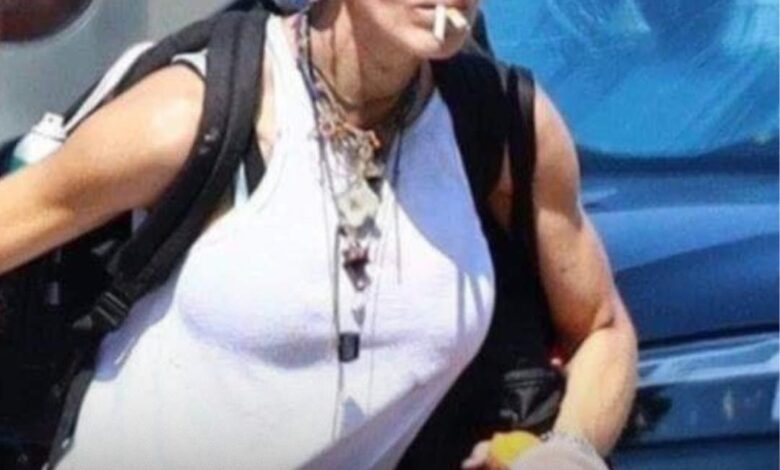
There was a time when Loni Willison lived a life that many people could only imagine.
She appeared in fitness magazines, built a reputation around health and image, and carried the kind of confidence that comes from being admired in an industry built on perfection. Her photos were polished, her presence magnetic, and her future—at least from the outside—looked secure.
But the version of her life people saw was only part of the story.
Years later, that image has been replaced by something almost unrecognizable. Today, Willison is often seen on the streets of California, searching through dumpsters, moving quietly through spaces that exist far from the spotlight she once occupied.
The contrast is stark.
Not just in appearance, but in circumstance.
And when asked how everything changed, she doesn’t hesitate to point to a specific moment in her life—the relationship that, in her words, marked the beginning of her decline.
Her marriage to Jeremy Jackson, known for his role on Baywatch, was short-lived but deeply turbulent. The two were together for less than two years before their relationship ended in 2014, but the impact of that period has lingered far longer.
When questioned about what went wrong, Willison’s response is direct and unfiltered.
“My ex-husband,” she said. “Getting married. At least I got divorced.”
Her words carry both accusation and distance, as if she’s still trying to separate herself from a past that refuses to let go.
According to reports, their relationship included a violent incident in which Jackson allegedly attempted to choke her during an intoxicated altercation. The situation marked a breaking point, but it wasn’t the end of the challenges that followed.
In many ways, it was only the beginning.
After her divorce, Willison gradually disappeared from public view. For nearly four years, there were no updates, no appearances, no signs of the life she once led.
Then, in 2018, she reemerged.
But not in the way anyone expected.
Gone was the carefully maintained image of a fitness model. In its place was a woman visibly struggling—short hair, a worn appearance, and clear signs of physical decline. The transformation shocked those who remembered her former life, raising questions that didn’t have simple answers.
Since then, her situation has only grown more complex.
In a recent interview, she spoke candidly about her current condition, describing constant physical pain and a life shaped by experiences that are difficult to fully understand.
“My stomach hurts really bad,” she said. “I’m in a lot of pain.”
But it’s not just physical discomfort she describes.
Willison believes she has been affected by something she struggles to explain—an ongoing sensitivity to electricity and environmental elements that, in her view, prevents her from living indoors.
She claims that for nearly a year, she experienced daily “electrocution,” an experience she says changed how her body reacts to the world around her.
“I can’t live inside anywhere,” she explained. “I pick up on electricity, chemicals, metals… my body filters it somehow.”
Her description is fragmented, uncertain, and deeply personal. It reflects a reality that may not align with conventional explanations, but one that clearly shapes how she experiences her daily life.
When asked whether she has sought help from the city of Los Angeles or other support systems, her response is just as stark.
“There’s nothing that anybody can offer me,” she said.
Despite reports that assistance has been offered, she maintains that she has never asked for it and does not believe it would change her situation.
It’s a statement that reflects more than independence.
It suggests a disconnect—a sense that the solutions others see are not the ones she feels she needs.
At the same time, her outlook isn’t entirely defined by despair.
When asked about her life, she acknowledges both sides of it.
“There’s good parts and there’s bad parts,” she said. “But whatever.”
That “whatever” carries a quiet resignation, but also a kind of acceptance. Not satisfaction, but endurance.
Even in the midst of visible struggle, there is a sense that she continues to move forward on her own terms, however difficult those terms may be.
Her physical condition reflects the toll of that journey.
During the interview, her hands were noted to be severely injured, prompting concern from those speaking with her. When advised to seek medical attention, she dismissed the suggestion calmly.
“I’ll be fine,” she said.
It’s a response that speaks to a larger pattern—one where help is either declined or seen as unnecessary, even when the need appears obvious to others.
Looking back, there were earlier signs of the challenges she would later face.
In a 2018 interview, she spoke openly about her struggles with addiction, specifically crystal meth, and described feeling as though she was being “tortured” in her own home. Those statements hinted at a deeper crisis that extended beyond substance use alone.
Meanwhile, Jeremy Jackson has also publicly acknowledged his own struggles with addiction, including issues with drugs, steroids, and alcohol. His past includes legal trouble as well, including a plea agreement in 2017 related to a violent incident.
The intersection of their lives, marked by instability and conflict, appears to have left lasting consequences for both.
But while Jackson’s story continues within the public sphere, Willison’s has moved in a very different direction.
Away from structured environments.
Away from support systems.
And far from the life she once lived.
Her story is difficult to categorize.
It’s not simply about fame lost or circumstances changed. It’s about the unpredictable ways in which life can shift, sometimes gradually, sometimes all at once, leaving behind a version of reality that no longer resembles what came before.
For those who remember her as a model, the contrast is striking.
But for Willison, this is no longer a transformation.
It’s her present.
A present defined by pain, resilience, confusion, and a sense of autonomy that doesn’t always align with what others expect.
There are no easy conclusions to draw.
No simple explanations that tie everything together.
Only a story that continues to unfold, shaped by choices, experiences, and perceptions that remain deeply personal.
And at its center is a woman who once lived in the spotlight, now navigating a world that looks very different—one where survival, in all its forms, has become the defining theme.