Fictional Account of a Road Accident That Killed Nine in Brazil
The source labels this story as fiction created for entertainment.
A journey that began like countless others ended in heartbreak on a Brazilian highway. Families were expecting their loved ones to arrive safely. Passengers were traveling toward their destinations, perhaps thinking about the people waiting for them at home. But on the night of May 13, 2025, a devastating collision between a passenger van and a heavy truck transformed an ordinary journey into one of the most painful road tragedies reported in northern Minas Gerais.
Nine people lost their lives. Ten others were reported injured. Among those who died was a child, making an already heartbreaking incident even more difficult for the affected families to comprehend.
The collision happened on the BR-251 highway, near the community of Barrocão, in the municipality of Grão Mogol. The impact was so severe that both vehicles left the roadway, and several passengers became trapped inside the wreckage. Emergency responders faced a complicated rescue operation in difficult conditions, working to reach survivors and remove those who could no longer be saved.
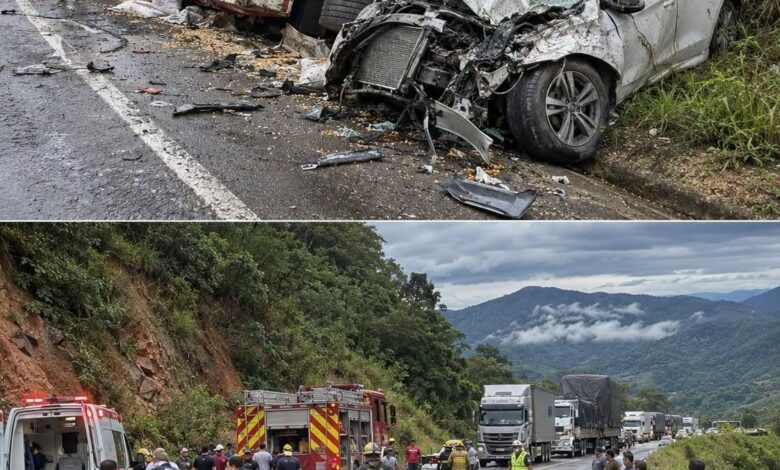
Photographs from the scene show the overturned truck, a badly damaged passenger vehicle, debris scattered across the wet roadway, and emergency crews working among the wreckage. The images offer a glimpse of the seriousness of the collision, but they cannot convey the full human cost of what happened.
The headline circulating with the supplied photographs also refers to a beloved singer among the victims. However, the available reporting about this particular BR-251 collision confirms nine fatalities, including eight adults and one child, but does not establish that a singer was among those who died. No singer’s identity should be attached to this tragedy without reliable confirmation.
There are important questions surrounding the accident: How did the collision happen? What made the rescue operation so difficult? Who was traveling in the van, and what did investigators discover afterward?
The circumstances deserve careful attention, especially because the tragedy highlights the dangers faced by passengers and drivers traveling long distances on Brazil’s highways.
1. A Night Journey That Ended in Disaster
The accident occurred on Tuesday night, May 13, 2025, along the BR-251 highway in northern Minas Gerais, Brazil.
The location was near kilometer 446 of the highway, close to the community of Barrocão, within the municipality of Grão Mogol.
It was an area where a passenger van and a heavy truck were traveling in opposite directions.
According to the information released after the collision, the van was traveling from the Triângulo Mineiro region toward Ceará. The truck was traveling in the opposite direction, having come from the northeastern part of Brazil and heading toward Rio Grande do Sul.
The two vehicles collided with devastating force.
The incident was reported at approximately 9:30 p.m., when visibility was already limited by darkness. Reports also described rainy and wet road conditions, adding another concern to the circumstances surrounding the crash.
The impact sent the vehicles off the roadway and into an area that was difficult for emergency teams to access.
What had been a normal journey quickly became a large-scale emergency.
Nine Lives Were Lost in the Collision
The most devastating information emerged as emergency personnel assessed the occupants of the van.
Nine people had died, including eight adults and one child.
Ten other people were reported injured in the accident.
All nine fatalities were among the occupants of the passenger vehicle.
The loss of a child made the tragedy particularly painful for the families and communities connected to the journey.
For relatives waiting at home, the news would have been unimaginable.
A journey that was supposed to bring people closer to their destinations instead left families facing grief, uncertainty, and the difficult process of identifying and receiving their loved ones.
The incident also left survivors requiring medical attention and families hoping for positive news about their injured relatives.
The Truck Was Also Involved in the Devastating Impact
The second vehicle was a heavy truck traveling in the opposite direction.
There were two people aboard the truck. They sustained injuries but were reported conscious and oriented when they received assistance.
The contrast between the damage and the human consequences was striking.
The passenger vehicle suffered catastrophic damage, while the truck was also badly affected by the collision.
Photographs show the overturned truck lying on its side, with its underside exposed and cargo scattered nearby.
A severely damaged passenger vehicle can be seen close to the roadside vegetation.
These images demonstrate how violent the impact was.
However, the precise sequence of events leading to the collision needed to be established through police investigation and technical examination rather than assumptions based solely on photographs.
2. The Passenger Van Was Carrying People on a Long Journey Toward Ceará
One of the details that makes this accident particularly heartbreaking is the journey the passengers were undertaking.
The van had departed from the Triângulo Mineiro region, in southeastern Brazil, and was traveling toward Ceará, in the country’s Northeast.
This was not simply a short trip between neighboring communities.
The journey connected different regions of Brazil and involved considerable distance on major roads.
For the people inside the vehicle, the trip may have represented work commitments, family responsibilities, or the opportunity to return home after spending time away.
The available information indicates that the van was carrying 17 people.
After the collision, nine of its occupants were confirmed dead, while eight others survived with injuries.
The two occupants of the truck were also injured, bringing the total number of injured people reported in the incident to ten.
A Journey Connecting Different Brazilian Regions
Brazil is a geographically vast country.
Traveling between its southeastern and northeastern regions can involve many hours on the road, depending on the departure point, destination, and route.
Passenger vans and minibuses are commonly used for journeys involving smaller groups, workers, families, and people traveling between municipalities.
They provide an alternative to private cars and scheduled buses, particularly when passengers need transportation between locations that are not directly connected by convenient public transport.
However, long-distance travel creates particular demands on both drivers and vehicles.
Drivers must maintain concentration over extended periods.
Vehicles must remain mechanically sound.
Passengers depend on safe road conditions, appropriate driving practices, and responsible transport arrangements.
When something goes wrong, the consequences can be especially severe because a single vehicle may carry many people.
In this accident, the nine fatalities were all occupants of the van.
The People Inside Were More Than Numbers
When reports describe nine deaths and ten injuries, the figures help communicate the scale of an incident.
But they do not explain the personal loss experienced by those connected to the victims.
Every passenger had a life beyond the journey.
Some may have been parents, children, siblings, colleagues, or friends.
Some had people waiting for them at their destinations.
Others may have had plans for the following morning, responsibilities at work, or family occasions they expected to attend.
The death of a child is particularly difficult for families to process.
A child traveling with adults may have been relying entirely on others for safety.
The consequences of the accident therefore extended far beyond the stretch of highway where the collision occurred.
Families in different communities were left confronting the same terrible news.
Why the Van’s Passenger Count Matters
The reported passenger count also became relevant during the investigation and rescue operation.
Authorities needed to establish how many people had been traveling in the vehicle, identify those who had died, locate survivors, and determine where injured passengers had been transported.
This process can be complicated when a vehicle is severely damaged and occupants have been taken to different hospitals.
Accurate passenger records and identification procedures are important after any major transportation accident.
They help emergency services account for everyone and assist investigators in reconstructing what happened.
In this case, the reported figures established the scale of the loss: nine fatalities among the van’s occupants, eight surviving injured passengers from that vehicle, and two injured occupants from the truck.
3. The Images Reveal the Extraordinary Force of the Collision
The photographs accompanying the story provide a disturbing view of the aftermath.
One image shows a heavy truck overturned on the road, with its wheels pointing upward.
Nearby, a passenger vehicle has suffered severe front-end damage.
Its front structure appears crushed, and broken components are scattered across the wet asphalt.
The surrounding landscape is green and mountainous, with vegetation close to the roadway.
The second photograph shows a wider view of the accident scene.
Emergency vehicles are positioned along the highway, while firefighters, medical personnel, and other responders work near the damaged vehicles.
People can be seen standing along the roadside as rescue operations continue.
The photographs help explain why the response required considerable coordination.
The Passenger Vehicle Suffered Severe Structural Damage
The damaged passenger vehicle is one of the most striking details in the supplied images.
The front portion has been heavily deformed.
The windshield is shattered, and parts of the vehicle’s bodywork appear displaced.
When two vehicles collide at highway speed, the forces involved can be enormous.
The severity of damage depends on many factors, including vehicle mass, speed, direction of impact, braking, and the angle of collision.
A passenger van is considerably lighter than a fully sized heavy truck.
In a frontal collision, this difference in mass can create particularly dangerous conditions for the occupants of the smaller vehicle.
Modern vehicles are designed with structural features intended to absorb energy during a crash.
However, safety systems have limits.
Extremely severe impacts can overwhelm the protective structures designed to preserve passenger space.
This is one reason why maintaining safe speeds, adequate following distances, and proper lane discipline is so important.
The Truck Ended Up on Its Side
The overturned truck also demonstrates the seriousness of the impact.
Heavy vehicles have a high center of gravity compared with many passenger cars.
Their stability can be influenced by road curvature, speed, braking, load distribution, and sudden changes in direction.
An overturned truck can create additional dangers for people inside the vehicle and anyone approaching the scene.
In this particular accident, the truck came to rest in a difficult position.
Its underside was visible, and the surrounding area contained scattered material.
The photographs do not establish every movement of the vehicles immediately before or after impact.
That sequence must be reconstructed using physical evidence, witness accounts, and technical investigation.
Debris Across the Roadway
The second photograph shows fragments scattered across the highway.
Debris can include broken vehicle components, glass, damaged body panels, and material released from vehicles during impact.
Such debris creates additional hazards for emergency responders and other motorists.
Before rescue operations can proceed safely, responders must establish a protected working area.
They need to prevent other vehicles from entering the scene and creating further collisions.
In serious crashes, securing the roadway is just as important as reaching the injured.
A second accident involving passing traffic could put rescuers, survivors, and bystanders at additional risk.
The Mountainous Background Adds Another Dimension
The landscape visible in the images is also worth noting.
The highway passes through a region characterized by hills, vegetation, and elevated terrain.
These surroundings create beautiful views, but they can also make certain sections of a road more demanding.
Depending on the location, drivers may encounter curves, changing gradients, limited shoulders, and areas where roadside vegetation restricts visibility.
The precise design of the accident location must be established through road assessments rather than inferred from a photograph.
Nevertheless, the images show that the collision occurred in a rural environment where access to the damaged vehicles was not straightforward.
This became an important challenge for emergency teams.
4. Why the Rescue Operation Was So Difficult
After a major collision, the first priority is to reach anyone who may still be alive and provide immediate medical assistance.
In the BR-251 accident, this task was complicated by the position and condition of the vehicles.
The wreckage was located in an area that responders described as difficult to access.
Several occupants were trapped inside the damaged passenger vehicle.
This meant that rescuers needed to do more than simply open doors and move people out.
Specialized equipment and coordinated procedures were necessary.
Firefighters Had to Free People Trapped in the Wreckage
When vehicle structures collapse around occupants, rescue teams may need to use hydraulic cutting and spreading equipment.
These tools can cut through metal and create openings that allow rescuers to reach trapped individuals.
The process is often called vehicle extrication.
It requires careful planning.
A vehicle that has been severely damaged may contain unstable components, sharp metal edges, damaged electrical systems, and structures under tension.
Moving one part without understanding how the rest of the wreckage is positioned can create additional risks.
Firefighters therefore assess the scene before deciding how to proceed.
They may stabilize the vehicle, identify safe access points, and determine which components need to be removed.
The objective is to create enough space to reach and safely remove occupants.
Why Rescue Work Requires Specialized Training
Vehicle extrication is one of the most technically demanding aspects of emergency response.
Firefighters must understand vehicle construction and the way different materials behave when damaged.
Modern vehicles may contain reinforced steel, airbags, electrical components, and high-voltage systems in certain models.
Even older vehicles can present serious structural challenges after a high-energy collision.
Rescuers must also consider the medical condition of trapped passengers.
An injured person may have spinal trauma, internal injuries, fractures, or breathing difficulties.
The way a person is removed can influence their condition.
This is why rescue operations are performed by trained teams using established procedures.
The Scene Required More Than One Emergency Service
The accident mobilized several agencies.
The Military Fire Department of Minas Gerais carried out rescue operations.
The Mobile Emergency Medical Service, known as SAMU, assisted with medical care.
The Federal Highway Police helped secure the road and manage traffic.
Civil Police investigators and forensic personnel examined the scene.
Each organization had a different responsibility.
Firefighters concentrated on rescue and access to trapped occupants.
Medical teams assessed and transported injured people.
Highway police controlled traffic and helped maintain safety around the operation.
Forensic personnel documented physical evidence that could later assist the investigation.
This cooperation was essential because the accident involved multiple vehicles, numerous victims, and a location that complicated access.
The Human Side of the Rescue
Emergency workers who respond to incidents involving multiple fatalities face extremely difficult circumstances.
They must work efficiently while maintaining concentration.
They may encounter severely damaged vehicles, trapped passengers, and families waiting for information.
The situation can be emotionally demanding even for experienced professionals.
At the same time, rescuers cannot allow emotion to interfere with essential procedures.
They must prioritize medical needs, communicate with colleagues, and make decisions under pressure.
The work performed at the BR-251 scene was part of a wider effort involving firefighters, ambulance personnel, police officers, and forensic specialists.
Their responsibilities continued long after the initial collision.
They needed to assist survivors, account for victims, preserve evidence, and help restore safe conditions on the highway.
5. Ten People Were Injured and Transported for Medical Care
Although nine people died, the accident also left ten people requiring medical attention.
Eight injured passengers had been traveling in the van.
The other two injured people were the occupants of the truck.
The survivors faced a difficult situation.
Some were injured while trapped in the damaged vehicle.
Others needed assessment to determine whether they had fractures, internal injuries, or other trauma.
Medical Teams Had to Prioritize the Most Serious Injuries
When a major accident produces multiple casualties, emergency personnel use triage procedures.
Triage is a method of prioritizing patients according to the urgency of their medical needs.
It does not mean that some injured people are unimportant.
Instead, it helps medical teams allocate limited resources to those who need immediate intervention.
A patient with severe breathing difficulties, major bleeding, or signs of serious internal injury may require immediate attention.
Another person with a less serious injury may be treated after the most critical cases have been stabilized.
This approach is especially important when many people are injured at the same time.
Ambulances Took Survivors to Hospitals in the Region
The injured were transported to medical facilities in Francisco Sá and Montes Claros.
These locations serve communities in northern Minas Gerais.
Montes Claros is an important regional healthcare center, making it a destination for patients requiring more specialized medical attention.
The use of multiple ambulances helped distribute the injured according to their needs and available hospital capacity.
Medical care after a major road accident can involve several stages.
First responders provide immediate stabilization at the scene.
Patients are then transported to hospitals where doctors can perform further examinations and treatment.
Depending on the injury, patients may require surgery, intensive care, imaging examinations, or ongoing observation.
Some Injuries May Not Be Immediately Obvious
Not every serious injury is visible.
A person involved in a high-impact collision may initially remain conscious and appear relatively stable.
However, internal bleeding, head injuries, and damage to internal organs may not be immediately apparent.
This is why medical assessment is important even when someone believes they have escaped with only minor injuries.
The force involved in a vehicle collision can affect the body in ways that are not obvious from the outside.
Survivors may also experience psychological distress.
Fear, shock, anxiety, sleep difficulties, and memories of the accident can remain long after physical injuries have healed.
Support from healthcare professionals, family members, and mental health specialists can be valuable during recovery.
The Survivors Also Faced an Emotional Aftermath
For those who survived a collision in which other passengers died, recovery can involve complicated emotions.
They may feel relief at having survived, grief over those who did not, or distress about the events they witnessed.
These reactions can occur even when someone has not suffered severe physical injuries.
There is no single timetable for emotional recovery.
Some people begin processing the experience immediately.
Others may notice anxiety or distress only after returning home.
Recognizing the emotional consequences of serious accidents is an important part of caring for survivors.
6. Investigators Examined What Caused the Head-On Collision
After the rescue operation, attention turned to the circumstances that led to the crash.
A collision between a heavy truck and a passenger van raises several important questions.
Which vehicle crossed into the other vehicle’s lane?
Were road conditions a contributing factor?
Was either driver traveling too fast for the conditions?
Did mechanical failure play a role?
These questions cannot be answered simply by looking at the damaged vehicles.
Investigators need to examine the physical evidence and reconstruct the sequence of events.
Preliminary Findings Pointed to a Possible Lane Invasion
Initial information from the investigation indicated that the truck may have crossed into the opposite lane before striking the van.
This was reported as a preliminary finding rather than a complete final explanation of the crash.
The distinction is important.
A preliminary reconstruction can provide an early indication of what happened, but investigators still need to examine vehicle positions, impact marks, road conditions, and other evidence.
A complete investigation should establish the movements of both vehicles immediately before the collision.
It should also consider whether any contributing circumstances affected the drivers’ ability to avoid the impact.
The Road Was Reported to Be Wet
Rain and wet road conditions were among the details reported after the accident.
Water on the road can reduce tire grip and increase stopping distances.
The effect depends on several factors, including vehicle speed, tire condition, road surface, drainage, and the amount of water present.
Heavy vehicles require particular care because their mass can make sudden braking and steering more difficult.
However, wet pavement alone does not prove why a collision occurred.
Investigators must determine whether weather conditions contributed to the incident and whether the drivers adjusted their behavior accordingly.
Darkness and Visibility May Also Have Been Relevant
The accident occurred at approximately 9:30 p.m.
At that time, natural daylight was no longer available.
Night driving can reduce the distance at which drivers recognize obstacles and changes in road conditions.
Headlights illuminate only a limited portion of the roadway.
On rural highways, drivers may also encounter fewer streetlights than they would in urban areas.
This can make it more difficult to identify vehicles approaching from the opposite direction, especially around curves or areas with changing elevations.
Nevertheless, darkness should not automatically be considered the cause.
A proper technical investigation must evaluate all available evidence.
The Importance of Forensic Examination
Police forensic specialists examine the scene to understand how the collision happened.
Their work may include documenting:
The final position of both vehicles.
Damage to the front, sides, and rear of the vehicles.
Tire marks and braking evidence.
Debris distribution.
Road markings and lane boundaries.
Road surface conditions.
The surrounding terrain.
Available visibility and lighting.
Investigators may also examine vehicle components and technical records.
The evidence can help establish the direction of travel, approximate impact location, and whether either vehicle moved outside its lane.
Witness statements and survivor accounts may provide additional information.
Combining these sources is more reliable than relying on a single photograph or an early description.
Why Establishing Responsibility Takes Time
When a serious collision results in multiple deaths, determining responsibility is a sensitive and important process.
Investigators must distinguish between what is known, what is suspected, and what can be demonstrated through evidence.
A preliminary finding that one vehicle crossed the center line does not automatically resolve every question.
There may be other factors involving road design, vehicle condition, visibility, or driver behavior.
The purpose of the investigation is to establish the circumstances accurately.
This matters not only for any legal proceedings but also for identifying safety problems that may help prevent similar accidents.
7. The Question Surrounding the Singer Mentioned in the Headline
The supplied headline contains an additional claim that deserves clarification.
It says that one of the nine people who died was a beloved singer.
That wording may attract attention because public figures often have large communities of fans, and news of a sudden death can spread quickly.
However, the verified information available about the May 13 collision on BR-251 does not establish that a singer was among the nine fatalities.
The reported victims consisted of eight adults and one child traveling in the van.
The early news coverage focused on the passenger count, rescue operation, injured survivors, and investigation.
It did not reliably identify a singer among the people who died.
Why Identifying the Victims Correctly Matters
When a tragedy involves several fatalities, identifying the victims is an important responsibility.
Authorities need to establish each person’s identity before releasing remains to their families.
Families also need accurate information so that they can begin making funeral arrangements and notifying relatives.
At the same time, public reporting must be careful not to associate an unrelated person’s name with an accident.
A misleading headline can cause unnecessary distress, particularly when it suggests that a recognizable public figure has died.
It can also create confusion among fans and family members.
Was a Singer Actually Among the Victims?
Based on the information that can be established about this specific accident, that claim remains unverified.
There is not enough reliable information to name a singer or describe the person’s career, family, or musical achievements.
It is therefore important not to invent an identity.
The tragedy itself is already significant.
Nine people lost their lives, including a child, and ten others were injured.
Those facts deserve attention without adding unsupported details.
Why Sensational Headlines Can Distort Tragic Events
A headline can shape how readers understand an incident before they have seen any of the details.
When a headline emphasizes a famous singer, readers may assume that a celebrity was among the victims.
If that claim is not supported, the headline can create a misleading impression.
Responsible reporting should separate confirmed information from speculation.
It should also avoid using the suffering of victims and their families simply to generate attention.
In this case, the most important verified story is the devastating collision on BR-251 and the lives affected by it.
The families deserve accurate information and respectful coverage.
8. Why BR-251 Is a Challenging Highway for Long-Distance Drivers
The BR-251 is an important federal highway in Brazil.
It crosses large areas and connects different regions, serving passenger traffic as well as commercial transportation.
For drivers covering long distances, highways such as this are essential.
They allow goods, workers, families, and travelers to move between communities.
However, long stretches of rural highway can present significant safety challenges.
Curves and Changes in Elevation Require Attention
Some sections of northern Minas Gerais contain mountainous and hilly terrain.
Roads passing through these landscapes may include curves, gradients, and changing visibility.
A driver approaching a curve must consider speed, road conditions, vehicle weight, and available stopping distance.
Heavy trucks require additional care because their handling characteristics differ from those of smaller vehicles.
A loaded truck may need considerably more distance to stop than a passenger car.
Even an empty heavy vehicle requires careful operation because of its mass and braking characteristics.
The Importance of Road Shoulders
Road shoulders provide additional space for vehicles that experience mechanical problems or need to stop in an emergency.
They can also offer a margin of safety when drivers need to recover from unexpected situations.
On narrow roads or stretches with limited shoulders, a driver may have fewer opportunities to avoid a dangerous situation.
The surrounding terrain can make this problem more complicated.
A steep embankment, roadside vegetation, or a barrier may limit the available space.
The supplied photographs show the vehicles close to roadside vegetation and difficult terrain.
However, they do not provide enough information to assess the exact road design at the point of impact.
Wet Weather Creates Additional Risks
Rain affects driving in several ways.
It can reduce tire grip, limit visibility, and create water accumulation on the roadway.
If tires cannot move water away efficiently, the risk of losing contact with the road surface can increase.
This phenomenon is known as hydroplaning.
It can occur when a layer of water builds between the tires and the road, reducing the driver’s ability to steer or brake effectively.
The risk is influenced by speed, tire condition, tread depth, water depth, and road surface.
Drivers should reduce speed when conditions deteriorate rather than relying on the speed limit as a guarantee of safety.
Nighttime Travel Requires Greater Concentration
Driving after dark can be demanding even on familiar roads.
Headlights provide a limited field of illumination.
Fatigue may also become more noticeable during late hours.
Professional drivers and people undertaking long-distance journeys should plan appropriate rest periods.
A tired driver may experience slower reactions, reduced attention, and difficulty maintaining lane position.
These factors can become particularly dangerous when combined with poor weather and challenging road geometry.
Why Highway Improvements Matter
Road safety does not depend only on drivers.
Infrastructure plays an important role.
Road design, lane markings, lighting, signage, drainage, barriers, and maintenance all influence the likelihood and severity of accidents.
Where traffic volumes are high, improvements may be needed to separate opposing traffic, improve visibility, and provide safer places for vehicles to stop.
The exact improvements required depend on engineering assessments and local traffic data.
Nevertheless, major accidents can provide an important opportunity to examine whether existing road conditions adequately protect motorists.
9. What Families Experience After a Major Road Accident
The immediate news of a collision is only the beginning of a difficult period for the people connected to those involved.
After emergency responders leave the scene, families still have to deal with the consequences.
For relatives of those who died, the first hours may involve waiting for official confirmation, identification procedures, and communication with authorities.
For families of injured survivors, the focus may shift toward hospital visits, medical updates, and difficult decisions about treatment and recovery.
Waiting for Information Can Be Extremely Painful
In large accidents, not every family receives information at the same time.
Some relatives may know that a loved one was involved but not know their condition.
Others may be trying to establish which hospital received the injured passengers.
Authorities and medical facilities need accurate identification information before providing certain details.
This can make the first hours particularly stressful.
Families may need to contact hospitals, police departments, and other relatives while trying to understand what has happened.
The Process of Identifying Victims
After a fatal accident, forensic teams may use several methods to establish identities.
These can include fingerprint analysis, dental records, medical information, and other identification procedures.
The appropriate method depends on the condition of the remains and the available records.
Identification is important because it ensures that the correct person is recognized and that remains are released to the appropriate family.
It also supports the investigation and the official documentation of the incident.
The Loss of a Child Has a Particular Impact
The death of a child in the BR-251 collision added another dimension to the tragedy.
A child depends on adults for protection, transportation, and many everyday decisions.
When a child dies unexpectedly, parents, siblings, grandparents, and extended relatives may experience profound grief.
There is no simple way to describe or measure that loss.
The emotional impact can extend throughout a family and community.
It is important for reporting to remain respectful and avoid unnecessary speculation about the child’s final moments.
The confirmed fact that a child was among the victims is already enough to communicate the seriousness of the tragedy.
Supporting Survivors Beyond Their Physical Injuries
The ten injured people also faced the challenge of recovery.
Some may have needed immediate medical treatment, while others may have required longer periods of rehabilitation.
Physical recovery can involve repeated appointments, medication, surgery, and physiotherapy.
Emotional recovery can be equally complicated.
People who survive serious accidents may experience fear of traveling, anxiety when hearing sudden noises, or distress when remembering the collision.
Family support and professional care can help.
The process is different for every individual, and survivors should not be pressured to recover emotionally according to a fixed timetable.
10. Important Road Safety Lessons From the BR-251 Tragedy
A single accident cannot explain every danger associated with highway travel.
However, the collision highlights several important road safety principles that apply to drivers, passengers, transport operators, and public authorities.
Drivers Must Adapt Speed to Actual Conditions
Speed limits are important, but they do not guarantee that a particular speed is safe under every circumstance.
Rain, darkness, curves, visibility, and traffic conditions can all affect the appropriate speed.
A driver traveling at the posted limit may still need to slow down when the road becomes wet or visibility decreases.
The goal is to maintain enough control to respond to unexpected events.
Staying in the Correct Lane Is Essential
Lane discipline is one of the most fundamental principles of road safety.
Crossing into opposing traffic can create an extremely dangerous situation.
Drivers should remain within their marked lane and avoid unnecessary overtaking, especially near curves, hills, and areas where visibility is limited.
When the road markings are difficult to see, reducing speed and increasing attention become even more important.
Fatigue Should Never Be Ignored
Long-distance travel can create pressure to reach a destination quickly.
However, continuing to drive when tired can significantly reduce concentration.
Drivers should take regular breaks and stop when they feel sleepy.
Opening a window or increasing music volume is not a reliable substitute for rest.
For commercial transport operators, scheduling should allow drivers adequate time to recover between journeys.
Vehicles Need Regular Maintenance
Tires, brakes, steering systems, lights, and suspension components all contribute to vehicle safety.
Before a long journey, drivers and transport companies should ensure that the vehicle is in suitable mechanical condition.
Tire pressure and tread depth deserve particular attention.
Brake systems should also be inspected regularly.
For passenger transport, maintenance is not merely an operational expense.
It is an essential part of protecting the people inside the vehicle.
Passengers Should Use Seat Belts
Seat belts remain one of the most important protective features in road vehicles.
They help restrain occupants during sudden deceleration and reduce the risk of being thrown against interior surfaces or ejected from the vehicle.
Passengers should wear properly fitted seat belts throughout the journey.
Children should use appropriate child restraint systems according to their age, size, and applicable regulations.
The use of seat belts cannot prevent every serious injury, but it can substantially improve the chances of surviving a collision.
Transport Companies Must Prioritize Passenger Safety
Companies and operators providing passenger transportation have responsibilities beyond simply getting people from one destination to another.
They must consider vehicle condition, driver qualifications, passenger capacity, scheduling, and compliance with transport regulations.
Long-distance passenger vehicles should be properly maintained and operated by qualified drivers.
Authorities also have a role in monitoring transport services and enforcing safety standards.
A safe journey depends on a chain of responsibilities.
When one part of that chain fails, the consequences can be severe.
11. How Emergency Services Respond to Accidents Involving Multiple Victims
The BR-251 collision also demonstrates why emergency services need to work together during major road incidents.
When multiple people are injured and vehicles are severely damaged, no single organization can manage every aspect of the response.
Firefighters, ambulance personnel, police officers, and forensic specialists must coordinate their work.
The First Priority Is Securing the Scene
Before rescuers can work safely, they must understand the dangers surrounding the accident.
These may include moving traffic, unstable vehicles, leaking fuel, damaged electrical components, and loose debris.
The highway may need to be closed in both directions.
Police officers can establish traffic control points, redirect approaching vehicles, and create a protected area for emergency crews.
This reduces the risk of another collision while rescuers are working.
Medical Triage Helps Save Time
When numerous people are injured, emergency personnel must quickly identify those requiring the most urgent treatment.
Medical triage helps organize this process.
Patients with immediately life-threatening conditions receive priority.
Others may be treated once the most critical cases have been stabilized.
The method helps emergency teams use available resources effectively during situations involving many casualties.
Hospitals Must Coordinate Their Response
Receiving multiple injured people at once can place considerable pressure on regional hospitals.
Emergency departments may need to prepare treatment areas, surgical teams, imaging facilities, and intensive care resources.
Communication between ambulance teams and hospitals is essential.
It allows medical personnel to understand the expected number and condition of incoming patients.
For a large accident in a rural region, coordination between hospitals in neighboring municipalities may also be necessary.
The Investigation Continues After the Rescue
Once survivors have been transported and the immediate danger has been addressed, forensic teams can continue examining the accident scene.
They document the vehicles, road surface, debris, and other physical evidence.
This work may continue after the damaged vehicles have been removed.
The information can help investigators determine what happened and whether any legal responsibilities should be considered.
The process may take time, particularly when a collision involves multiple vehicles and fatalities.
12. Why Responsible Reporting Matters When Nine People Lose Their Lives
A tragedy involving nine fatalities naturally attracts public attention.
People want to know what happened, who was involved, whether anyone survived, and what investigators discovered.
Social media can spread photographs and headlines within minutes.
However, the speed of online sharing also creates opportunities for misinformation.
The headline accompanying the supplied images illustrates why careful reporting is necessary.
Do Not Confuse an Unverified Celebrity Claim With Confirmed Information
The suggestion that a beloved singer was among the victims is emotionally powerful.
But the available reporting about the BR-251 accident does not establish that claim.
A name should not be attached to the nine fatalities without reliable confirmation.
If a musician or another public figure was involved in a separate accident, that information should not be mixed with this incident simply because the dates or headlines appear similar.
Readers deserve to know which details are confirmed.
Respect the Privacy of Victims and Families
Photographs of damaged vehicles may help explain the scale of a collision.
However, images showing victims in distress or revealing private family information should be treated with caution.
Families should not have to discover sensitive information about loved ones through sensational online posts.
Responsible coverage focuses on the facts, the emergency response, the investigation, and the broader safety lessons.
It avoids unnecessary graphic descriptions.
Why Accurate Numbers Matter
Even basic information can become confused when early reports are updated.
Different accounts may initially provide different passenger counts, injury totals, or details about the vehicles.
The figures in this case are particularly important:
Nine people died.
Eight of the deceased were adults.
One of the deceased was a child.
Ten people were injured.
The collision involved a passenger van and a heavy truck.
The accident happened near Barrocão, in Grão Mogol, on BR-251.
These details provide a clear picture without requiring speculation.
13. A Community Left to Remember the Lives Lost
The effects of a fatal road accident are not limited to the people who were physically present.
Families, friends, colleagues, and entire communities may feel the consequences.
The passengers were traveling between different regions of Brazil.
Their relatives and personal connections may have been spread across several municipalities.
This means that the news could have reached many households far from the accident scene.
The Pain of Unexpected Loss
Unexpected death creates a particular kind of shock.
Families often have little time to prepare emotionally.
A person may leave home in the morning, communicate with relatives during the day, and then suddenly become unreachable.
When news of a serious accident arrives, families may initially hope that their loved one is among the survivors.
The confirmation of a death can change everything.
Ordinary responsibilities are interrupted by the need to arrange funerals, contact relatives, and support one another.
For some families, the emotional effects may continue for years.
Communities Often Come Together During Difficult Times
In the aftermath of a major tragedy, local communities may organize support for affected families.
Friends and neighbors can help with practical responsibilities.
Religious communities may offer spaces for mourning.
People who knew the victims may share memories and messages of sympathy.
These acts cannot reverse what happened, but they can help families feel less alone.
The communities connected to the passengers were left facing the difficult task of remembering those who did not return.
The Importance of Remembering Without Sensationalizing
A headline may communicate that nine people died.
A photograph may show the destruction left behind.
But neither can fully represent the lives that were interrupted.
The people involved were not simply passengers in a vehicle.
They had relationships, responsibilities, experiences, and plans.
Remembering that human reality is important when discussing any major accident.
The tragedy should be understood not only through the number of victims but also through the families and communities affected.
14. What Should Travelers Remember Before Taking a Long-Distance Road Trip?
Although the BR-251 accident happened in Brazil, the lessons apply to road users everywhere.
Long-distance travel requires preparation.
A few simple precautions can help reduce risks and make journeys safer.
Check the vehicle before departure.
Inspect the tires, brakes, lights, windshield wipers, and other essential systems. Do not ignore warning indicators or unusual mechanical noises.
Plan adequate rest periods.
Fatigue can reduce attention and reaction time. Drivers should take breaks and avoid continuing when they feel sleepy.
Reduce speed in poor weather.
Rain and wet pavement require greater stopping distances. Drivers should leave additional space between vehicles.
Avoid dangerous overtaking.
Do not overtake when visibility is restricted or when approaching curves, hills, and other areas where opposing traffic may be difficult to see.
Wear seat belts.
Every occupant should use an appropriate seat belt, regardless of where they are sitting.
Follow passenger capacity rules.
Vehicles should never carry more people than their approved capacity allows.
Keep a safe distance from heavy trucks.
Large vehicles have substantial blind spots and require more space to stop. Drivers should avoid remaining too close to them.
Use appropriate child restraints.
Children should be secured using suitable child seats or booster systems according to their size and local regulations.
Keep emergency contacts accessible.
Travelers should know how to contact emergency services and share their route with someone they trust when undertaking particularly long journeys.
These precautions cannot eliminate every risk, but they can help prevent avoidable accidents and reduce the severity of some collisions.
15. Nine Lives Lost, Ten People Injured: The Questions This Tragedy Leaves Behind
The collision on BR-251 near Grão Mogol was a devastating event that affected many people.
On the night of May 13, 2025, a passenger van and a heavy truck collided near the community of Barrocão.
Nine occupants of the van died, including a child.
Ten other people were injured.
Emergency crews faced difficult conditions while reaching the wreckage, freeing trapped occupants, and transporting survivors to nearby hospitals.
The photographs show the scale of the destruction.
An overturned truck, a severely damaged passenger vehicle, scattered debris, emergency vehicles, and rescuers working along the highway provide a visual record of the aftermath.
But the most important part of the story is not the damaged machinery.
It is the people whose lives were changed forever.
The families of those who died were left with an unimaginable loss.
The survivors faced physical injuries and the emotional consequences of a serious collision.
The emergency workers who attended the scene had to perform difficult tasks under considerable pressure.
Investigators were left with the responsibility of determining precisely how the crash happened and whether any factors could have been prevented.
The preliminary information concerning a possible lane invasion, together with reports of wet road conditions and limited nighttime visibility, highlighted several issues that deserved careful examination.
The claim that a beloved singer was among the victims, however, remains unverified in the available reporting about this accident.
That distinction matters because accurate information is particularly important when families are grieving.
Ultimately, this tragedy is a reminder that every long-distance journey carries responsibilities.
Drivers must remain attentive, transport operators must maintain their vehicles, passengers must use appropriate safety equipment, and authorities must continue improving road conditions.
A highway may connect distant communities, but it also requires constant attention to safety.
Nine people never reached their destination that night. Their loss left families mourning, survivors recovering, and communities asking how such a devastating collision could happen. Their memory deserves to be treated with dignity, and the lessons from this tragedy deserve to be taken seriously.