Erika Kirks Viral Medal Moment, Medal Engraving Video Sparks Debate
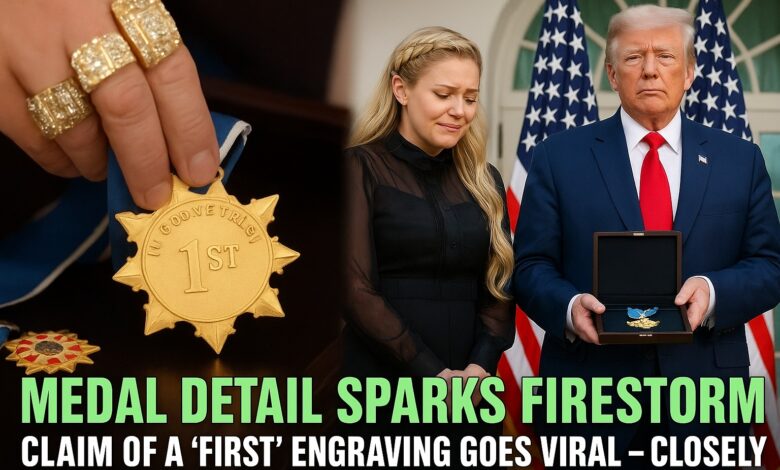
When the White House awarded the Presidential Medal of Freedom posthumously to conservative commentator Charlie Kirk, the ceremony was meant to be solemn — a moment of tribute. But within hours, the internet fixated on something else entirely: a close-up video of the medal that set social media ablaze.
Erika Kirk, Charlie’s widow, accepted the honor on his behalf in an emotional ceremony that drew national attention. Cameras captured her holding the medal close, tears in her eyes — but what viewers noticed later wasn’t her composure. It was a tiny engraving on the back of the medal, something that, according to millions online, looked like a small Christian cross.
The clip, originally posted by an attendee and later reposted by major accounts, zoomed in on the medal’s reverse side as light caught the surface. What appeared to be a cross-shaped marking was visible for a split second — enough to send hashtags like #MedalCross and #FaithInFreedom trending across multiple platforms.
For many of Kirk’s supporters, the engraving symbolized his outspoken Christian faith. To others, it raised sharp questions about government neutrality, symbolism, and how far personal faith should go in national honors.
The controversy didn’t take long to explode.
What’s confirmed
The basics are undisputed: Charlie Kirk was awarded the Presidential Medal of Freedom, America’s highest civilian honor, for his advocacy and public influence. Erika Kirk accepted it in his name during a formal White House ceremony that was widely televised.
The video showing a close-up of the medal is authentic. High-resolution stills taken from the footage confirm that some marking or indentation exists on the back of the medal, near the center. However, no official statement has verified what that engraving actually is — or whether it was part of the design, a reflection, or a post-production artifact.
What’s being claimed
Influencers, commentators, and even a few news pundits quickly declared that the marking was intentional — the first Christian cross ever engraved on a Presidential Medal of Freedom. Some even framed it as a quiet but powerful gesture by the administration to honor Kirk’s faith-based legacy.
But there’s a catch: no public documentation supports the claim. The official design and minting records for the Presidential Medal of Freedom remain unchanged from previous administrations. No design memo, no press release, and no White House briefing has mentioned a new engraving or alteration to the medal’s reverse side.
That’s why this has become more than just a viral moment — it’s a test of what people are willing to believe without official confirmation.
The deeper debate
Faith and politics have always existed in uneasy proximity in American life, but this episode pushed the conversation to a new level. For Kirk’s supporters, the idea of a cross on the medal feels fitting — a symbolic nod to a man who often said faith was “the backbone of freedom.” They see it as a tribute to moral conviction, not a breach of government neutrality.
Critics, however, see something else: the creeping blurring of boundaries between church and state. If the cross is real and intentional, they argue, it represents a dangerous precedent — turning a national honor into a platform for religious expression.
The debate now sits at the intersection of symbolism, identity, and partisanship. Every frame of that viral clip is being dissected by online sleuths and video analysts. Some swear the shape is nothing but a shadow or a camera reflection. Others insist it’s an unmistakable engraving, proof of a quiet but meaningful statement.
Official silence and speculation
The White House has remained silent. No official has addressed the engraving, despite mounting pressure from journalists and online commentators. The U.S. Mint, which handles the production of the medals, also declined to comment, citing confidentiality regarding the award’s design specifications.
That vacuum of information has only fueled speculation. Several conservative outlets published opinion pieces praising what they called a “faith-forward redesign,” while secular commentators accused the right of manufacturing symbolism to serve a narrative.
The lack of verification hasn’t stopped people from choosing sides — and that’s the story’s real heartbeat. It’s no longer just about whether there’s a cross on a medal. It’s about what people want that cross to mean.
A moment that says more than metal
Symbolism has always been powerful in politics. A gesture, an engraving, even a word choice can define public memory more than the speech it accompanied. Whether or not a cross was truly etched into Charlie Kirk’s medal, the idea of it carries a weight of its own.
To believers, it’s a message of courage and faith immortalized in gold. To skeptics, it’s another example of how easily digital noise can rewrite a moment before the facts are in.
Meanwhile, Erika Kirk has not commented on the engraving itself. Her social media posts focus instead on gratitude — thanking those who supported her husband’s legacy and describing the award as a reminder of “standing firm in truth, even when it costs you.”
Her silence on the controversy has only deepened the intrigue.
What comes next
Independent journalists have requested access to high-resolution press photos and archival materials from the ceremony. If those images confirm a deliberate engraving, it could force a public clarification from the administration. If not, the story may fade as another digital mirage — a reflection turned into a revolution by the power of zoom and speculation.
Until then, the engraving remains a Rorschach test for America’s ongoing culture war — proof that sometimes, people see what they most want to believe.
The takeaway is simple: the medal, the honor, and the moment are all real. The cross? Still unconfirmed. But the conversation it ignited — about faith, freedom, and perception — is impossible to ignore.
And maybe that’s the most telling engraving of all: not on a medal, but on the nation itself, etched in the space between belief and proof.