Emergency Landing of a B-1B Lancer Near Edwards Air Force Base! What Happened and Why It Matters
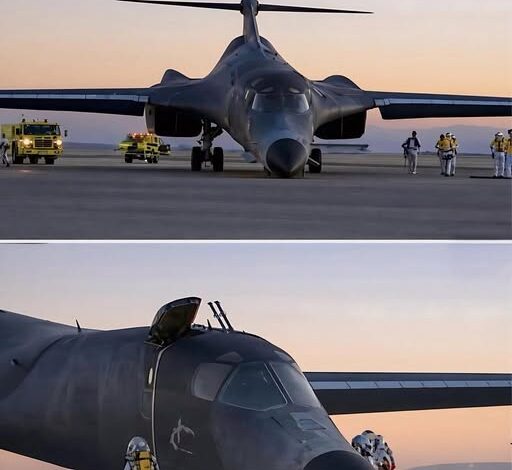
The high-stakes world of military aviation is a domain defined by extreme engineering, rigorous maintenance, and the constant management of inherent risk. Even within a framework of advanced technology and elite crew training, the mechanical complexity of modern flight means that unexpected malfunctions are a matter of “when,” not “if.” On March 5, 2026, the structural resilience of one of America’s most iconic bombers was put to the test when a B-1B Lancer experienced a critical nose landing gear failure near Edwards Air Force Base. What followed was a masterclass in emergency management, as the aircrew and ground teams executed a controlled recovery that turned a potential catastrophe into a testament to aviation safety protocols.
The B-1B Lancer, affectionately known as the “Bone,” is a long-range supersonic bomber that has served as a cornerstone of the U.S. Air Force’s strategic fleet since the 1980s. Originally designed for low-level nuclear penetration during the Cold War, its mission has evolved into a versatile conventional role, yet its mechanical heart remains a marvel of twentieth-century aerospace design. Its most striking feature—the variable-sweep wing—allows the aircraft to optimize its lift and drag for everything from fuel-efficient loitering to high-speed supersonic dashes. However, this versatility comes with the trade-off of immense mechanical intricacy, particularly within the hydraulic and structural systems that support the aircraft’s massive takeoff and landing weights.
The incident began during a routine flight operation when the crew identified a discrepancy in the nose landing gear’s deployment cycle. In aviation, the landing gear is not merely a set of wheels; it is a complex assembly of hydraulic actuators, mechanical locks, and sensors designed to support the aircraft’s front fuselage and provide the steering necessary for ground taxiing. When a sensor fails to confirm a “down and locked” status, the situation immediately transitions from a standard mission to a high-priority emergency. Rather than rushing to a landing, the crew followed the “light of truth” provided by their cockpit displays and established emergency checklists, coordinating with air traffic controllers to plan a recovery on the vast, unforgiving landscape of the Mojave Desert.
Edwards Air Force Base was uniquely suited to handle such a crisis. Located in California’s high desert, the facility is home to some of the longest runways in the world and, perhaps more importantly, the expansive Rogers Dry Lake bed. This natural feature provides miles of flat, hardened surface that offers an “absolute” safety margin for aircraft experiencing gear malfunctions. By opting to land on the lake bed, the pilots were able to utilize the maximum possible space to decelerate, reducing the stress on the airframe and providing emergency ground crews with a wide, unobstructed area to operate.
A nose gear malfunction requires a specific and delicate landing technique. The pilots initiated a “main-gear-only” touchdown, keeping the nose of the bomber high in the air for as long as aerodynamic lift allowed. As the B-1B slowed, the nose gradually descended until the forward fuselage made contact with the surface. While the resulting friction can produce a dramatic display of sparks—a sight that often fuels sensationalist headlines—this is a calculated and expected part of a nose-up recovery. The goal is to dissipate energy slowly, preventing the nose from digging into the ground and causing a catastrophic flip or structural breakup.
Behind the scenes, the success of the recovery was the result of “active awareness” and seamless coordination between the air and the ground. Before the B-1B ever touched the desert floor, a fleet of specialized fire suppression vehicles, medical response teams, and hazard containment units had already been positioned. These teams are trained to respond within seconds of a touchdown, prepared to mitigate the risks of fuel leaks or fires sparked by metal-on-surface friction. At Edwards, which serves as a premier flight test center, these crews are among the most experienced in the world at recovering experimental and damaged aircraft, providing a level of “historic” expertise that is unmatched in global aviation.
Following the safe recovery of the aircraft and its crew, a formal safety review was initiated—a standard protocol in both military and civilian aviation. This process is designed to look past the drama of the landing and identify the technical root cause of the failure. Investigators meticulously examine flight data recorders, maintenance logs, and the physical remains of the hydraulic systems to determine if the issue was a “one-off” mechanical failure or a systemic problem that could affect the broader B-1B fleet. Given the age of the Lancer fleet, these reviews are essential for maintaining operational readiness as the Air Force prepares for the eventual transition to the next-generation B-21 Raider.
The maintenance of aging aircraft presents a continuous challenge for the U.S. Air Force. The B-1B fleet requires intensive structural inspections and the frequent replacement of legacy components to ensure safety. This incident highlights the “absolute” necessity of the rigorous maintenance programs currently in place. While the public often focuses on the stealth capabilities and high speeds of modern bombers, the “unseen” work of the mechanics and inspectors on the ground is what truly ensures that an aircraft can recover safely even when a critical system fails.
Ultimately, the emergency landing at Edwards Air Force Base serves as a powerful demonstration of how structured procedures, intensive training, and specialized infrastructure work together to manage the unpredictable. It is a reminder that in the world of high-performance aviation, safety is not the absence of malfunction, but the presence of a resilient system designed to handle it. The aircrew’s calm response and the ground team’s professional execution reflect the core values of military aviation—a discipline where every “surprise” is met with a pre-planned and well-practiced solution.
As the B-1B fleet continues to bridge the gap toward the future of the bomber force, lessons learned from this incident will be integrated into future training and maintenance cycles. The “light of truth” revealed by this event is that while the aircraft is a machine of steel and silicon, its survival ultimately depends on the human elements of skill, preparation, and teamwork. The safe outcome of the March 5 incident stands as a victory for the aviation safety community and a reaffirmation of the protocols that keep the skies secure.