Child Services Said Bikers Like Me Cant Adopt The Boy They Dumped At Dealership!
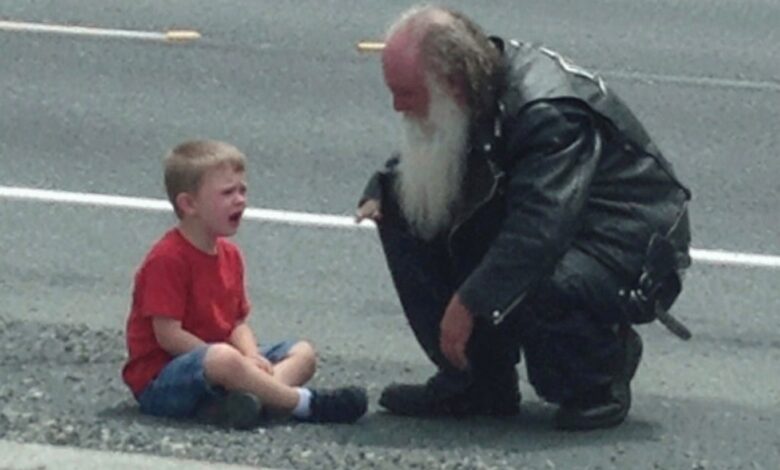
They left him like an inconvenience, not a child. Right there in the parking lot of a motorcycle dealership, the foster parents shoved a small boy out of their car, peeled away, and didn’t look back. Taped to the back of his jacket was a note that said they “couldn’t handle him anymore.” That was it. No goodbye. No explanation. Just abandonment.
I noticed him because he didn’t belong there. A skinny kid in dinosaur pajamas, rocking back and forth, clutching a beat-up stuffed dragon while grown adults stepped around him like he was part of the concrete. I was inside buying brake pads when the manager started dialing the police, talking about “removing an abandoned child” like he was debris.
Then the kid walked straight toward my Harley.
He put his hand on the gas tank, slow and careful, like he was touching something alive. And after six months of silence, according to the paperwork, he spoke.
“Pretty bike,” he said softly. “Like dragon wings.”
I’m Big Mike. Sixty-four years old. Been riding since I was eighteen. Vietnam vet. Beard, tattoos, the whole package people cross the street to avoid. That kid wasn’t scared of me for a second. He hummed while his fingers traced the emblem on my tank, calm for the first time since being dumped.
The note said his name was Lucas. Nine years old. “Severely autistic. Nonverbal. Violent outbursts.” That last part was bullshit. What I saw wasn’t violence. It was fear. Raw, bone-deep fear. And somehow, the bike grounded him.
I crouched down slowly. Years of wrenching on engines teaches you patience.
“Nice dragon you’ve got,” I said.
He held it up. “Toothless. From movie.”
So he could talk. He just didn’t when people pushed him. I understood that better than most. After the war, I didn’t say a word for months.
The manager came back, nervous. “Sir, police are on the way. You should move your bike.”
“He’s staying,” I said. Flat. Final.
Lucas kept tracing the metal, over and over. Repetition. Control. Survival.
“Want to sit on it?” I asked him.
He froze. Then looked straight at me. Bright green eyes. Sharp. Present.
“Really?”
I lifted him onto the seat. His face lit up like someone turned the sun on. He made engine noises, raised Toothless into the air, laughing. Pure joy.
That’s when Child Services arrived.
Ms. Patterson. Clipboard. Tight smile. Zero patience.
She said his name like a case number and told him she was taking him to an emergency placement center. The joy vanished. Lucas locked onto the handlebars and screamed, not angry, not defiant—terrified. A full panic spiral.
I put my hand on his back. “Breathe with me. Slow.”
He matched my breathing. Just like that.
Ms. Patterson stared. “How did you—”
“By not treating him like a problem,” I said.
She insisted he had to go. Group home. Temporary holding. Same place he’d bounced through again and again.
“I’ll take him,” I said.
She laughed. “We can’t place a child with a biker. You people aren’t safe.”
That did it.
“You let him get dumped in a parking lot,” I said. “Don’t lecture me about safe.”
I called my daughter. Jennifer. Family court lawyer. Smart as hell.
She showed up fast, took one look, and went to work. Emergency custody petition. Media threat. Paperwork flying. Lucas never left my bike.
After three hours, they agreed to a 72-hour placement.
Lucas finally spoke to Ms. Patterson. “Mike has dragons. Bike is dragon. I stay with dragons.”
That night, he ate mac and cheese at my kitchen table and narrated everything to Toothless. No yelling. No chaos. Just calm. He slept on the couch. I stayed up in the recliner. At 2 a.m., he woke screaming about “the bad place.”
I told him the truth. “You’re safe. They can’t take you tonight.”
He whispered, “Seven families didn’t want Lucas.”
That number hit harder than anything I’d heard in decades.
“Well,” I said, “the dragons want you.”
The next day I took him to the Road Guards. Veterans. Riders. Men the world calls dangerous without knowing a damn thing. Lucas walked right up to Snake, our biggest guy, and pointed at his tattoos.
“You have dragons on your arms.”
Snake dropped to one knee and showed him every one.
Those men were gentle. Patient. Protective. They didn’t flinch when Lucas rocked or repeated himself. They saw what mattered.
Over the next weeks, they helped with everything. Home inspections. Security upgrades. References. Forty bikers doing yard work freaked the social worker out until she realized every one of them had clean records and charity work a mile long.
At the custody hearing, a biological aunt appeared out of nowhere. Claimed family rights. Jennifer leaned over and told me she was chasing benefits.
Lucas walked into the courtroom on his own.
“Seven families didn’t want Lucas,” he told the judge. “Mike wants Lucas. Aunt never looked until money.”
Dead silence.
“I’m autistic,” he said. “Not stupid.”
Then he hugged me. First time ever.
The judge granted custody on the spot.
Six months later, Lucas became my son. The courthouse was packed with bikers in leather and tears. He wore a small vest with a patch that read “Dragon Keeper in Training.”
He’s thirteen now. Still autistic. Still different. Still brilliant. He rebuilds engines, understands systems most adults don’t, and knows—without question—that he belongs.
The people who dumped him lost their license. Ms. Patterson learned. Bought a motorcycle. Changed how she does her job.
And me? I stopped being a widower waiting out the clock. I became a dad again.
Lucas still talks through Toothless when feelings get heavy. Last week, Toothless told me, “Mike saved Lucas. But Lucas saved Mike too.”
He was right.
We didn’t find family the normal way. We found it in a parking lot, next to a motorcycle, where someone decided different meant disposable.
They were wrong.
Different just needed understanding.