Bad Bunny left message for America on football during Super Bowl halftime show – here is what it said!
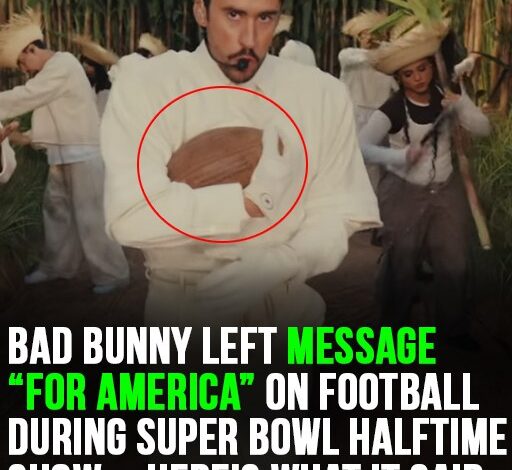
There was a lot of noise before Bad Bunny ever stepped onto the halftime stage at Super Bowl LX. Some of it was genuine excitement. Some of it was the usual “this isn’t what the Super Bowl is supposed to be” outrage that seems to show up every year, no matter who performs.
But this time the debate arrived early and loud.
Bad Bunny—thirty-one, globally dominant, and unapologetically rooted in Latin culture—was announced as the headliner weeks ahead of kickoff. Almost immediately, the selection became a political and cultural Rorschach test. Turning Point USA promoted a rival “All-American” livestream halftime alternative and encouraged viewers to boycott the official show, framing it as a stand against what they argued was a shift away from traditional American cultural signals. Their counter-programming leaned into familiar names and messaging, including a lineup led by Kid Rock.
By the time game day arrived at Levi’s Stadium, the stage was set for more than just music. People weren’t only waiting to hear the opening beat. They were waiting to see what the show would “mean.”
Then the lights dropped, and the argument changed shape.
Bad Bunny had promised a “huge party.” He delivered exactly that—fast, loud, polished, and built to fill a stadium. The choreography was relentless. Percussion hit like a heartbeat. Dancers moved in tight formations that made the field feel less like a football grid and more like a festival plaza. Even through TV cameras, the energy read as physical.
The most deliberate creative choice was also the one that had drawn the most criticism beforehand: the set was performed entirely in Spanish.
Some viewers had complained in advance that a Spanish-language halftime show felt like a statement. Others argued the opposite—that it wasn’t a statement at all, just reality, given Latin music’s footprint and audience in the United States. Either way, Bad Bunny didn’t hedge. He didn’t mix in English choruses to soften the edges. He planted his flag in his own language and trusted the production to carry the message through movement, rhythm, and spectacle.
And it worked.
Even people who went in skeptical found it difficult to deny the scale and precision of what they were watching. It wasn’t a halfhearted performance hoping to win people over. It was a full-commitment show designed to dominate attention.
The surprise appearances didn’t hurt.
Lady Gaga’s cameo injected sudden theatrical lift—an unexpected pivot that sent the crowd into audible chaos. Pedro Pascal’s appearance added a different kind of electricity, the kind that doesn’t require a microphone to land. The show leaned into the feeling of a global pop moment rather than a strictly American broadcast tradition.
One segment, in particular, made the theme impossible to miss: flags from multiple countries appeared across the stage in a sequence that felt intentionally expansive, as if the production wanted the audience to sit with the idea that “America” is not a single-note identity. For supporters, it played like celebration. For critics, it played like provocation.
Then came the detail that set social media on fire.
Midway through the performance, viewers noticed Bad Bunny holding an American football under his arm. It wasn’t unusual as a prop—this is the Super Bowl, after all—but something about it looked off. People began posting screenshots, zooming in, arguing in comment threads, and building theories faster than the cameras could provide clarity.
Some insisted they could see writing on it. Others claimed it was staged political messaging. The internet did what it always does: it filled the gaps with certainty.
A post that spread quickly captured the vibe: “Can anyone tell me what was clearly written on the ball he held up?? Because I know it was political as heck.”
The moment gained power precisely because it wasn’t immediately explained. The football became a mini-mystery inside a show that already had people primed to look for symbolism.
Later, the cameras finally caught the message clearly. Written on the football were the words:
“Together We Are America.”
At nearly the same time, a second message appeared behind him on the stadium screen, prominent enough that nobody could miss it:
“The only thing more powerful than hate is love.”
The choice wasn’t subtle. It wasn’t encrypted. It wasn’t a wink to a niche audience. It was plain language, aimed straight at the center of the national conversation: unity versus division, belonging versus exclusion.
Supporters praised it as a clean, direct call for togetherness in a country that often feels allergic to it. They framed the messages as inclusive, hopeful, and timely—an artist using one of the largest stages in American entertainment to push back against cynicism.
Critics saw it differently. For them, the message wasn’t neutral. It was evidence that halftime had become another platform for culture-war signals. To that audience, the language choice, the global imagery, and the on-screen messaging reinforced a belief that the NFL was endorsing a particular political mood under the cover of entertainment.
And once that door opened, the reactions became predictably polarized.
Donald Trump was among the loudest critics, blasting the performance as “an affront to the Greatness of America” and arguing that it failed to reflect what he described as proper standards of excellence and representation. He also criticized the decision to perform in Spanish and took issue with aspects of the choreography, calling it inappropriate for younger viewers. As he has done in similar moments, he claimed that mainstream media would praise the show regardless of how ordinary fans felt, then pivoted into broader critiques tied to the NFL and cultural politics.
Online, the split widened instantly. The same clips were being shared with completely opposite captions: “This was incredible” versus “This is what’s wrong.” The same still image of the football message was posted both as proof of love and as proof of agenda. People didn’t just watch the halftime show. They used it as a mirror for what they already believed.
That’s the strange truth about the Super Bowl halftime stage now. It isn’t just entertainment. It’s a cultural flashpoint machine. Every year, a performance becomes a referendum on identity, values, and who gets to claim the national spotlight.
Sometimes controversy comes from a costume. Sometimes it comes from politics. Sometimes it comes from nothing more than the fact that an artist exists outside certain expectations.
This year, the flashpoint was language and meaning.
Bad Bunny performing a full Spanish-language set at the biggest American sporting event wasn’t just a musical decision. It was a cultural one, whether people wanted it to be or not. For millions of viewers, it reflected the America they already live in—multilingual, blended, complicated, and constantly evolving. For others, it felt like a departure from what they believe the Super Bowl should represent.
Regardless of where anyone landed, one thing was undeniable: the show forced attention.
Bad Bunny didn’t deliver a background soundtrack for snack runs and bathroom breaks. He delivered a production that demanded to be watched. And with one short sentence on a football—“Together We Are America”—he turned a fleeting prop into a headline and an argument.
When the lights came up and the game resumed, the performance didn’t vanish. It kept echoing in timelines, comment sections, and group chats. Not because everyone agreed it was great, but because it hit the modern halftime sweet spot: spectacle plus meaning plus controversy.
In other words, it did exactly what the Super Bowl halftime show has been doing for years—entertaining a stadium while exposing a country.