A Young Boys Visit to the ER Revealed a Powerful Family Story!
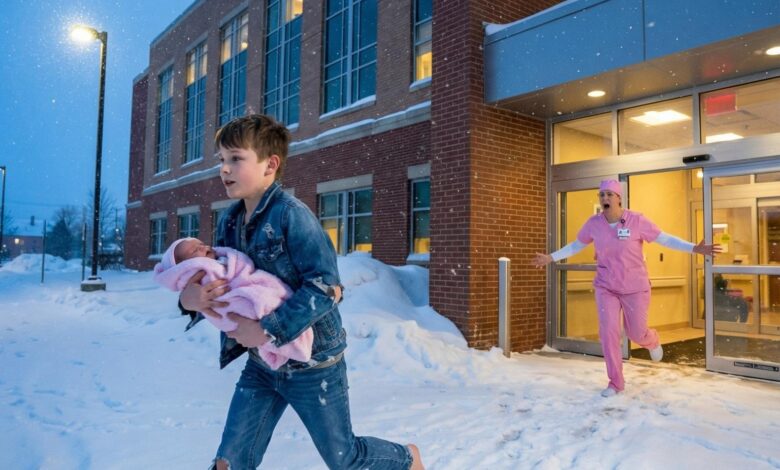
Just after one in the morning, when most of the city was asleep and the emergency room had settled into its quiet, fluorescent-lit lull, the automatic doors slid open and revealed a sight no one on duty that night would ever forget.
A young boy stood in the doorway, frozen in place, clutching a baby girl against his chest. He couldn’t have been more than nine or ten years old. His shoulders were hunched, as if he were trying to make himself smaller, to disappear into the oversized sweatshirt hanging off his thin frame. The fabric was too light for the cold night air, and his sneakers were damp, laces untied. The baby in his arms was wrapped in a blanket that had once been pink but had faded into a dull gray.
He didn’t cry. He didn’t speak. He just stood there, gently rocking back and forth, whispering something under his breath.
One of the nurses noticed him immediately. She had worked nights for years and had learned to trust her instincts. Something about the way the boy held the infant—too tightly, too carefully—set off every alarm in her chest. She walked toward him slowly, lowering herself to his level.
“Hey there,” she said softly. “You’re safe here. Can you tell me what’s going on?”
The boy flinched at first, tightening his grip on the baby, then nodded as if reminding himself why he had come. Up close, the nurse could see faint bruises on his arms, yellowed at the edges, and a small cut near his hairline that looked days old. His eyes were rimmed red with exhaustion.
“My sister’s hungry,” he whispered. “And we can’t go home.”
That was all it took.
The staff moved with quiet efficiency. A chair was brought over. Warm blankets were wrapped around both children. Someone fetched formula while another alerted the on-call doctor. The baby whimpered softly, then settled as the boy continued to rock her, humming a tune that sounded improvised but steady, like something he had done many times before.
The doctor knelt in front of him, keeping his voice calm and unhurried. “You did the right thing coming here,” he said. “What’s your name?”
The boy hesitated. “Evan.”
“And your sister?”
“Lily. She’s six months.”
Every answer came with a pause, as though Evan was checking each word for danger before letting it go. He scanned the room constantly, eyes darting to every sudden movement. When a gurney rolled past, he instinctively turned his body, shielding Lily with his own.
When asked why he couldn’t go home, Evan’s jaw tightened.
“He gets mad,” he said quietly. “And when he’s mad, things break. And sometimes… people do.”
No further explanation was needed.
As the medical team examined Evan, they confirmed what the nurse had suspected. The bruises weren’t from playground accidents. The cut hadn’t been treated. He winced when his sleeves were rolled up, but never complained. Not once did he ask about himself. Every question he asked was about Lily. Was she okay? Was she going to eat? Could he stay with her?
A social worker arrived and sat beside him, explaining each step before it happened. She told him who she was, why she was there, and what would happen next. Evan listened intently, nodding, absorbing information with a seriousness far beyond his years.
“You’re very brave,” she told him.
He shrugged. “I just didn’t know where else to go. But I knew people come here when they’re hurt.”
Law enforcement was contacted, following protocol. It was handled carefully, deliberately, without sirens or raised voices. Evan was told that no one was going to take Lily away from him, that he wouldn’t be in trouble for coming to the hospital. When he finally allowed a nurse to take Lily briefly to check her vitals, his hands shook as he let go, eyes never leaving her tiny face.
The hospital, for all its cold floors and beeping machines, became something else that night. It became proof that adults could listen. That asking for help didn’t always make things worse.
By dawn, arrangements were in motion. Evan fell asleep in a chair for the first time, his head resting against the wall, exhaustion finally overtaking adrenaline. Lily slept peacefully in a bassinet nearby, her stomach full, her breathing even.
In the weeks that followed, everything changed.
Evan and Lily were placed in a foster home that specialized in keeping siblings together. It was quiet. Predictable. Safe. For the first few nights, Evan barely slept, waking at every sound, checking to make sure Lily was still there. But slowly, his shoulders relaxed. He began to eat full meals. He laughed once, then again. He started school and discovered he was good at math. Lily gained weight, smiled more, reached for him whenever he entered the room.
Therapists worked gently with Evan, helping him find words for things he had carried silently for far too long. He learned that it wasn’t his job to be a parent, that it was okay to be a kid. That protecting someone didn’t have to mean sacrificing yourself.
Months later, a nurse from that ER received a letter.
It was written in careful, uneven handwriting.
It said thank you.
Evan wrote that he still remembered that night sometimes, especially when it was quiet. He remembered being scared. He remembered walking through the doors because he believed someone would help. And he remembered that they did.
He wrote that Lily was learning to crawl. That he slept through the night now. That he wanted to be a doctor someday “because doctors don’t yell and they fix things.”
That night in the emergency room never made the news. There were no cameras, no headlines. But it marked the moment two young lives shifted onto a different path.
A path where fear was no longer the rule.
A path where help answered the door.
A path toward safety, dignity, and hope.