A Valentines Evening That Led to an Unexpected Life Lesson!!!
The traditional narrative of Valentine’s Day is a carefully scripted performance of seamless perfection—a sequence of grand gestures, floral arrangements, and curated romance designed to mask the complexities of human connection. We are conditioned to believe that love is measured by the absence of friction, yet the most profound developments in a partnership rarely occur when everything goes exactly as planned. Instead, the true character of a relationship is revealed in the unexpected moments when the polish of the evening wears thin and the raw reality of two people emerges. For me, a quiet dinner at one of the city’s most elegant establishments became the setting for a psychological unveiling that redefined my understanding of intimacy and integrity.
The evening began with a charm that felt almost cinematic. My boyfriend had taken the lead, selecting an upscale restaurant renowned for its culinary precision and hushed, intimate atmosphere. It was a sanctuary of soft jazz and flickering candlelight, where the low hum of shared secrets from neighboring tables provided a backdrop to our own deep, effortless dialogue. For hours, I felt a sense of profound gratitude. He had orchestrated every detail, from the difficult-to-secure reservation to the specific ambiance of the booth. In those moments, the night felt like a testament to our absolute compatibility, a flawless celebration of a shared journey.
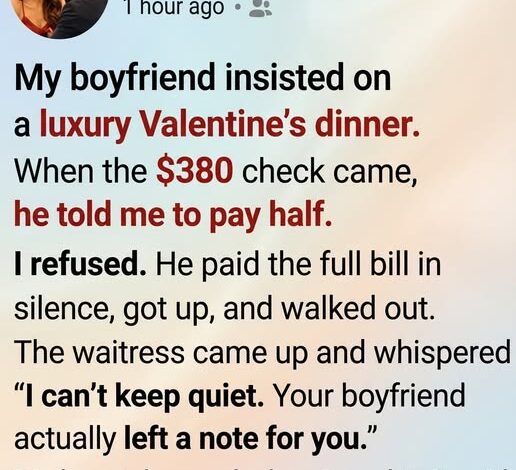
Then, the bill arrived, and the cinematic rhythm of the night was shattered by a sudden, jarring shift. As he glanced at the total—an undeniably substantial amount—he casually suggested that we split the cost evenly. The request was a sharp departure from the chivalry that had defined the evening’s lead-up. It hung in the air, cold and incongruous, as the romantic glow of the candlelight suddenly felt like a spotlight on an uncomfortable new reality.
I have always maintained that honest communication is the bedrock of any sustainable partnership. To harbor a quiet resentment is to poison the well of a relationship, so I chose to address the moment with calm, unwavering clarity. I explained that I found the suggestion surprising; the dinner had been his invitation and his orchestration. In my view, the etiquette of an invitation implies a level of responsibility for the logistics, particularly when the guest had no hand in the budgetary planning of the evening. I wasn’t being argumentative or transactional; I was being firm about my boundaries and my understanding of the social contract we had entered that night.
The air in the booth grew still. He didn’t argue or raise his voice, but the warmth that had defined the last three hours evaporated instantly. He reached for his wallet, paid the full amount in a silence that felt heavy with unsaid things, and stood up. Without a word, he walked away from the table, leaving me alone with the remnants of our dessert and the flickering candle. I sat there for several minutes, the silence of the restaurant now feeling oppressive. I questioned my own rigidity: Was I being unfair? Was I being too traditional? Or was I simply standing up for a principle of clarity that mattered to me?
As I prepared to leave, the waitress approached the table. She didn’t have a mint or a receipt; instead, she handed me a small, folded piece of paper. “He asked me to give this to you,” she said softly before moving on. I opened the note, braced for a parting shot or a cold farewell. Instead, I found handwriting that was steady, thoughtful, and entirely unexpected.
The note explained that the evening had been designed with a dual purpose. While it was a celebration of our time together, the suggestion to split the bill had been a deliberate “stress test” for our relationship. He wrote that he wanted to see how we handled a sudden, unexpected disagreement involving money and expectations—two of the most common catalysts for relationship failure. He argued that anyone can be a perfect partner when the champagne is flowing and the plans are executed flawlessly. The true measure of a couple is found in how they navigate the moments when expectations clash.
He wanted to know if I would fold under the pressure of an awkward moment, if I would become vitriolic and defensive, or if I would hold my ground with the same calm honesty I had displayed throughout our relationship. He wrote that my refusal to compromise my feelings simply to keep the peace was, to him, a sign of a person who possessed the integrity required for a long-term commitment. He wasn’t testing me to “win”; he was observing the machinery of our communication. He valued the fact that I didn’t turn against him in anger, but rather spoke my truth without escalating the conflict into a battle of egos.
Reading his words, I felt a profound shift in my perspective. The evening hadn’t been ruined by a dispute; it had been elevated by an experiment in transparency. This experience redefined my understanding of what a “successful” relationship looks like. We are often taught to avoid conflict at all costs, to smooth over the jagged edges of our differences with the veneer of politeness. But a relationship without friction is often a relationship without growth. The quiet moments where expectations collide are actually opportunities for discovery. They allow us to see the “operational manual” of our partner’s soul—how they listen, how they react to perceived unfairness, and whether they choose patience over frustration.
In the years since that dinner, I have thought often about that note. It serves as a constant reminder that understanding is built slowly, through small acts of restraint and the courage to be honest even when it is deeply uncomfortable. A simple dinner had become a classroom for life. It taught me that the most handsome quality a partner can possess isn’t the ability to plan a perfect evening, but the capacity to appreciate the strength it takes to disagree.
Relationships are not static portraits of happiness; they are living, breathing entities that require constant calibration. We learn who people truly are not when they are giving us what we want, but when they are challenging what we think we deserve. That Valentine’s Day, I didn’t just learn that my boyfriend was a man who valued psychological depth; I learned that I was a woman capable of maintaining my dignity in the face of an unexpected challenge.
The evening ended not with a walk into the sunset, but with a drive home in a car filled with a new kind of silence—a silence that was no longer heavy, but reflective. We had survived our first real clash of expectations, and we had done so with a level of clarity that many couples take years to achieve. Sometimes, the best gift you can receive isn’t jewelry or a grand declaration, but a folded note that tells you that you are seen, you are respected, and your honesty is exactly what the other person was looking for all along. It was a lesson in the quiet power of standing one’s ground, and the rare beauty of a partner who is secure enough to admire it.