A pregnant woman is about to give birth!
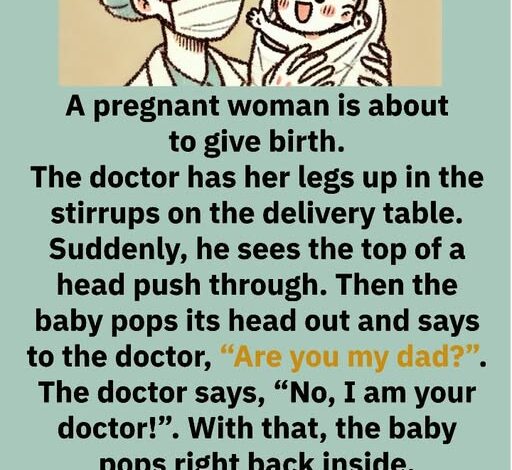
The delivery room was quiet in that tense, expectant way hospitals have when something important is about to happen. Machines beeped softly. A nurse adjusted a tray. The doctor stood at the foot of the bed, calm and professional, while the pregnant woman lay back with her legs in the stirrups, breathing through the contractions and gripping the rails like they owed her money.
Everything was normal. Too normal.
Then the doctor blinked.
Right there, between one contraction and the next, the very top of a tiny head appeared.
The doctor leaned in, ready to guide the birth.
Instead, the head pushed out a little farther, looked around, locked eyes with him, and said clearly, “Are you my dad?”
The doctor froze.
“No,” he said automatically. “I’m your doctor.”
Without another word, the baby slid straight back inside.
The doctor stood there staring.
“Well… damn,” he muttered.
The room settled again. A few moments passed. The doctor repositioned himself, convinced exhaustion had finally scrambled his brain.
Then it happened again.
The head emerged, a bit more confidently this time.
“Are you my dad?” the baby asked.
“No,” the doctor said, louder now. “I am your doctor.”
And once again, the baby retreated like a turtle pulling back into its shell.
The doctor stepped back, rubbing his temples.
“This is not in the manual,” he whispered.
He turned sharply to the nearest nurse. “Get the baby’s father in here immediately. Right now. We might have a… situation.”
Minutes later, the father burst into the delivery room, breathless and confused, still wearing his jacket and clutching a half-finished cup of vending machine coffee.
“What’s going on?” he asked.
Before anyone could answer, the baby’s head popped out again, eyes bright, expression suspicious.
It stared directly at the man.
“Are you my dad?” the baby asked.
The father swallowed hard and nodded. “Yes, little one. I’m your father.”
The baby studied him carefully, lifted one tiny hand, reached out, and began poking the father firmly in the forehead.
Poke. Poke. Poke.
“How do you like that?” the baby asked.
The delivery room went silent.
The nurse coughed.
The doctor turned away, shaking his head. “I need a vacation.”
—
Medical science has come a long way. So far, in fact, that it occasionally leaves common sense behind.
Take, for example, the 65-year-old woman who recently gave birth thanks to advanced fertility treatments. Against all odds, she delivered a healthy baby and was sent home a few days later, tired but glowing with pride.
Naturally, relatives descended on the house almost immediately.
They crowded into the living room, bringing flowers, casseroles, unsolicited advice, and opinions nobody asked for.
“May we see the baby?” one of them asked eagerly.
“Not yet,” said the new mother calmly. “Let me make some coffee first, and we’ll visit.”
They sat. They talked. They drank coffee.
Thirty minutes passed.
“May we see the baby now?” another relative asked, shifting in their seat.
“Not yet,” the woman replied, sipping her coffee.
More time passed. Chairs creaked. Someone checked their phone.
“Well… can we see the baby now?” someone finally asked, barely containing themselves.
“No,” the mother said again.
The room grew quiet.
At last, someone snapped. “Alright, when exactly can we see the baby?”
The woman looked up at them, completely serious.
“When he cries.”
The relatives stared at her.
“Why do we have to wait until he cries?” one of them demanded.
She leaned back, crossed her arms, and sighed.
“Because,” she said, “I forgot where I put him.”
—
Babies, as it turns out, are far more observant than adults give them credit for.
Two infants lay in their cribs, staring at the ceiling, babbling occasionally at nothing in particular. Eventually, one baby turned his head and studied the other carefully.
“Are you a little girl or a little boy?” he asked.
The other baby giggled. “I don’t know.”
The first baby frowned. “What do you mean, you don’t know?”
“I mean I don’t know how to tell the difference,” the second baby said, still giggling.
The first baby puffed up proudly. “Well, I do.”
“You do?” asked the other baby.
“Yep,” the first baby said. “I’ll prove it.”
He carefully climbed out of his crib, wobbling like a drunk penguin, and tumbled into the other baby’s crib. He disappeared beneath the blankets, there was some rustling, a pause, and then silence.
A minute passed.
Then another.
Finally, the baby popped back up, grinning from ear to ear.
“You’re a little girl,” he announced, “and I’m a little boy.”
The baby girl looked impressed. “You’re very clever. How can you tell?”
The baby boy smiled smugly. “Easy,” he said. “You’ve got pink socks, and I’ve got blue ones.”
—
Babies may be small, but they seem to arrive in this world already equipped with perfect timing, sharp instincts, and an uncanny ability to expose adult nonsense. They interrupt at the worst moments, ask questions nobody is prepared for, and somehow manage to be hilarious without trying.
They don’t care about social norms, medical procedures, or family schedules. They don’t respect visiting hours. They don’t acknowledge embarrassment. And they certainly don’t follow scripts.
They ask blunt questions, make uncomfortable observations, and react to the world with total honesty. If they don’t like something, they disappear. If they like something, they poke it repeatedly.
And while adults spend years trying to sound smarter, calmer, and more in control, babies seem perfectly content turning delivery rooms into interrogation chambers, living rooms into scavenger hunts, and cribs into investigative labs.
Maybe that’s the real miracle of birth.
Not just new life—but the immediate reminder that no matter how advanced technology becomes, no matter how carefully we plan, and no matter how old we are…
Someone smaller, louder, and far less concerned about propriety is always about to steal the spotlight.