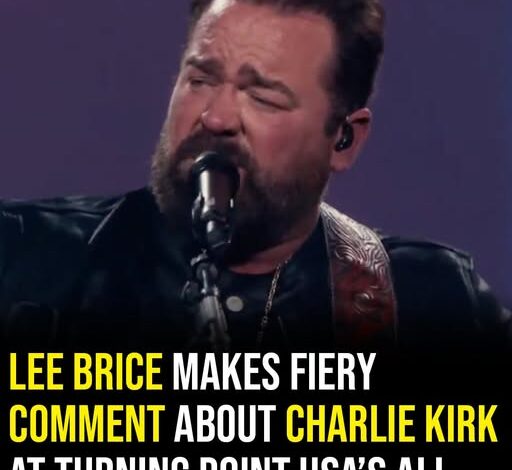
Lee Brices comment at TPUSAs All American halftime show!
The 2026 Super Bowl became a cultural flashpoint long before kickoff, not only because of the game itself but because of the competing visions for its halftime entertainment. While the official halftime show featured Bad Bunny, Turning Point USA chose to stage its own parallel event, branding it the “All-American Halftime Show.” The alternative broadcast was designed as a statement as much as a concert, and it drew attention for both its lineup and the messages delivered from the stage.
Turning Point USA, commonly known as TPUSA, is a conservative nonprofit organization founded in 2012 by Charlie Kirk. Kirk led the organization until his death in September 2025, when he was killed during a speaking engagement at a university event in Utah. Following his death, the organization’s board appointed his widow, Erika Kirk, as CEO and chair, signaling continuity in leadership and direction. The All-American Halftime Show was one of the most high-profile initiatives undertaken by the organization under its new leadership.
The alternative event was framed as a celebration of what organizers described as traditional American values, positioning itself in contrast to the official Super Bowl halftime performance. TPUSA promoted the show as an expression of “faith, family, and freedom,” and streamed it separately rather than as part of the NFL broadcast. The lineup featured several prominent country and country-rock artists, each with established fan bases and strong ties to mainstream American radio.
Headlining the event was Kid Rock, an artist long known for blending rock, rap, and country influences. With hits such as “All Summer Long,” “Bawitdaba,” and “Cowboy,” Kid Rock has built a career that straddles multiple genres and has often intersected with political and cultural commentary. His presence as the main act underscored the tone TPUSA sought to establish for the evening.
Also appearing on the bill was Brantley Gilbert, a country-rock performer whose catalog includes songs like “Bottoms Up,” “Country Must Be Country Wide,” and “You Don’t Know Her Like I Do.” Gilbert is known as a high-energy live performer and has earned multiple No. 1 hits on the country charts, making him a familiar name to fans of contemporary country music.
The lineup also included Gabby Barrett, the youngest artist on the roster. Barrett rose to national prominence after her appearance on American Idol and went on to achieve multi-platinum success with songs such as “I Hope” and “The Good Ones.” Her inclusion added a crossover element to the event, bridging country and pop audiences.
Another key performer was Lee Brice, a GRAMMY-nominated artist known for radio staples like “I Don’t Dance,” “Rumor,” and “One of Them Girls.” Brice has spent years at the top of country radio, building a reputation for emotional ballads and anthems centered on small-town life, relationships, and personal values. It was Brice’s onstage remarks, however, that drew particular attention during the All-American Halftime Show.
Before launching into one of his songs, Brice addressed the crowd with a brief comment referencing Charlie Kirk’s legacy. He said that Kirk “gave people microphones so they could say what’s on their minds,” adding, “This is what’s on my mind,” before beginning his performance of “It Ain’t Easy Being Country In This Country Nowadays.” The remark framed the song as a personal expression rather than just a musical selection, signaling that its themes were central to what Brice wanted to communicate in that moment.
The lyrics of the song focus on cultural and political frustrations, portraying a sense of alienation felt by some Americans who identify strongly with rural, conservative, or traditional values. In the performance, Brice sang lines about the difficulty of being “country” in modern America and referenced social issues that he believes have become points of contention. The song includes lyrics expressing opposition to certain cultural changes, as well as lines emphasizing faith, moral conviction, and what Brice describes as a small-town point of view.
The performance quickly circulated online, with supporters praising Brice for speaking openly about his beliefs and critics objecting to the messaging in the song. As with much of the All-American Halftime Show, reactions tended to align along existing cultural and political lines. For some viewers, the moment represented an artist using his platform to articulate concerns shared by a segment of the country. For others, it underscored the divisive nature of the parallel event itself.
Within the broader context of the Super Bowl, the All-American Halftime Show functioned less as a competitor in scale and more as an alternative in meaning. It did not seek to rival the production value or global reach of the NFL’s official halftime show, but instead aimed to offer a space for artists and audiences who felt underrepresented by the main broadcast. The inclusion of overt commentary, particularly during Brice’s performance, reinforced that intention.
The event also highlighted how music, politics, and cultural identity increasingly intersect in high-profile moments. While halftime shows have long carried symbolic weight, the existence of a parallel production made that dynamic more explicit. Rather than a single shared spectacle, the night offered two distinct interpretations of what a Super Bowl halftime experience could represent.
By the end of the evening, the All-American Halftime Show had succeeded in drawing attention, not only to its artists but to the ideas it sought to elevate. Lee Brice’s comment and song became one of the defining moments of the broadcast, encapsulating the tone TPUSA aimed to strike. Whether viewed as an expression of free speech or as a polarizing statement, the performance ensured that the alternative halftime show would be discussed well beyond Super Bowl Sunday.
In a media landscape where entertainment and ideology increasingly overlap, the event served as a reminder that music is often more than background noise. For many artists and audiences, it remains a vehicle for identity, belief, and personal truth, capable of igniting conversation long after the final note fades.