Photo of passenger on flight goes viral – and everyone is saying the same thing
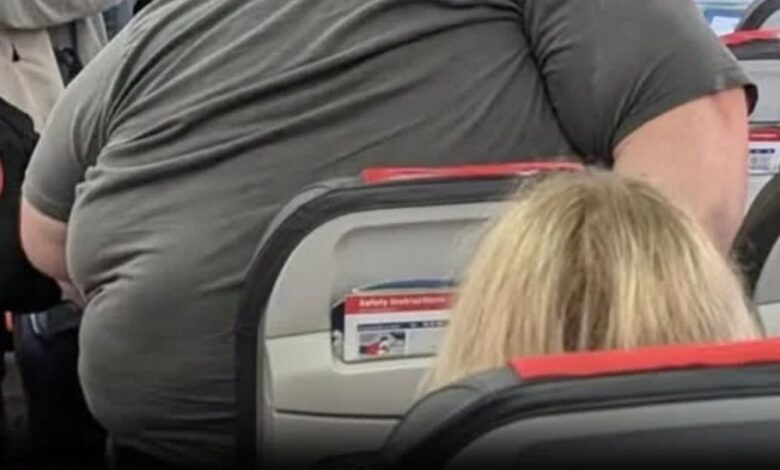
A single photograph from inside a commercial airplane has reignited one of the most divisive discussions in modern travel: how should airlines accommodate passengers of all body types in increasingly smaller seats?
The image, showing a visibly plus-sized passenger struggling to fit into a standard economy seat, has gone viral after being reposted by the Miami-based music group Pretty Ricky. Originally uploaded to Facebook in late 2024, the photo has now amassed thousands of comments and millions of views, setting off a storm of debate across social media platforms.
“Airlines will have to create policies for plus-sized passengers,” the group wrote in the caption. “This photo shows how difficult it is for people who don’t fit comfortably into one seat — and also for those sitting beside them. There needs to be a fair middle ground.”
The picture itself, though simple, sparked an avalanche of opinions. Within hours, Facebook threads filled with competing arguments — some practical, others judgmental, and many emotional.
The Outrage and the Divide
A large portion of commenters sided with the view that passengers who cannot fit within a single seat should be required to purchase an additional one.
“If you’re taking up two seats, you should pay for two,” one user wrote, echoing a sentiment repeated in hundreds of comments. “Tall passengers pay extra for legroom. Why should width be treated any differently?”
Another person chimed in, “This is simple. Either buy two seats or airlines should offer a few larger ones and charge accordingly. That’s not discrimination — that’s logistics.”
Many others took a harsher stance, framing the issue as a matter of personal responsibility. “The reason most people are overweight isn’t medical,” one commenter claimed. “It’s lifestyle choices — and those choices have consequences. You can’t expect others to pay the price for them.”
A few even drew from personal experience. “I’ve lost 90 pounds,” one person wrote. “I know what it’s like. Being that large is a choice 99 percent of the time.”
The Counterpoint: Shrinking Seats and Shifting Standards
But not everyone agreed.
Others pointed out that the problem isn’t passengers — it’s the airlines themselves. “Seats have been getting smaller for years,” one user noted. “The average passenger — tall, short, thin, or plus-sized — is less comfortable than ever. This isn’t just a plus-size issue. It’s a design issue.”
Indeed, industry data supports that claim. Over the past two decades, average seat width in many U.S. airlines has decreased from about 18.5 inches to as little as 16 inches. Pitch — the space between rows — has shrunk by up to five inches, squeezing passengers closer together to increase capacity and profits.
“Everyone is paying more for less space,” travel columnist Christopher Elliott wrote when the photo first began circulating. “The airline industry has designed discomfort into its business model. What we’re seeing now is the collision between corporate efficiency and basic human needs.”
The Rise of Plus-Size Travel Activism
Among those adding her voice to the debate was plus-size travel influencer Jae’lynn Chaney, who has built a platform advocating for equitable treatment of larger travelers.
“Why should I have to shrink myself to fit into spaces that were never designed for me?” Chaney said in a recent TikTok video addressing the viral photo. “The problem isn’t me — it’s the system.”
Chaney, who has long pushed for airlines to provide extra seating at no additional cost for plus-sized travelers, argued that accessibility isn’t a luxury — it’s a necessity.
“People tell me to just buy a first-class ticket,” she said. “But even first-class seats don’t accommodate all body types. Flying shouldn’t be reserved for the few who can physically fit into the system.”
Her comments reignited a conversation that has been building for years, as advocacy groups call for clearer, fairer policies. Some are even pushing for what they’ve termed a “Passenger Bill of Rights” for body diversity, ensuring that every person — regardless of size — can travel safely and with dignity.
The Push for Policy Change
While no major airline has yet overhauled its seating policies in response to such activism, the debate has reached lawmakers. In the United States, the Federal Aviation Administration has periodically reviewed seat size regulations, though it has yet to impose minimum standards for comfort or accessibility.
Some advocates have proposed mandating a range of seat sizes to reflect the diversity of passengers. Others argue for systemic change: better seat design, transparent pricing, and more inclusive accommodations.
Opponents of such reforms, however, claim that implementing them would increase ticket prices for everyone. “Every inch of cabin space is revenue,” says aviation analyst Derek Monroe. “If you make seats wider or leave gaps for comfort, you reduce total capacity. That cost gets passed directly to passengers.”
The question, then, becomes one of fairness versus feasibility: Should airlines be required to adapt their designs for inclusivity, or should passengers adjust to existing standards — even when those standards exclude them?
The Human Side of the Debate
Beyond policy and profit margins, the viral photo also touched on something more personal — the quiet humiliation many plus-sized travelers feel when flying. Stories flooded the comment sections: passengers describing being stared at, photographed without consent, or forced to ask for seatbelt extensions in front of strangers.
“It’s not just about space,” one commenter wrote. “It’s about dignity. Nobody wants to feel like a burden just for sitting down.”
Another added, “We need compassion, not mockery. Flying is stressful for everyone — especially for those who don’t fit the mold.”
Experts in body-image psychology echoed that sentiment, noting that public shaming — whether online or in real life — can have long-term emotional consequences. “When people are photographed or ridiculed for their bodies, it reinforces stigma,” said Dr. Lena Franks, a behavioral health specialist. “It doesn’t lead to better health outcomes. It just leads to pain.”
Searching for a Middle Ground
Despite the intensity of the debate, some commenters tried to bridge the divide. “Maybe it’s not about blame,” one person suggested. “Maybe it’s about design innovation. Cars have adjustable seats. Why not airplanes?”
Others proposed practical ideas — larger seats at a proportional price, redesigned cabins with flexible configurations, or travel vouchers for passengers affected by seating discomfort.
Still, the conversation remains polarized. The internet, as always, thrives on extremes — outrage on one side, indignation on the other. But buried among the noise is a common truth: air travel has become uncomfortable for nearly everyone, and something needs to change.
A Reflection on What the Photo Really Means
The viral photo may have started as an argument about weight, but it ultimately became a symbol of a broader issue — how industries treat human diversity in pursuit of efficiency.
The image of one person struggling to fit into a space too small for them resonates far beyond airplanes. It’s a metaphor for how modern systems often expect people to adapt to structures that were never built with them in mind.
As the photo continues to circulate, new discussions keep surfacing — about compassion, fairness, accessibility, and the balance between personal responsibility and public design.
Maybe that’s why the image struck such a nerve. It’s not just about one passenger. It’s about all of us — squeezed, uncomfortable, and wondering when comfort became a luxury.
For now, the airlines remain silent. The seats remain small. The arguments rage on.
But one viral moment has made the question impossible to ignore: when every inch counts, what does it really mean to give people enough space to exist?