Remembering Catherine O Hara! A Look Back at One of Her Final Public Appearances Months Before Her Passing
The entertainment world is reflecting on the life and legacy of Catherine O’Hara, an actress whose presence reshaped modern comedy with a rare blend of fearlessness, intelligence, and emotional precision. Her passing at the age of 71, following a brief illness, has left a profound sense of loss across film, television, and theater—an absence felt not just by colleagues, but by millions of viewers who grew up with her characters and carried them into adulthood.
News of her death emerged quietly in the early hours of Friday morning after emergency responders were called to her home in Los Angeles. She was transported to a nearby hospital in serious condition, where she later passed away. Within hours, tributes began to appear from across the industry, each echoing a similar sentiment: Catherine O’Hara was not only singularly talented, but deeply respected as a collaborator, a professional, and a human being.
Her career spanned more than four decades, yet it never felt static. O’Hara possessed the rare ability to evolve without erasing herself. She could be outrageous without cruelty, absurd without emptiness, and heartfelt without sentimentality. That balance made her indispensable in comedy and unforgettable in drama.
For many audiences, she first became a household name as Kate McCallister in Home Alone. What could have been a standard supporting role became something far richer under her control. She gave the frantic mother at the center of the chaos emotional gravity, grounding the film’s slapstick humor in genuine parental desperation. Her performance helped turn a holiday comedy into a perennial classic, one revisited year after year for both laughter and comfort.
Decades later, she reintroduced herself to an entirely new generation through her role as Moira Rose on Schitt’s Creek. The character could have easily become a caricature—overdressed, overaccented, and detached from reality. Instead, O’Hara infused Moira with vulnerability beneath the theatricality, transforming her into one of television’s most iconic figures. The performance earned her widespread critical acclaim, including major awards, but more importantly, it redefined what late-career reinvention could look like.
Yet those roles only scratch the surface of her body of work. O’Hara was a cornerstone of filmmaker Christopher Guest’s mockumentary universe, where improvisation demanded both bravery and discipline. In films such as Best in Show and A Mighty Wind, she demonstrated a mastery of timing and character construction that elevated ensemble comedy into something resembling jazz—precise, unpredictable, and deeply human.
Earlier in her career, she left an indelible mark in films like Beetlejuice, where her performance balanced surreal humor with emotional realism. Whether working in studio blockbusters or niche comedies, she brought the same commitment and seriousness to the craft, treating comedy not as something lighter than drama, but as something equally demanding.
Born and raised in Toronto, O’Hara never lost her grounding despite international fame. Colleagues frequently noted her lack of pretension and her sharp observational humor off camera. She was known for arriving prepared, listening intently, and elevating scenes without overshadowing others. Younger actors often spoke of how generous she was with her time, offering encouragement without condescension and advice without ego.
Away from the spotlight, she built a quiet, enduring personal life. Married for decades to production designer Bo Welch, she was deeply devoted to her family and famously protective of her privacy. Those close to her say she viewed fame as a byproduct of work, not its purpose. Family dinners, long conversations, and ordinary routines mattered more to her than red carpets or press cycles.
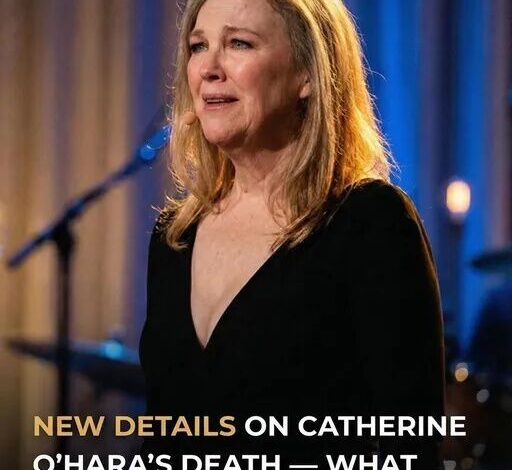
In the months before her passing, O’Hara made one of her final public appearances at a small industry event, where attendees noted her warmth and unmistakable presence. She spoke briefly, joked easily, and thanked collaborators with sincerity rather than ceremony. There was no sense of farewell, no dramatic framing—just a woman who had spent her life doing the work and showing up fully, until she no longer could.
As news of her death spread, fans revisited scenes, monologues, and interviews, rediscovering the subtle choices that made her performances endure. What stood out most was not just how funny she was, but how truthful. Even in the most exaggerated moments, there was always a recognizable emotional core. That honesty is why her characters never faded into nostalgia. They remained alive, relevant, and strangely comforting.
Catherine O’Hara leaves behind a legacy measured not only in awards or iconic roles, but in the way she reshaped expectations for women in comedy—at every age. She proved that reinvention is not about chasing trends, but about deepening craft. She showed that comedy could be elegant, biting, ridiculous, and tender all at once.
Her influence will continue through the countless performers she inspired and the audiences who return to her work in moments of joy, stress, and remembrance. Laughter, after all, was her most enduring gift—and one that does not disappear with time.
Though she is gone, Catherine O’Hara’s presence remains unmistakable. In the cadence of a line delivery. In the courage to be bold without apology. In the understanding that humor, when done right, tells the truth more clearly than anything else ever could.