US launches military strikes on Venezuela, Trump says Maduro captured and flown out of the country!
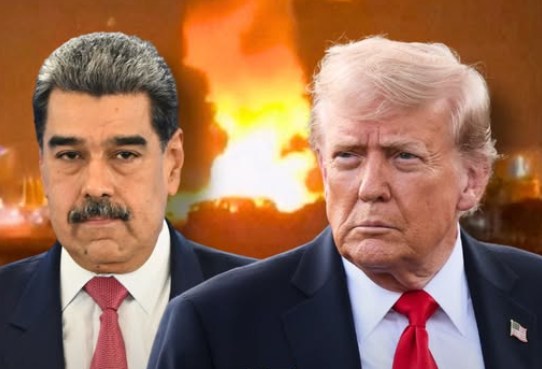
In a stunning escalation of geopolitical tension that has sent shockwaves across the Western Hemisphere, the United States military launched a series of high-precision strikes against Venezuela in the early hours of Saturday morning.1 The operation, which President Donald Trump characterized as a “large-scale strike,” culminated in the extraordinary capture of Venezuelan President Nicolás Maduro and his wife, Cilia Flores.2 According to a series of statements from the White House and the Department of Justice, the couple was seized during a clandestine ground operation and has already been flown out of the country to face criminal prosecution on American soil.3+2
The capture was reportedly executed by the U.S. Army’s Delta Force, the military’s elite Tier 1 special operations unit.4 Sources familiar with the mission described it as a surgical strike aimed at the heart of the Venezuelan leadership, designed to minimize collateral damage while decapitating the command structure of a regime the U.S. has long labeled a “mafia state.” The operation follows months of a palpable military buildup in the Caribbean, where the USS Gerald R. Ford aircraft carrier strike group and an array of supporting warships had been positioned in what many analysts now see as a deliberate prelude to this weekend’s events.5+1
For months, the Trump administration has been laying the groundwork for this intervention through a series of maritime interdictions.6 Recent weeks saw the U.S. Navy and Coast Guard seize two massive oil tankers off the Venezuelan coast and launch deadly kinetic strikes against more than thirty smaller vessels. The administration alleged these boats were part of a state-sponsored drug smuggling network.7 President Trump specifically noted that recent air strikes had targeted “the dock area where they load the boats up with drugs,” framing the military action not as a traditional regime-change war, but as a massive international law enforcement operation conducted with the full might of the American military.+1
The legal machinery of the United States moved just as quickly as the special forces on the ground. Attorney General Pam Bondi took to social media on Saturday morning to confirm the arrival of the high-profile detainees. In a sharply worded post, Bondi declared that Nicolás Maduro and Cilia Flores would “soon face the full wrath of American justice on American soil in American courts.” Her statements underscore a long-standing U.S. legal strategy that has targeted Maduro for years. The Venezuelan leader was previously indicted in 2020 on charges of narco-terrorism, conspiracy to import cocaine into the United States, and the possession of machine guns and destructive devices.8
Bondi clarified that the current proceedings are being handled by the Southern District of New York, a jurisdiction famed for its pursuit of high-level international criminals.9 While Maduro’s legal troubles in the U.S. date back years, the inclusion of his wife, Cilia Flores, in this capture marks a significant expansion of the legal scope.10 Flores, often referred to as the “First Combatant” in Venezuela, had not been previously charged in the 2020 indictment, leading to speculation that new, sealed indictments were handed down by a grand jury immediately preceding or following the military strikes.+1
The political reaction in Washington has been swift and largely divided along predictable lines, though the audacity of the operation has stunned even seasoned diplomats. Secretary of State Marco Rubio, a long-time and vocal hawk on Venezuelan affairs, has reportedly been in close contact with congressional leaders. According to a high-ranking Republican senator, Rubio indicated that the administration “anticipates no further action in Venezuela,” suggesting that the mission was strictly a “capture and extract” operation rather than an attempt to occupy the country or engage in long-term nation-building.11 The strategy appears to be focused on removing the Maduro leadership and allowing the domestic political vacuum to be filled by internal forces, under the shadow of the massive U.S. naval presence still lurking off the coast.
However, the international community has reacted with a mixture of disbelief and profound concern. While many Western allies have long criticized Maduro’s human rights record and his disputed reelection, the use of direct military force to abduct a sitting head of state—no matter how contested his legitimacy—has raised serious questions about international law and the future of regional stability. Proponents of the move, including Attorney General Bondi, argue that the “courage to demand accountability” outweighs the traditional diplomatic protocols, particularly when dealing with what they categorize as an international narco-trafficking organization masquerading as a government.
The humanitarian and social implications within Venezuela remain the most volatile variable in this unfolding drama. With the Maduros gone, the power structure in Caracas is in a state of total flux. The military strikes on infrastructure and dock areas have undoubtedly disrupted the daily lives of millions, and the sudden absence of the central executive could lead to either a peaceful transition to the opposition or a descent into chaotic infighting among the remaining regime loyalists and various paramilitary groups.
As the sun sets on the first day of the post-Maduro era, the world’s attention turns to the United States federal court system. The logistical and security challenges of holding a former head of state in a New York jail are unprecedented. The trial, should it proceed, promises to be one of the most significant legal events in the history of international relations, potentially revealing the inner workings of the alleged “Cartel of the Suns” and the complex web of drug trafficking, money laundering, and illicit arms deals that the U.S. claims defined the Maduro presidency.
President Trump, for his part, has already begun to frame the mission as an unmitigated success for his administration’s “America First” doctrine. By utilizing elite special forces rather than a broad-scale ground invasion, the administration claims it has achieved its primary objective with maximum efficiency. Attorney General Bondi’s public gratitude toward the “brave military” echoes a sentiment of triumphalism that is likely to dominate the administration’s narrative in the coming weeks. For the people of Venezuela, however, the “wrath of American justice” is only the beginning of a very uncertain new chapter, as the smoke clears from the strikes and the reality of a country without its long-time leader begins to set in.