Remember her? She was so pretty, See how she looks now
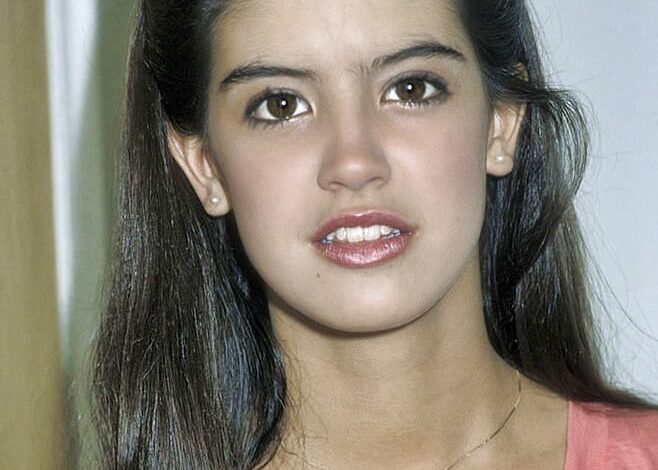
Phoebe Cates, once one of Hollywood’s most captivating faces, remains a name that evokes nostalgia for an entire generation of movie lovers. Known for her charm, beauty, and natural screen presence, she became an icon of the 1980s — only to seemingly vanish from the spotlight by the mid-1990s. What happened to her? Why did she walk away from fame at her peak? The truth behind her decision is as grounded and graceful as the woman herself.
Born in New York City on July 16, 1963, Phoebe Belle Cates was destined to cross paths with the entertainment world. Her family was deeply rooted in it — her father, Joseph Cates, was a successful Broadway producer and television pioneer, and her uncle helped produce several Academy Awards ceremonies. Even her social circle was filled with artists; the legendary Andy Warhol was a family friend. With such a background, it seemed inevitable that Phoebe would end up performing in some form. Yet her first dream wasn’t acting — it was dance.
From a young age, Cates trained in ballet at prestigious schools like Juilliard and the Professional Children’s School. But at 15, a devastating knee injury ended that dream. Unable to continue dancing, she turned to modeling — more out of practicality than passion. She later admitted she didn’t enjoy it, describing it as “the same thing over and over” and doing it mostly for financial independence.
Her acting career began almost by chance. In 1982, she landed her first role in Paradise, an Israeli-produced film often compared to The Blue Lagoon for its tropical setting and youthful sensuality. Though Cates later expressed discomfort about some of the scenes, the film marked her debut — and her entrance into Hollywood’s radar. That same year, she starred in Fast Times at Ridgemont High, the film that would make her unforgettable.
As Linda Barrett, the confident and alluring high-schooler, Phoebe Cates delivered a performance that became iconic. The film itself captured the teenage experience of the early 1980s — awkward, wild, and unapologetically real. It also introduced audiences to a young cast that included Sean Penn, Jennifer Jason Leigh, and Nicolas Cage. Fast Times went on to earn its place in the U.S. National Film Registry, immortalizing it as a cultural milestone. For Cates, it cemented her as the quintessential American beauty of the era.
Following Fast Times, she starred in Private School (1983), where she also lent her voice to songs on the soundtrack. Then came Gremlins (1984), the film that would make her a household name. As Kate Beringer, the small-town sweetheart caught in a nightmare of mischievous monsters, she blended warmth with wit — proving she was more than just a pretty face. The movie became a global hit, spawning a sequel, Gremlins 2: The New Batch, in 1990.
Throughout the 1980s, Phoebe Cates worked steadily, appearing in comedies, dramas, and even stage productions. She took on roles in Date with an Angel (1987), Shag (1989), and Drop Dead Fred (1991), the latter earning her cult status among fans who adored its eccentric mix of humor and heartbreak. Yet despite her growing fame, she remained refreshingly unaffected by Hollywood’s chaos.
Cates often spoke about preferring the theater over film, drawn to the authenticity and creative challenge of live performance. “I think of theater as what I prefer to do best,” she once said. “As an actress, I’ve only felt truly content for about two years.” That honesty reflected her growing disconnect with the movie industry — an environment she found shallow and repetitive compared to her love for storytelling and art.
Then came the turning point. In 1983, while auditioning for The Big Chill, Phoebe met actor Kevin Kline. He was 16 years her senior, already an acclaimed stage and film performer, and the two instantly connected. They married in 1989, and over the next few years, their family grew with the birth of two children, Owen and Greta. It was then that Cates made a decision few Hollywood stars have the courage to make — she chose her family over fame.
In interviews, she explained that raising her children and creating a stable home meant more than chasing roles or red carpets. Kline later shared that they agreed one of them would always be home with the kids, and since his career required frequent travel, Phoebe decided to step away from acting. For her, it wasn’t a loss — it was a choice rooted in love and purpose.
Still, she never completely disappeared. In 1994, she starred in Princess Caraboo, based on the true story of a woman who fooled 19th-century England into believing she was royalty. It was a fitting final role — a film about illusion, identity, and self-reinvention. After that, she quietly left Hollywood behind.
A decade later, she returned briefly for a cameo in The Anniversary Party (2001), directed by her old friend Jennifer Jason Leigh. It was a small, personal project that allowed Cates to appear alongside her husband and children — a symbolic nod to how her career and family had always intertwined. Since then, her on-screen appearances have been rare, but her influence remains strong.
Away from film, Phoebe Cates built a new chapter in her life. In 2005, she opened Blue Tree, a boutique on Madison Avenue in Manhattan. The store reflects her taste — a mix of art, fashion, literature, and curated curiosities. It’s personal, creative, and deeply authentic, much like her. She once described it as “a general store for interesting people.” It’s become a local favorite, frequented by New Yorkers and longtime fans who still recognize her.
Now in her early sixties, Cates continues to live a quiet, fulfilling life in New York with her family. Her daughter, Greta, performs under the stage name Frankie Cosmos and has built her own successful music career, while her son Owen has worked in film. Both credit their parents with giving them space to grow up grounded, far from Hollywood’s glare.
Phoebe Cates’ story isn’t one of tragedy or lost potential—it’s one of balance, self-awareness, and contentment. In a business that often consumes people, she had the clarity to walk away before it did. She built a life that was not only her own but also deeply meaningful. And while the world still remembers her as the girl from Fast Times at Ridgemont High or the brave heroine from Gremlins, the real Phoebe Cates is something far greater — a woman who chose peace over fame, family over vanity, and authenticity over illusion.
Decades later, fans still ask what happened to her, and the answer is refreshingly simple: she’s happy. And that may be the most extraordinary Hollywood ending of all.